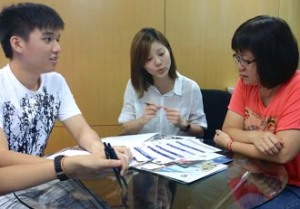
Tag Archives: top course to study in Malaysia

Top 20 Jobs of the Future: Which is the Best Course to Study in Malaysia?

What are the Future Jobs that Malaysian Students Need Know so that You Can Choose the Right Course?

As the digital economy grows, Malaysia must be prepared to choose jobs that will be in demand in the future as well as still exist. 75 million job roles are expected to disappear by 2022 according to the “Future of Jobs Report 2018” by the World Economic Forum. Furthermore, another 133 million roles are expected to emerge. The Fourth Industrial Revolution (Industry 4.0), artificial intelligence (AI), innovation, automation, Internet of Things (IOT) and other technological advancement would impact all industries. The Industry 4.0 will change the kinds of jobs needed across all market sectors.

Between 3.3 million and 6 million jobs are expected to be created in Malaysia by 2030, but with the new age of automation Industrial 4.0, preparation and training are fast becoming the critical factor as the new workforce would need new skills.

The world is changing and changing fast, but what does that mean for your education and career? Find out which jobs are growing and what degrees those jobs need.

Whether you are fresh out of school and considering your degree options or are looking to switch careers, this article is for you. Learn what new jobs will be around for decades to come so that you can prepare yourself by choosing the right course to study. This will help you plan your education and training for long-term benefits as well as ensure that you don’t become jobless when you graduate.

You may also be interested in:

Please fill up the Form below and I will WhatsApp you and provide you with sound advise on how to choose the best private university or college in Malaysia to study at. If you do not give your mobile number or full name as in IC, your query will not be answered. Our knowledgeable & experienced counsellor will send you a message on WhatsApp & provide assistance from there.

Go back

Your message has been sent

Warning
Warning
Warning
Warning
Warning
Warning
Warning
Warning
Warning
Warning

Warning.

The Best Jobs of the Future for Malaysian Students to Consider

Finance & Investment Graduate from UCSI University
EduSpiral advised me to study Finance because it had high job demand & salary.
Darren, Finance & Investment Graduate

There is no question that technology is the driving force behind many of the new jobs in the coming years, and the reason that some jobs will no longer be needed. Subsequently, if you are considering a university degree today, it may be worth considering courses that will lead you to careers that will be around in the future.

This is the logical choice if you would like to concentrate on a degree that leads to good employment and a well-paying career – but it should not stop you from studying something you are passionate about. Education should make you happy as well as securely employed.

By having a view of emerging job trends, it is hoped that students would be inspired to draw up study plans and select career choices and pathways as early as schooling years up to university level that will ensure success in future careers and work environments.

Below you can find 20 of the best jobs of the future for Malaysia students after secondary school to consider. Some of these jobs are already available today, but they are tipped to stay around for decades yet.

#1: Coders

Coding is fast becoming one of the most sought-after skills for technology companies and between researcher groups. There is no doubt that coding is going to pave the way for new jobs in the future.

The software industry is one of the fastest-growing industries in the world with work opportunities in many areas including, but not limited to, telecommunications, defence, electronics and, of course, software development and computing. With a Software Engineering degree, you will be qualified to design, program and create software for literally anything you can think of.

Software Engineering is the field of studying, devising and building a practical solution to a problem. Through software engineering coursework, students learn to create and maintain computer programs and applications.

The objective of a software engineer is to understand a problem within a computer and create software that eases the problem. To work as a software engineer, students should pursue at least a bachelors degree from a top private university. Courses in a computer science undergraduate program may include computer fundamentals, data structures, principles of programming languages, software engineering, and computer architecture.

Software Engineering is an Engineering profession concerned with the processes, methods, and tools for the design and development of high quality, reliable software systems. This involves the study and application of software specification, design, implementation, testing, and documentation of software. Target systems may range from simple software applications to mission-critical real-time systems.

Software Engineering includes the design and implementation of specific, reliable, efficient and secure software systems for a multitude of purposes. Of course, you also have to be able to write or code software if you are going to be able to build the systems around it. ‘Software’ are the programs that we all use on our computers – but Software Engineering goes so much deeper than that. Software engineers usually design a program to fulfil a certain need or solve a problem. Every time you use your email, or an app on your smartphone or a computer accounting system you are using software.

Software Engineering is concerned with the design and implementation of reliable and secure software systems, which have the functionality required for the intended purpose. Software Engineering is also sometimes referred to as “software programming”. Software Engineering is a booming industry with no shortage of opportunities to create unique and life changing programs.

#2: Blockchain developer

You may have heard about Bitcoin or cryptocurrency in the past few years or you may be familiar with “blockchain,” the record-keeping technology behind bitcoin. Intended to be a framework for cryptocurrency Bitcoin when it was first created in 2008, Blockchain technology today is fast penetrating into applications beyond the financial sector.

Blockchain has been experimented in asset management, intellectual property management, logistics, medical records, supply chain, the sharing economy, and more. Blockchain has been described as the most disruptive invention since the Internet. The significance of Blockchain is in its ability to create a trusted record system which is distributed between multiple parties. Put simply, it uses computer systems to create trust in digital-economy transactions. It is a ledger of data that cannot be manipulated.

Blockchain has the potential to revolutionise almost every industry in the modern economy – and higher education is no different. As more students wake up to the digital ledger’s potential, Malaysia’s universities are taking note and adding the subject to their offerings.

Details from the Michael Page Malaysia Salary Benchmark 2020 highlights that fintech is growing at an accelerated rate in Malaysia therefore demand for tech-savvy professionals with experience in e-money and blockchain technologies is strong. Demand for professionals in Blockchain is rising rapidly and this is an opportunity for students interested in computer science to specialise in this field.

#3: Virtual Reality Specialist

Immersive technology is increasing in demand everywhere, and that means job potential for graduates in Virtual Reality. As Augmented Reality (AR) and Virtual Technology (VR) transform the way we shop, play games and even construct military strategies, private universities in Malaysia are fielding increased demand from employers and aspiring students to produce graduates with the skillsets to work in this field.

In the next 30 years, virtual and augmented reality applications and devices at the everyday consumer level will likely be used commonly just like smartphones are used so widely today.

In order, to design and create those virtual reality environments, developers will have to employ specialists who can absorb abstract descriptions of environments and transform them into actual digital experiences. These specialists will have advanced skills in 3D conceptualization, be highly detailed oriented, and be receptive to new and advancing technologies.

#4: Cybersecurity Analysts/Experts

As technology advances, the number of computer systems in Malaysia and globally has increased dramatically, and the dependence upon them by individuals, businesses, industries and governments have grown. This means that there are an increasing number of systems at risk. Serious financial damage can result from cyber attacks and sometimes even physically.

These cyberthreats take many forms such as application attacks, malware, ransomware, phishing, exploit kits). Unfortunately, cyber adversaries have learned to launch automated and sophisticated attacks using these tactics – at lower and lower costs. As a result, keeping pace with cybersecurity strategy and operations can be a challenge, particularly in government and enterprise networks where, in their most disruptive form, cyberthreats often take aim at secret, political, military or infrastructural assets of a nation, or its people.

Computer security, also known as cyber security or IT security, is the protection of computer systems from the theft and damage to their hardware, software or information, as well as from disruption or misdirection of the services they provide.  Cybersecurity refers to a set of techniques used to protect the integrity of networks, programs and data from attack, damage or unauthorized access.

Asean’s cybersecurity spending is forecasted to grow 15% CAGR (compound annual growth rate) between 2015 and 2025. In addition, Malaysia is one of the top three Asean countries that are expected to contribute 75% of the cybersecurity services market share by 2025. In addition, Malaysia targets employing 20,000 cybersecurity professional by 2025.

With so much data that needs to be protected from theft or damage, governments and businesses need trained professionals in Computer Security or Cyber Security to ensure sufficient protection. A degree programme in Cyber Security or Computer Security is not easy to study therefore students should choose top universities in Malaysia with a proven track record in information technology education and having won awards as evidence of their capability. The best universities in Computer Security or Cyber Security will ensure that graduates will be equipped with the knowledge and skills to handle the complexities of the job which will result in an excellent career.

#5: Data Scientist

Data science is a combination of different disciplines such as data inference, algorithm development, and technology so that we can solve analytically complex problems. Huge amounts of raw information, streaming in and stored in enterprise data warehouses. We will need advanced systems and capabilities to sort out the data and analyse it to be used to create value for business.

Data Science or Data Analytics is a combination of various tools, algorithms, and machine learning principles with the aim to find hidden patterns from the raw data. A Data Analyst explains what is going on by processing history of the data. While a Data Scientist not only does the exploratory analysis to discover insights from it, but also uses various advanced machine learning algorithms to find the occurrence of a particular event in the future.

A Data Scientist will look at the data from many angles, sometimes angles not known earlier. All these make Data Science very valuable to companies who want to target large groups of people or customers and analyse the data and behaviour so that they could come up with business strategies.

Malaysia’s national ICT agency Multimedia Development Corporation (MDeC) has unveiled a plan, supported by seven public and private institutes of higher learning (IHLs), to increase the number of local data scientists from the current 80 to 2000.

Statistics show that there will be about two million job openings for data professionals and that the demand for people with this knowledge and skill will outstrip supply by a ratio of two to one.

#6: IoT Specialists

Primarily, IoT is not about the Internet. It is about the physical objects around us that are connected to the Internet.   The Internet of Things (IoT) is a system of interrelated computing devices, mechanical and digital machines, objects, animals or people that are provided with unique identifiers and the ability to transfer data over a network without requiring human-to-human or human-to-computer interaction.

IoT is more than just having Internet connectivity on everyday appliances. Essentially, IoT is a convergence of smart devices that generates data through sensors to create new information and knowledge to boost human intelligence, productivity and quality of life.

IoT is defined as “Intelligent interactivity between human and things to exchange information and knowledge for new value creation”. It is a complex yet complete solution compassing three main technology components, namely connected things with embedded sensors, connectivity and infrastructure, and last but not least, analytics and applications.

A thing, in the Internet of Things, can be a person with a heart monitor implant, a farm animal with a biochip transponder, an automobile that has built-in sensors to alert the driver when tire pressure is low — or any other natural or man-made object that can be assigned an IP address and provided with the ability to transfer data over a network.

According to youth in Malaysia, the most exciting technologies expected to have the largest impact on their future lives will be Internet of Things (IoT) based on survey findings released by Microsoft.

The Internet of Things (IoT) is ranked as the top technology that Malaysian youth expect to have the biggest impact on their lives. In recent years, the confluence of power devices, cloud and data has enabled bold visions on how IoT can be an integrated part of our digital future.

#7: AI jobs

Artificial intelligence is an evolving field that requires broad training, so courses typically involve principles of computer science, cognitive psychology and engineering.  In addition, Artificial Intelligence (AI) is the attempt to build artificial systems that have intelligent behaviour.

There are two main directions of research. One is to understand natural intelligence by the use of computer models. The other provides techniques and technology for building systems capable of intelligent decisions and actions. Thus AI is both a science and an engineering discipline. Applications of AI range from ‘smart’ controllers for household devices to computers that can converse in English, play games, conduct intelligent web searches or act as the brain of a robot.

Leading technology giants Facebook, Google, Amazon are all excited about Artificial Intelligence. Google CEO Sundar Pichai emphasized in 2017 just how important AI is to the future of the company, stating, “I’m really happy with how we are transitioning to an AI-first company. The Google Assistant is one of our first steps towards that future…Advances in machine learning are helping us make many Google products better… Beyond that, we continue to set the pace in machine learning and AI research.” — Alphabet 1Q17 Earnings Call

In addition, Amazon CEO Jeff Bezos shared at the Code Conference in California “It’s hard to overstate how big of an impact AI is going to have on society over the next 20 years.”

#8: Cloud Computing Specialist

Malaysia is facing challenges in building its digital workforce, as reflected in the fast-growing demand for digital talent despite a comparative shortfall in supply. The country needs to focus on creating ‘new collar’ workers, a workforce that is equipped with skills in Cloud, AI and other emerging technologies.

Cloud computing is the delivery of computing services—servers, storage, databases, networking, software, analytics and more—over the Internet (“the cloud”). Companies offering these computing services are called cloud providers and typically charge for cloud computing services based on usage, similar to how you are billed for water or electricity at home.

Cloud computing means storing and accessing data and programs over the Internet instead of your computer’s hard drive. The cloud is just a metaphor for the Internet.

We have to face new types of jobs, environments and technologies. Education has to move together with such advancements therefore students need to choose courses in line with these developments or be left behind by making the wrong choice.

#9: Fintech Professionals

In the past 10 years, we have seen a rapid development in technology-related financial services globally. In fact, investments in Financial Technology or FinTech – an umbrella term that encompasses all institutions that provide and employ newly developed digital and online technologies in the banking and financial services industries – has been steadily increasing, with the industry receiving USD 17.4 billion in investment in 2016 and a whopping USD 31 billion in the following year.

In Malaysia, some of the biggest names in the financial industry are taking steps to facilitate FinTech providers, leading to a future of rapid expansion. With the interest in the FinTech industry in Malaysia growing at such a pace, there is a strong requirement for Fintech graduates & professionals to take up roles.

Primarily comprising start-up firms, the FinTech industry specialises in disruptive innovation that many experts believe democratises finance, makes it more accessible and takes a lot of the guesswork out of financial decision-making for both personal and commercial users.

By blurring the lines between technology and finance, FinTech players such as robo-advisory and asset management firms, online lenders, online banks, peer-to-peer lending platforms, mobile payment firms and online remittance firms like InstaReM are redefining financial services, reconstituting the financial landscape and possibly even pushing traditional financial models towards obsolescence.

#10: App Developers

Understanding of databases, especially distributed databases, Master/Slaves and fault-tolerance

With more and more mobile phones and smart devices being used to manage personal finance, make payments and send and receive money, the demand for mobile apps and solutions, along with those who can create them, is absolutely booming.

In Malaysia, the Smart Phone Penetration is 75.9% while the Mobile Banking Population is at 40% with more opportunity for growth. The mobile banking transaction volume in 2017 1.02 Billion and the value was RM48.3 Billion. This translates to a huge demand for mobile app developers, especially Android engineers.

Skills/experience required include:

  • Knowledge of Machine Learning, Artificial Intelligence (AI) and Deep Learning
  • Programming languages: C#, C++, Java, Python
  • JavaScript
  • Analytical skills

#11: Financial Analysts

Worldwide, the financial services sector records the highest earnings and drives a country’s economic growth.  The Financial sector stands as one of the largest sectors in Malaysia with more than 300,000 people employed. The role of the financial sector is envisioned to continue growing to be a key driver and catalyst of Malaysia’s economic progression. This sector is projected to be more competitive, dynamic, inclusive, diversified, and integrated, with the ability to offer world class financial services, in terms of breadth, depth and quality to serve the needs of Malaysia.

As FinTech start-ups continue to grow, so will the demand for financial analysts who can manage and create budgets, assemble financial reports, run business studies, conduct analyses and make forecasts about future revenues and market trends. For some firms, they may also provide advisory inputs on areas such as stock splits and bond issues.

There is a demand for top graduates in banking and finance in Malaysia. Salaries for banking & finance graduates in Malaysia can be very high. The country is said to require 40,000 qualified financial talents by 2020 yet about 56,000 new finance industry jobs will be available in the next 10 years.

#12: Physiotherapist

As the Malaysian population becomes more educated and affluent as well as age, there are more cases of Arthritis and musculoskeletal conditions. With education and a higher income, Malaysians are more open to visiting Physiotherapists to find relief from these conditions.

According to the Malaysian Physiotherapy Association, currently there is an estimated 2,759 practising physiotherapists in the country which is only 0.88 Per 10,000 population. Therefore, there is a demand for more qualified and trained Physiotherapists.

The job of a Physiotherapist can be very satisfying as you have the power to bring physical relief to people who are in pain with hands-on treatment. In addition, you also provide emotional support and self-help strategies that will empower your patients to improve their own health, strength and quality of life.

#13: Robotics Engineer/Specialist

Between 3.3 million and 6 million jobs are expected to be created in Malaysia by 2030, but with the new age of automation Industrial 4.0, preparation and training are fast becoming the critical factor as the new workforce would need new skills.

By 2022, an operational stock of almost 4 million industrial robots are expected to work in factories worldwide. These robots will play a vital role in automating production to speed up the post-Corona economy. At the same time, robots are driving demand for skilled workers. Educational systems must effectively adjust to this demand.

The World Robotics 2020 Industrial Robots report found 2.7 million robots already working across the world. Sales of new robots remain high with 373,000 units shipped globally in 2019, a drop of 12% from the previous year – but still the third highest volume ever recorded.

The study of robotics is a very new field and is a combination of various areas of study. The focus will vary from university to university and students will need to research and look at the subjects to see which one would fit their future career goals. A robot is the product of a combination of Mechanical Engineering, Electronic Engineering and Computer Science or Ai.

#14: Electrical & Electronic Engineer

Electrical & Electronic Engineering covers research, design, development, manufacturing and management of complex systems for many different uses. The computer, tablet or smartphone you purchased recently is a creation of Electrical Engineering design.

Furthermore, robots are comprised of sensors, actuators, microprocessors and sophisticated feedback control systems, all designed by Electrical Engineers. Wireless communication and the Internet are just a few areas electrical engineering has helped flourish, by developing better phones, more powerful computers, and high-speed modems. As we enter the 21st century, the technology that surrounds us will continue to expand and electrical engineers are leading the way.

Imagine the infrastructure that allows you to call anywhere in the world on your mobile phone. Think about the electricity wires that connect your house to the power grid and think about the small electronic devices that you are probably carrying in your pocket or bag. Those who study  will never be out of a job.

Studying Electrical and Electronic Engineering puts you at the centre of a vibrant and fast-moving discipline of relevance to industries such as electronics, information technology, manufacturing, energy generation and supply, transport, and communications. Graduating with a Electrical and Electronic Engineering degree accredited by the Board of Engineers Malaysia (BEM) offers you a quicker, more direct route to Professional Engineer status and opens the doors to working overseas because of the Washington Accord. Electrical & Electronic Engineering jobs are high in demand with excellent salaries, therefore, it will provide incredible opportunities for a great future should you choose the right university to prepare you well.

#15: Digital Marketer

According to We Are Social’s new Digital 2019 Q4 Global Digital Statshot report produced in partnership with Hootsuite, a wealth of new data has contributed to impressive growth across various aspects of digital across the globe. The number of internet users around the world is rapidly approaching 4.5 billion, with the report estimating that implementation of 5G networks will create new digital milestones as mobile data usage reaches unprecedented speeds.

In Malaysia, four-fifths of the country’s 32.25 million population are now online, with 78% being active social media users. These statistics led to Malaysia being ranked 26th in the IMD World Digital Competitiveness Ranking in 2019 with a 79% Internet penetration rate – one of the highest in the Southeast Asia region. There have also been promising moves by Malaysia’s government to keep this momentum going, such as the two key initiatives announced to further boost Malaysia’s digital economy that include developing more tech talent.

With digital marketing now an integral part of any industry, the need for professionals with suitable skills has become a priority for most businesses. However, the rapid evolution of digital marketing has created a “digital disconnect” where professionals are yet to reach the expected level of digital skillsets. This has led to a shortage of suitable talent in the technology jobs market, including digital marketing technology.

Digital marketing is the act of engaging consumers of a certain product through the use of electronic devices such as smart phones, computers, digital billboards, tablets, game consoles and more. Digital Marketers will use multiple online platforms like Facebook, Instagram, YouTube, Google Search, Email, etc. to engage with their audience.  The degree course prepares students for interactive marketing skills through creativity and application of modern digital media to promote sales and profits.

#16: Human Resource Manager

Successful companies realize that workers are as crucial an asset to a company’s success as capital or material holdings.

Attracting the most qualified employees and matching them to the jobs for which they are best suited is important for the success of any company in Malaysia. It is more cost effective to hire the right staff than to take in staff who are not matched to the position and waste the company’s resources in the hiring process and remuneration.

Therefore, today’s human resource professionals are increasingly working with the organization’s top executives on strategic planning to create the conditions that enhance employee performance and to contribute to the overall operations and performance of organizations striving to succeed in the competitive business world.

Human Resource personnel participate in activities of the company related to recruiting and hiring, training and development of staff, determining staff compensation and benefits, employee relations including handling grievances, ensuring occupational health and safety, and other activities geared towards strengthening their organization’s entire workforce.

Almost every company in Malaysia need at least one Human Resource staff to take care of the needs on their employees. Medium and Large companies will have a dedicated Human Resources Department to ensure their staff are well compensated, motivated, trained and receive the correct amount of benefits due to them.

#16: Accountant

Presently, Malaysia has about 7.5 million Accountants. The country requires another 60,000 Accountants. All Accountants have to abide by a strict code of ethics and maintain high professional standards. All practising accountants must register with the Malaysian Institute of Accountants (MIA).

Accounting is the study of how businesses track their income and assets over time. Accountants complete many tasks besides preparing financial statements and recording business transactions including computing costs and efficiency gains from new technologies, participate in the set up for acquisitions and mergers, quality management, developing and using information systems to track financial performance, tax strategy, and health care benefits management.

#18: Animators

In 2019, Malaysia’s animation scene hit a milestone, says Hasnul. Local animated productions such as Ejen Ali, Upin & Ipin and BoBoiBoy made about RM90 million in total.

According to the Malaysia Digital Economy Corporation (MDEC) — the government-sponsored agency central to the nation’s digital content success, the total digital content industry in Malaysia now stands at RM 7 billion ($1.68 billion) with exports doubling since 2014 to RM 1 billion ($2.4 million). It reports there are now over 100 homegrown studios that have produced more than 65 original IPs and seen their work travel to 120+ countries, with an export value of RM170 million (over $32.2 million). Malaysian students can take advantage of this rapid growth in animation to fill the increase in job demand.

3D animation is basically animating objects that appear in a three-dimensional space. They can be rotated and moved like real objects. 3D animation is at the heart of games and virtual reality. Additionally, it may be used in presentation graphics. Students will develop a vision as an animator, studying concept development, storyboarding, 2D and 3D character animation, editing, graphic processes, sound recording, visual effects, post-production, marketing and distribution. Students wanting to study animation should choose a top private university in Malaysia that has a proven track record, experienced lecturers and adequate facilities & software.

#19: Game Designer/Developer

More people are now playing video games than ever before and according to the Newzoo Global Games Market Report 2021, by the end of 2021 the industry is estimated to generate revenues of $175.8 billion and there will be 2.9 billion players worldwide. The Asia-Pacific region by far accounts for the most players worldwide (55% of the global number), which makes sense as the region is home to roughly the same share (54%) of the world’s online population.

The games market will continue to grow in the following years, exceeding $200 billion at the end of 2023. The Games Industry is growing at an incredible rate and shows no sign of ever slowing down. Almost everyone plays games in some form or another whether on the PC, console or on their mobile devices. The Game Industry is generating more revenue than any other entertainment medium out there so the potential for game developers out there are enormous and is constantly growing daily!

Game developers are amongst the most highly skilled creative talent out there in the creative industry. To be a successful game developer, one not only has to figure out the problems of making a fun and entertaining game but also has to solve the complex production and marketing problems related to the industry. Hence, there is a need for people who are trained and competent in the workflow of Game Development with very specialized fields of study.

#20: Hoteliers and Chefs

As the Covid Pandemic comes to an end, people around the world are set to start travelling again. Before the pandemic hit, tourism was big business, accounting for more than 10 percent of global GDP. The share was even larger in tourism-dependent countries. However, keep in mind that you will only graduate in 4 years times from your hotel management or culinary arts degree, by that time, the tourism industry would have recovered and will need hoteliers and chefs.

Humans will always need human interaction which can never be replaced by technology. Hence, hoteliers and chefs will always be in demand now and in the future. Although, the environment may be more technologically advanced, hoteliers will provide the much needed human touch and chefs would feed our desires.

The demand for well trained hospitality management & tourism management and culinary arts professionals will continue to increase in Malaysia as well as globally therefore providing excellent opportunities for jobs. A degree in hotel management could set you up for a successful career at an airline, large hotel or restaurant chain, an exhibition or conference center, a major event venue and more.
Which are the Best Courses to Study in Malaysia after SPM or IGCSE / O-Levels?

Top Ten List of Best Courses to Study in Malaysia after SPM, O-Levels, UEC, STPM, A-Levels or Pre-University

I have grouped all the courses that are popular and have job demand in Malaysia into 10 main areas of study. Some courses have higher job demand and salary than others. You have to choose based on your list of criteria of what’s important to you. This list of top ten of the best courses to study in Malaysia makes it easier for students to narrow down to which area that you are interested in and would best suit you.

Choosing a course to study is a process in finding out who you are, what you are good at and its job prospects. An experienced & knowledgeable Education Advisor would be invaluable in assisting you to choose the right course. Here at EduSpiral Consultant Services, I do the research on the job demand for the careers in Malaysia, Salary Reports, and universities so that I can advise students based on facts and evidence. Furthermore, in my 20-year career, I have counselled thousands of students to choose their course and career, and many have already graduated and found the career of their dreams.

You might also be interested to read these:

Please fill up the Form below and I will WhatsApp you and provide you with sound advise on how to choose the best private university or college in Malaysia to study at. If you do not give your mobile number or full name as in IC, your query will not be answered. Our knowledgeable & experienced counsellor will send you a message on WhatsApp & provide assistance from there.

Go back

Your message has been sent

Warning
Warning
Warning
Warning
Warning
Warning
Warning
Warning
Warning

Warning.

The Top Ten List of Best Courses to Study in Malaysia

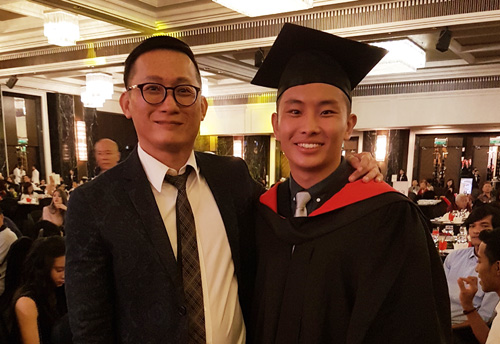
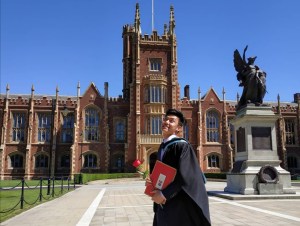
EduSpiral advised & helped me choose the best college for A-Levels. I obtained a scholarship & have graduated from a top ranked UK University. Lucas, A-Levels at HELP Academy & Law Degree from Queens University Belfast
EduSpiral advised & helped me choose the best college for A-Levels. I obtained a scholarship & have graduated from a top ranked UK University.
Lucas, A-Levels at HELP Academy & Law Degree from Queens University Belfast

Choosing the right course to study in Malaysia after high school is one of the most important decisions you can make in your life. This can be a confusing and difficult time if you are unprepared.

With the wide variety of courses available to a student, the time can be a confusing one if not guided properly by an experienced and knowledgeable education counsellor.

It can be confusing for students to choose the right major for their undergraduate degree studies in Malaysia. Preparations should have been made even before this time but fear not it is still not too late if you have not decided on a career path. It is important for you to research carefully the career that you intend to pursue.

Here at EduSpiral Consultant Services, we do our research on the job demand for the careers in Malaysia, Salary Reports, and universities so that we can advise our students based on facts and evidence. Students need to talk to the right education counselors so that you get the right information to help you in making this life-changing decision.

Below is a list of Top 10 Courses that students can consider studying in Malaysia. Some of them have very high job demand and salary, while others not so much. There are many factors in choosing a course such as your interest & skills, your academic results, the budget for your studies, job demand, salary, and more.

The list would serve as a guide in your decision-making.

  1. Best Computer Science, Computing & Information Technology (IT) Courses to Study in Malaysia
Software Engineering at Asia Pacific University (APU)
I was confused about what to study & at which university. Talking to EduSpiral helped clear my doubts.
Zen Yi, Graduated from Software Engineering at Asia Pacific University (APU)

Best Accounting, Finance & Quantitative Studies Courses to Study in Malaysia

Best Business Management Courses to Study in Malaysia

Best Engineering & Built Environment Courses to Study in Malaysia

Best Mass Communication Courses to Study in Malaysia

Best Hospitality, Tourism & Culinary Arts Courses to Study in Malaysia

Best Art and Design Courses to Study in Malaysia

Best Health Science Courses to Study in Malaysia

Best Applied Science Courses to Study in Malaysia

Best Humanities & Social Science Courses to Study in Malaysia

Best Course Choices for Science Stream Students in Malaysia

  1. Engineering & Built Environment
    • Mechanical Engineering
    • Electrical & Electronic Engineering
    • Telecommunication Engineering
    • Civil Engineering
    • Chemical Engineering
    • Mechatronic Engineering
    • Petroleum Engineering
    • Geology
    • Quantity Surveying
    • Construction Project Management
    • Interior Architecture
    • Architecture
  2. Health Sciences
    • Medicine
    • Dentistry
    • Optometry
    • Pharmacy
    • Nursing
  3. Applied Sciences
    • Biotechnology
    • Food Science
    • Aquatic Science
    • Nutrition

Best Course Choices for Arts Stream Students in Malaysia

Note that Science stream students from SPM, STPM, UEC, O-Levels or A-Levels can choose to study science or arts courses. Arts students cannot study science course except for engineering if they meet the requirements.

First, EduSpiral took me around to a few universities and advised me on which course that would suit me. Finally, after deciding, EduSpiral met up with me and my Dad to help me to register.
Jia Jin, Foundation in Design at Taylor’s University

Computing

  • Computer Science
  • Software Engineering
  • Information Communications Technology
  • Networking
  • Database Administration
  • Business Information Systems
  • Systems Security
  • Forensic Computing
  • Cloud Computing
  • Mobile Computing
  • Computer Games Development or Games Design
  • Intelligent Systems

Mass Communication

  • Branding & Advertising
  • Journalism
  • Broadcasting
  • Media Studies
  • Public Relations
  • Marketing Communications
  • Events Management
  • Social Media Marketing

Business

  • Management
  • Business Administration
  • Human Resource Management
  • Marketing
  • eBusiness
  • Entrepreneurship
  • International Business
  • Logistics
  • Supply Chain Management

Accounting, Finance & Quantitative Studies

  • Accounting
  • Accounting & Finance
  • Actuarial Science
  • Banking, Finance
  • Finance & Investment
  • Banking & Finance
  • Islamic Banking
  • Economics
  • Financial Economics

Humanities & Social Sciences

  • Law
  • Early Childhood Education
  • English & Communication
  • Teaching English as a Second Language (TESL)
  • Psychology

Arts and Design

  • Graphic Design
  • Multimedia Design
  • Fashion Design
  • Product Design
  • Industrial Design
  • Interior Design
  • 3D Animation
  • Entertainment Arts

Hospitality & Culinary Arts

  • Hotel Management
  • Culinary Arts
  • Tourism Management
  • Events Management

You might also be interested to read – Top 20 Courses to Study in Malaysia that has High Job Demand & Stable Salary

Ask a Knowledgeable & Experienced Education Consultant to Help you Make the Right Choice

Choosing a course to study is not a science, it is a process

Lonnie Sik, Founder of EduSpiral, has more than 15 years of experience counseling thousands of students on how to choose the right course & university

in finding out who you are and what you are good at. An experienced Education Advisor would be invaluable in assisting you to choose the right course.

Students should discuss their future choices with knowledgeable and experienced education counselors so that you get the right information to help you in making this life-changing decision.

Ask the right Education Counselors. Would you ask a Doctor on how to repair your car? Or would you ask a mechanic for medical advise?

Although this sounds ridiculous, but many students do listen to advise from young and inexperienced counselors from universities, colleges or agents’ offices.

Talking to an experienced education advisor would help you to navigate through this confusing time of choosing the best course that fits you.

Experienced education counselors are able to analyse your interests, personality and exam results to help you make a list of possible courses for consideration. EduSpiral Consultant Services staff have more than 20 years experience in counseling students.

Having worked in the private education industry, we have in-depth knowledge of each private university and college in what they are good at.

Useful article for you – Top Private Universities & Colleges in Malaysia

What do I want to do for my career?

"I was confused and had some questions. EduSpiral met up with me and my mum to explain more about the course and helped me choose the right course."
“I was confused and had some questions. EduSpiral met up with me and my mum to explain more about the course and helped me choose the right course.”
Gary, Accounting Graduate from University of Wollongong Malaysia (UOWM) KDU

You may have a clear idea of what you want to do for a career which makes choosing a course to study easier, particularly if you want to become a doctor or lawyer. You can search our articles section to see if we’ve already written about your dream graduate career and how you can achieve this.

When making a decision about your career, it is important to take into consideration the average salary. Starting salaries in Malaysia is about RM2800 to RM3000 for most careers while starting salaries in Singapore is about SGD2714.

Although starting salaries is generally the same level for everyone, what you do in the following years of your job will determine how much higher you would get.

Sometimes, the course that you are interested in may not have a high job demand or salary in Malaysia, hence, you have to weigh the cost of taking that course. You have to balance between passion and money.

If you come from a rich family then I guess you have no worries and can go for your passion but if you’re like general population, then you have to consider carefully the future salary of the course that you intend to take.

Many students forget that when they grow older, most will get married and start a family. In addition, you will need to care for your parents when they get old. All these will need money.

Therefore, it is also important to choose the right university that would equip you with the necessary knowledge and skills to move up in your career.

Many students make the mistake of choosing the cheapest university for their studies and then later realise that they cannot get the promotion or salary increment because they did not get the skills needed.

English is one of these skills that most students do not take seriously about its importance for promotion and salary increments in future jobs. Think about it, if you are unable to write a report or email in proper English or do a presentation smoothly, how would you be able to become a manager or CEO eventually?

These articles may change your life! – Top 10 Degree Courses in Malaysia with Highest Starting Salaries or List of Top Ranking Private Universities & Colleges in Malaysia

Help! I don’t know what course to choose to study at university- what do I do?

EduSpiral advised & helped me choose the best college for A-Levels. And now I have graduated from a top ranked UK University in Malaysia Dexter Leong, A-Levels at HELP Academy & Degree from University of Nottingham Malaysia Campus
EduSpiral advised & helped me choose the best college for A-Levels. And now I have graduated from a top ranked UK University in Malaysia
Dexter Leong, A-Levels at HELP Academy & Degree from University of Nottingham Malaysia Campus

It is important to choose the right course to study – you don’t want to waste your time and money on a Course you don’t want to do (or end up dropping out of). To help you decide which course is right for you, make a list of courses that are of interest to you.

Is it a subject you have already studied? For example, maybe you loved the English subject and you read novels for pleasure in your own time. You can consider Teaching English as a Second Language, journalism or Mass Communication. In addition, you don’t have to do a journalism degree to become a journalist – many degrees are considered!

Maybe you’ve always been interested in computers and the internet at home, and enjoyed maths at school, so are considering a degree in computer science, a course subject you probably won’t have studied before.

Experienced education counselors are able to analyse your interests, personality and exam results to help you make a list of possible courses for consideration.

Culinary Arts Graduate from KDU University College
I found information on KDU’s Culinary Arts programme easily through EduSpiral. He answered all my questions quickly & helped me to register.
Wei Kang,
Culinary Arts Graduate from KDU University College

Looking at your results in SPM, UEC or O-Levels could help you to decide which course you would be good at. If you are good in Maths & Physics then you can consider Engineering courses. Having good results in Chemistry, Biology & Maths, you can think of a career in Food Science, Pharmacy or Medicine.

Talking to an experienced education advisor would help you to navigate through this confusing time of choosing the best course that fits you.

Many students make the mistake of just listening to advise without verifying whether the information given is true or not. In addition, just because you have heard or seen a lot of advertisements by a particular university, doesn’t mean that it is the best in that course.

You should also ask yourself if you would still be interested in that subject for a further three or four years – enough to motivate yourself to work and research independently? Remember, you are going to work in this career for the next 50 years after graduation, therefore, you should have a high interest in the course.

The course that you choose should also have a job demand for you after you graduate. Choosing a course that you are passionate about without job demand and you may end up being jobless. Look for statistics and research to support whether there is a job demand for your future career in Malaysia or overseas.

Here at EduSpiral Consultant Services, we do our research on the job demand for the careers in Malaysia, Salary Reports, and universities so that we can advise our students based on facts and evidence.

Now why would you want to talk to EduSpiral Consultant Services when you can contact the private universities directly? Well, EduSpiral Consultant Services staff have more than 15 years experience in counseling students.

Having worked in the private education industry, we have in-depth knowledge of each private university and college in what they are good at. We have worked with our partner universities and colleges for many years while the counselors at the private universities or agents’ offices change every few years therefore they would not have the in-depth knowledge of the courses and the university that they are working at.

What am I good at? What am I not good at?

I contacted EduSpiral to find an affordable college for culinary arts. He arranged for me and my mother for a campus tour & helped me find a college that had excellent facilities that I could afford. Fu Wei, Diploma in Culinary Arts Graduate from YTL International College of Hotel Management
I contacted EduSpiral to find an affordable college for culinary arts. He arranged for me and my mother for a campus tour & helped me find a college that had excellent facilities that I could afford.
Fu Wei, Diploma in Culinary Arts Graduate from YTL International College of Hotel Management

An undergraduate degree course in Malaysia lasts three to five years – that’s a long time to spend studying something which you don’t enjoy, especially at a more intense level! First of all ask yourself what you have enjoyed studying at secondary school in Malaysia.

Your SPM or O-Level results will show what you are actually good at. Having good results in Maths, you can consider Actuarial Science, Accounting, Computing or Finance courses.

Certain courses have compulsory subject requirements to enter into them such as the science subjects for Medicine, Pharmacy, Dentistry, etc or Maths & Physics for Engineering courses. If your results are good in these subjects then you can consider them.

Having narrowed down to these courses, you can go for the Foundation in Arts for 1 year before really choosing which one to study for your degree.

Alternatively you can also think about subjects you definitely don’t want to study at university level and which you can’t wait to say goodbye to. Crossing these off will make your list of options smaller and less overwhelming.

Your parents and friends would also be able to give you an idea of what you are good at. Looking at your hobbies and interests would help to narrow down the list. Your hobby in drawing could open the possibility of choosing design courses.

Top 20 Courses Best for a Career in Industry 4.0 in Malaysia

Industrial Revolution (INR) 4.0 – Top Courses that You Should Study in Malaysia to be Ready for it

  • Industry 4.0, also known as the Fourth Industrial Revolution, is all about making business smarter and more automated.
  • What technologies are driving Industry 4.0
  • Top 20 Courses for a Career in Industry 4.0 in Malaysia

What are the implications of these future trends for key aspects of the future workforce and workplace that would concern you as a student? To address this question, we take a closer look at the major factors that are expected to shape the world of work in the coming decades so that you can be prepared by choosing the right course to study.

In doing so, our objective is not so much to predict the future but rather to understand what are the changes that technology in the era of Industry 4.0 is impacting jobs of the future. When we understand the future trends, we will know which courses to choose that will enable us to hone our skills to obtain a job that has high demand and salary.

You might also be interested to read these:

Please fill up the Form below and I will WhatsApp you and provide you with sound advise on how to choose the best private university or college in Malaysia to study at. If you do not give your mobile number or full name as in IC, your query will not be answered. Our knowledgeable & experienced counsellor will send you a message on WhatsApp & provide assistance from there.

Go back

Your message has been sent

Warning
Warning
Warning
Warning
Warning
Warning
Warning
Warning
Warning

Warning.

Which are the Top 20 Courses for a Career in Industry 4.0 in Malaysia?

Industry 4.0 is signalling a change in the traditional manufacturing landscape. Also known as the Fourth Industrial Revolution, Industry 4.0 encompasses three technological trends driving this transformation: connectivity, intelligence and flexible automation.

Industry 4.0 converges IT (Information Technology) and OT (Operational Technology), to create a cyber-physical environment. This convergence has been made possible thanks to the emergence of digital solutions and advanced technologies, which are often associated with Industry 4.0.

These technologies are helping to drive manufacturing’s digital transformation through the integration of previously disparate systems and processes through interconnected computer systems across the value and supply chain.

Embracing Industry 4.0, digital manufacturing and the interconnectivity that comes with it opens a myriad of benefits for companies, including greater agility, flexibility and operational performance.

Check out the best careers that you can get today as well as the ones that are more futuristic:

  1. Computer Science
  2. Software development or Software Engineering
  3. Information Technology (IT)
  4. Cybersecurity
  5. Data science
  6. Artificial Intelligence (AI)
  7. Internet of Things (IOT)
  8. Financial Technology (Fintech)
  9. Cloud Computing
  10. Blockchain
  11. Game Development
  12. Network Computing
  13. Mobile Computing
  14. Augmented Reality (AR)/Virtual Reality (VR)
  15. Engineering
  16. Mechatronic Engineering
  17. Electrical & Electronic Engineering
  18. Mechanical Engineering
  19. Robotics Engineering
  20. Telecommunications Engineering

What is Industry Revolution 4.0?

EduSpiral gave me useful information & evidence on why I should choose the best university. Philip Sim, Information Technology (IT) graduate from Asia Pacific University (APU)
EduSpiral gave me useful information & evidence on why I should choose the best university.
Philip Sim, Information Technology (IT) graduate from Asia Pacific University (APU)

Industry 4.0, also known as the Fourth Industrial Revolution, is all about making business smarter and more automated. Where the Third Industrial Revolution focused on switching mechanical and analog processes to digital ones, the Fourth Industrial Revolution focuses on deepening the impact of our digital technologies by making our machines more self-sufficient, able to “talk” to one another, and to consider massive amounts of data in ways that humans simply can’t—all in the name of efficiency and growth. Industry 4.0 technology represents a foundational shift in how businesses operate, as fundamental as the change from steam power to electricity in the Second Industrial Revolution.

Industry 4.0 is revolutionizing the way companies manufacture, improve and distribute their products. Manufacturers are integrating enabling technologies, including Internet of Things (IoT), cloud computing and analytics, and AI and machine learning into their production facilities and throughout their operations. These smart factories are equipped with advanced sensors, embedded software and robotics that collect and analyze data and allow for better decision making. Even higher value is created when data from production operations is combined with operational data from ERP, supply chain, customer service and other enterprise systems to create whole new levels of visibility and insight from previously siloed information. This technology leads to increased automation, predictive maintenance, self-optimization of process improvements and, above all, a new level of efficiencies and responsiveness to customers not previously possible.

Developing smart factories provides an incredible opportunity for manufacturers entering the fourth industrial revolution. Analyzing the large amounts of data collected from sensors on the factory floor ensures real-time visibility of manufacturing assets and can provide tools for performing predictive maintenance in order to minimize equipment downtime.

Using IoT devices in smart factories leads to higher productivity and improved quality. Replacing manual inspection with AI-powered visual insights reduces manufacturing errors and saves money and time. With minimal investment, quality control personnel can set up a smartphone connected to the cloud to monitor manufacturing processes from virtually anywhere. By applying machine learning algorithms, manufacturers can detect errors immediately, rather than at later stages when repair work is more expensive.

Industry 4.0 concepts and technologies can be applied across all types of industrial companies, including discrete and process manufacturing, as well as oil and gas, mining and other industrial segments.

Industry 4.0 optimizes the computerization of Industry 3.0

EduSpiral took me on a campus tour & gave in-depth information to help me decide. Eugene Ong, Electrical & Electronic Engineering at UCSI University
EduSpiral took me on a campus tour & gave in-depth information to help me decide.
Eugene Ong, Electrical & Electronic Engineering Graduate

When computers were introduced in Industry 3.0, it was disruptive thanks to the addition of an entirely new technology. Now, and into the future as Industry 4.0 unfolds, computers are connected and communicate with one another to ultimately make decisions without human involvement. A combination of cyber-physical systems, the Internet of Things and the Internet of Systems make Industry 4.0 possible and the smart factory a reality. As a result of the support of smart machines that keep getting smarter as they get access to more data, our factories will become more efficient and productive and less wasteful. Ultimately, it’s the network of these machines that are digitally connected with one another and create and share information that results in the true power of Industry 4.0.

Malaysia Lacks the Talent to Work in Industry 4.0 Jobs

The Malaysian Ministry of International Trade and Industry (MITI) tabled the the National Policy for Industry 4.0 to help advance the countries’ businesses and factories. This will ideally help the local industries to increase productivity, efficiency, quality, and to also develop new skills and talent with the people.

According to MITI, Malaysia is currently somewhere in between Industry 2.0, which is mass production of items, and Industry 3.0, automation. It is a slow process that is facing many challenges such as the lack of awareness and understanding of Industry 4.0 and also the lack of standards and skillsets.

Industry 4.0 is the new approach to combining traditional manufacturing processes and technology such as the Internet of Things (IoT) to enable machines to capture and convey more data via machine-to-machine communications to enable businesses to make smarter decisions.

All these have to be mobilised by a workforce equipped with the necessary skill sets to develop systems, applications and services such as artificial intelligence, Big Data and advanced analytics, robotics and automation.

In terms of preparing the necessary skilled manpower (for Industry 4.0), Indonesia and Singapore are far ahead (of Malaysia) because they have specific programmes from abroad for their workers to learn from

Malaysia did not have a standard system to produce graduates with the necessary skills for Industry 4.0, Ganesh said the local university syllabuses were somewhat out of date and did not fulfill the requirements of Industry 4.0.

“After completing their studies, our (university) graduates have to be retaught to master 4.0 elements like additive manufacturing and robotics, that is, how to handle and manage robots and so on

Unfortunately, many of the local industries were still depending on manual labour to carry out their operations, he said.

He also said that Malaysia has to seek out foreign technology to enable it to approach Industry 4.0 due to the shortage of efforts locally to develop home-grown technology to meet the needs of the new industry.

What technologies are driving Industry 4.0?

  • Data Science & Data Analytics
  • Autonomous Robots & Advanced robotics
  • Simulation/Digital Twins
  • Horizontal and Vertical Systems
  • Industrial Internet of Things (IIoT)
  • Cybersecurity Technology
  • Cloud Computing
  • Additive Manufacturing (AM)
  • Artificial Intelligence (Ai) & Machine Learning
  • Augmented and virtual reality (AR/VR)
Data Science & Data Analytics

Data science combines the scientific method, math and statistics, specialized programming, advanced analytics, AI, and even storytelling to uncover and explain the business insights buried in data.

Data science is a multidisciplinary approach to extracting actionable insights from the large and ever-increasing volumes of data collected and created by today’s organizations. Data science encompasses preparing data for analysis and processing, performing advanced data analysis, and presenting the results to reveal patterns and enable stakeholders to draw informed conclusions.

Autonomous Robots & Advanced robotics
I loved motorsports and EduSpiral gave me great advise to help guide me to achieve my dream. Justin Moo, Mechanical Engineering graduate from Taylor's University
I loved motorsports and EduSpiral gave me great advise to help guide me to achieve my dream.
Justin Moo, Mechanical Engineering graduate from Taylor’s University

Robotics play a major role in the manufacturing landscape today. Automated manufacturing solutions should be a key part of any operation that strives for maximum efficiency, safety and competitive advantage in the market. Manufacturing robots automate repetitive tasks, reduce margins of error to negligible rates, and enable human workers to focus on more productive areas of the operation.

Robots used in manufacturing fill numerous roles. Fully autonomous robots in manufacturing are commonly needed for high-volume, repetitive processes — where the speed, accuracy and durability of a robot offers unparalleled advantages. Other manufacturing automation solutions include robots used to help people with more intricate tasks. The robot executes components of the process such as lifting, holding and moving heavy pieces.

Compared with conventional robots, advanced robots have superior perception, integrability, adaptability, and mobility. These improvements permit faster setup, commissioning, and reconfiguration, as well as more efficient and stable operations. The cost of this sophisticated equipment will decline as prices for sensors and computing power decrease, and as software increasingly replaces hardware as the primary driver of functionality. Taken together, these improvements mean that advanced robots will be able to perform many tasks more economically than the previous generation of automated systems.

Producers are now deploying advanced robotics as an essential element of advanced automation that enables the self-controlled factory of the future. Enhancing plant structures and processes with digital technologies can increase productivity and flexibility in both the factory and the supply chain, enabling producers to rapidly adjust to changing customer needs.

Simulation/Digital Twins
Mechatronic Engineering at Asia Pacific University (APU)
I met EduSpiral and he helped me to filter all the information from the universities and choose the best university that fit me.
Vincent Hoy, Graduated from Mechatronic Engineering at Asia Pacific University (APU)

Simulations are used across industry to test products, systems, processes, and concepts. Often used during the design phase, simulations are often digital models using computer-aided design software applications. These models can be created in 2D or 3D to represent parts of a process or product, although they can also be created using mathematical concepts rather than computer-based models. The simulation works by introducing and testing different variables into the digital environment or interface to assess outcomes.

The digital transformation offered by Industry 4.0 has allowed manufacturers to create digital twins that are virtual replicas of processes, production lines, factories and supply chains. A digital twin is created by pulling data from IoT sensors, devices, PLCs and other objects connected to the internet. Manufacturers can use digital twins to help increase productivity, improve workflows and design new products. By simulating a production process, for example, manufacturers can test changes to the process to find ways to minimize downtime or improve capacity.

A digital twin is a virtual model that is created to accurately reflect an existing physical object. The physical object is fitted with sensors that produce data about different aspects of the object’s performance, for example on a wind turbine. This data is then relayed to a processing system and applied to the digital model. This digital model, or twin, can then be used to run simulations, study current performance and generate potential improvements that can then be applied back to the actual physical asset. A digital twin can also be created for non-physical processes and systems, mirroring the actual process or system and allowing simulations to be run based on real-time data.

The data used by digital twins is usually collected from Internet of Things (IoT) enabled devices, allowing for the capture of high-level information that can then be integrated into the virtual model.

A digital twin is, in effect, a virtual environment where ideas can be tested with few limitations. With an IoT platform, the model becomes an integrated, closed-loop twin that can be used to inform and drive strategy across a business.

A simulation replicates what could happen to a product, but a digital twin replicates what is happening to an actual specific product in the real world. Any changes to a simulation are limited to the imagination of a designer who needs to input any changes. However, because a digital twin offers real feedback, the designer can see if it is working as intended and then determine any improvements based on actual use. This translates from assets to other applications, such as for a manufacturing process, which can be assessed with real data to react to changing demands, requirements or business conditions. The difference is that while a simulation is theoretical, a digital twin is specific and actual.

Horizontal and Vertical Systems
Software Engineering at Asia Pacific University (APU)
I was confused about what to study & at which university. Talking to EduSpiral helped clear my doubts.
Zen Yi, Graduated from Software Engineering at Asia Pacific University (APU)

When it comes to horizontal integration, Industry 4.0 envisions connected networks of cyber-physical and enterprise systems that introduce unprecedented levels of automation, flexibility, and operational efficiency into production processes. This horizontal integration takes place at several levels:

  • On the production floor: Always-connected machines and production units each become an object with well-defined properties within the production network. They constantly communicate their performance status and, together, respond autonomously to dynamic production requirements. The ultimate goal is that smart production floors will be able to cost-effectively produce lot sizes of one as well as reduce costly downtime through predictive maintenance.
  • Across multiple production facilities: If an enterprise has distributed production facilities, Industry 4.0 promotes horizontal integration across plant-level Manufacturing Execution Systems (MES). In this scenario, production facility data (inventory levels, unexpected delays, and so on) are shared seamlessly across the entire enterprise and, where possible, production tasks are shifted automatically among facilities in order to respond quickly and efficiently to production variables.
  • Across the entire supply chain: Industry 4.0 proposes data transparency and high levels of automated collaboration across the upstream supply and logistics chain that provisions the production processes themselves as well as the downstream chain that brings the finished products to market. Third-party suppliers and service providers must be securely but tightly incorporated horizontally into the enterprise’s production and logistics control systems.

Vertical integration in Industry 4.0 aims to tie together all logical layers within the organization from the field layer (i.e., the production floor) up through R&D, quality assurance, product management, IT, sales and marketing, and so on. Data flows freely and transparently up and down these layers so that both strategic and tactical decisions can be data-driven. The vertically integrated Industry 4.0 enterprise gains a crucial competitive edge by being able to respond appropriately and with agility to changing market signals and new opportunities.

Industrial Internet of Things (IIoT)

The Internet of Things (IoT) is a key component of smart factories. Machines on the factory floor are equipped with sensors that feature an IP address that allows the machines to connect with other web-enabled devices. This connectivity makes it possible for large amounts of valuable data to be collected, analyzed and exchanged.

Cybersecurity Technology

Manufacturing companies have not always considered the importance of cybersecurity. However, the same connectivity of operational equipment in the factory or field (OT) that enables more efficient manufacturing processes also exposes new entry paths for malicious attacks and malware. When undergoing a digital transformation to Industry 4.0, it is essential to consider a cybersecurity approach that encompasses IT and OT equipment.

The cost of a data breach in industrial manufacturing is among the highest of any industry. A single breach averages $5.2 million in the industrial sector, according to the 2019 Cost of a Data Breach Report by the Ponemon Institute. It can be much worse. When the WannaCry ransomware attack took place in May 2017, many manufacturing companies were hit particularly hard, with several automobile companies shutting down factories for days. Overall losses totaled in the billions of dollars.

Today, you have more open factory floors and supply chains. You must have granular visibility and controls, eliminating risks of unauthorized users, applications and data on the network. You also have to accept that nothing is perfect despite these controls, that threats can still get in.

You need provisions to quickly detect and prevent against attacks. For example, tools to automate threat detection and response, leveraging machine learning for IoT and Industry 4.0. The technologies that increase the attack surface are the same technologies that can automate cybersecurity detection and prevention. However, automation must be used strategically.

Cloud computing

Cloud computing is a cornerstone of any Industry 4.0 strategy. Full realization of smart manufacturing demands connectivity and integration of engineering, supply chain, production, sales and distribution, and service. Cloud helps make that possible. In addition, the typically large amount of data being stored and analyzed can be processed more efficiently and cost-effectively with cloud. Cloud computing can also reduce startup costs for small- and medium-sized manufacturers who can right-size their needs and scale as their business grows.

Additive manufacturing (AM)

Additive manufacturing (AM) or additive layer manufacturing (ALM) is the industrial production name for 3D printing, a computer controlled process that creates three dimensional objects by depositing materials, usually in layers.

Using computer aided design (CAD) or 3D object scanners, additive manufacturing allows for the creation of objects with precise geometric shapes. These are built layer by layer, as with a 3D printing process, which is in contrast to traditional manufacturing that often requires machining or other techniques to remove surplus material.

AM is used to create a wide range of products across a growing number of industries, including:

  • Aerospace
    AM is particularly suited to aerospace applications due to its weight saving capability and ability to produce complex geometric parts such as blisks.
  • Automotive
    A variety of materials are widely additive manufactured for the automotive industry as they can be rapidly prototyped while offering weight and cost reductions.
  • Medical
    The medical sector is finding an increasing number of applications for additively manufactured parts, especially for bespoke custom-fitted implants and devices.

AI and machine learning

AI and machine learning allow manufacturing companies to take full advantage of the volume of information generated not just on the factory floor, but across their business units, and even from partners and third-party sources. AI and machine learning can create insights providing visibility, predictability and automation of operations and business processes. For instance: Industrial machines are prone to breaking down during the production process. Using data collected from these assets can help businesses perform predictive maintenance based on machine learning algorithms, resulting in more uptime and higher efficiency.

Augmented and virtual reality (AR/VR)

Industry 4.0 is increasing in recent years and is one of the main sectors where Augmented Reality and Virtual Reality technologies are being adopted.

In the context of Industry 4.0, Innovae augmented reality and virtual reality allow to empower the workforce and train operators to be more efficient in increasingly complex production processes.

In short, these technologies allow operators to obtain critical knowledge easily and visually, enabling the performance of tasks more efficiently.

The applications of augmented reality in Industry 4.0. are several and are aimed at supporting technicians in their real working environment.

Through augmented reality, the user can visualize step-by-step procedures of the task to be performed or even get visual instructions in real time from experts with remote assistance systems.

Currently, the presence of augmented reality in areas such as maintenance, assembly processes or quality control is already common and reference companies in various sectors are implementing systems based on augmented reality to revolutionize their industrial processes.

Edge computing

The demands of real-time production operations mean that some data analysis must be done at the “edge”—that is, where the data is created. This minimizes latency time from when data is produced to when a response is required. For instance, the detection of a safety or quality issue may require near-real-time action with the equipment. The time needed to send data to the enterprise cloud and then back to the factory floor may be too lengthy and depends on the reliability of the network. Using edge computing also means that data stays near its source, reducing security risks.

Which Courses are the Best for a Future Career in the Era of Industry 4.0 in Malaysia?

The International Labor Organization has estimated that almost 300 million jobs are at risk due to the coronavirus pandemic. Of those that are lost, almost 40% will not come back. According to research by the University of Chicago, they will be replaced by automation to get work done more safely and efficiently. Particularly at risk are so-called “frontline” jobs – customer service, cashiers, retail assistant, and public transport being just a few examples. But no occupation or profession is entirely future proof. Thanks to artificial intelligence (AI) and machine learning (ML), even tasks previously reserved for highly trained doctors and lawyers – diagnosing illness from medical images, or reviewing legal case history, for example – can now be carried out by machines.

At the same time, the World Economic Forum, in its 2020 Future of Jobs report, finds that 94% of companies in the UK will accelerate the digitization of their operations as a result of the pandemic, and 91% are saying they will provide more flexibility around home or remote working.

The world of work is in constant change. Email, video conferencing, and cloud sharing are now the norm and millions of people now work in the gig economy, rather than on structured payrolls. But perhaps the greatest debate about the future of work is centered on automation, artificial intelligence, and robotics, and their potential effects on jobs.

BETWEEN 3.3 million and 6 million jobs are expected to be created in Malaysia by 2030, but with the new age of automation Industrial 4.0, preparation and training are fast becoming the critical factor as the new workforce would need new skills.

Furthermore, the ever-increasing cost of living in Malaysia is making it challenging for fresh graduates and working professionals to support their lifestyle. In light of that, it would be important for students to plan ahead what career that you want to enter into so that you can choose a course that has future job demand and high salary in Malaysia.

By having a view of emerging job trends, it is hoped that students would be inspired to draw up study plans and select career choices and pathways as early as schooling years up to university level that will ensure success in future careers and work environments.

How to Choose the Right course to Study in Malaysia

Helping Students in Malaysia to Choose the Best Course that Fits Them

Written by EduSpiral Consultant Services For more information contact 01111408838

Having worked in the private education industry for more than 15 years, I have counseled thousands of Malaysians students in finding the right course that fits their personality, academic ability, budget and career choice so that they have a successful future.

I have worked in the private education industry in marketing and communications therefore I have garnered knowledge and experience about the many courses and private colleges out there. Having conducted market research, this helps in being able to identify the right college that would fit the student. My work experience includes Monash University, UCSI University, SEGi and a few other education institutions.

Why am I telling you this? Well, it is important that when you ask for help, you ask the right people. You won’t ask a Doctor on how to repair your car right? Therefore, in making this life changing decision, it is important to ask experienced and knowledgeable people who are interested in your future.

I enjoy helping students find their right place at the college of choice.  I love helping students and their families navigate the college and career search process. With thousands of career options and about 500 private colleges & universities out there, it can be a confusing and stressful process.

There are so many different steps involved in applying to college, and I hope to provide clear direction and simplify the process.

For a personalised advise on how to choose the right course contact 01111408838

Please fill up the form for more information. If you do not give your mobile number or full name as in IC, your query will not be answered. Please make sure you give a correct email address and check your email including the SPAM or JUNK email folder within 48 hours as we will email you the information. 

Go back

Your message has been sent

Warning
Warning
Warning
Warning
Warning
Warning

Warning.

EduSpiral gets to know who you are so we can advise you how to choose the best course in Malaysia that fits you

  • We review the student’s high school profile, all high school transcripts, projected courses, extracurricular activities, awards, hobbies, interests and outstanding talents.
  • Then we discuss the factors that are most important to the student in identifying appropriate colleges & universities that would fit you
  • We assist to develop priorities for college selection, including courses of study, location, size, extracurricular opportunities, and many other factors
  • Ensure that the student’s interests and achievements are carefully matched with appropriate colleges and universities in Malaysia

There are basically 3 reasons in choosing a course to study in Malaysia

1. We have to choose a course that we like. If we study something that we do not like, then we will hate our working life for

EduSpiral has more than 10 years of experience in counseling students on choosing the right courses

the next 60 years. There must be interest as well as passion for the course of study.

2. We have to choose a career that we are actually good at. Just because you like something, doesn’t mean that you are good at it. For example, some people think that they can sing, but when they open their mouths to sing, people run away. Like the American Idol, we see that some people cannot sing but actually believe that they can.

3. We should choose a career that can give us a good salary. Unless you have rich parents or just want to work for charity, then you can ignore this. Most of us need money to survive in this world. We assist students with research on the top jobs in demand in Malaysia to best advise which one would be the best choice. Especially now for most Malaysians where the cost of living is so high, we need to get a career that can provide for us, our future family as well as to support our parents when they grow old.

Help! I Don’t Know Which is the Best Course to Choose to Study at the Top Private University in Malaysia

It is important to choose the right course to study – you don’t want to waste your time and money on a

EduSpiral Consultant Services staff have more than 15 years experience in counseling students

course you don’t want to do (or end up dropping out of). To help you decide which course is right for you, make a list of courses that are of interest to you.

Is it a subject you have already studied? For example, maybe you loved the English subject and you read novels for pleasure in your own time. You can consider Teaching English as a Second Language, journalism or Mass Communication. In addition, you don’t have to do a journalism degree to become a journalist – many degrees are considered!

Maybe you’ve always been interested in computers and the internet at home, and enjoyed maths at school, so are considering a degree in computer science, a course subject you probably won’t have studied before. Experienced education counselors are able to analyse your interests, personality and exam results to help you make a list of possible courses for consideration.

Looking at your results in SPM could help you to decide which course you would be good at. If you are good in Maths & Physics then you can consider Engineering courses. Having good results in Chemistry, Biology & Maths, you can think of a career in Food Science, Pharmacy or Medicine. Talking to an experienced education advisor would help you to navigate through this confusing time of choosing the best course that fits you.

Many students after SPM make the mistake of just listening to advise without verifying whether the

My friend introduced me to EduSpiral because for a long time after SPM I still did not know what and where to study. EduSpiral took time to explain the courses to me and even took me around the university for a tour. Yammie Chau, Diploma in Business at UCSI University
My friend introduced me to EduSpiral because for a long time after SPM I still did not know what and where to study. EduSpiral took time to explain the courses to me and even took me around the university for a tour.
Yammie Chau, Diploma in Business at UCSI University

information given is true or not. In addition, just because you have heard or seen a lot of advertisements by a particular university, doesn’t mean that it is the best in that course.

Many of the course counselors at the universities are paid by the universities to get you to register there, so their main motivation is to get you to register, not to help you make the right choice.

You should also ask yourself if you would still be interested in that subject for a further three or four years – enough to motivate yourself to work and research independently? Remember, you are going to work in this career for the next 50 years after graduation, therefore, you should have a high interest in the course.

The course that you choose should also have a job demand for you after you graduate. Choosing a course that you are passionate about without job demand and you may end up being jobless. Look for statistics and research to support whether there is a job demand for your future career in Malaysia or Singapore. Here at EduSpiral Consultant Services, we do our research on the job demand for the careers in Malaysia, Salary Reports, and universities so that we can advise our students based on facts and evidence.

Now why would you want to talk to EduSpiral Consultant Services when you can contact the private universities directly? Well, EduSpiral Consultant Services staff have more than 15 years experience in counseling students. Having worked in the private education industry, we have in-depth knowledge of each private university and college in what they are good at. We have worked with our partner universities and colleges for many years while the counselors at the private universities or agents’ offices change every few years therefore they would not have the in-depth knowledge of the courses and the university that they are working at.

How to Choose the Right Course to Study after SPM?

My mother whatsapped EduSpiral & he provided vital information to help me make my decision to transfer my diploma. Soon Hong, Marketing at HELP University
My mother whatsapped EduSpiral & he provided vital information to help me make my decision to transfer my diploma.
Soon Hong, Marketing at HELP University

It can be confusing for students to choose the right major for their undergraduate degree studies in Malaysia. Preparations should have been made even before this time but fear not it is still not too late if you have not decided on a career path. It is important for you to research carefully the career that you intend to pursue.

Students after SPM or O-Levels would need to go through some sort of a Pre-University programme before entering into the degree course. Therefore, you still have about 1 to 1.5 years in your Pre-U programme to really figure out what to study for your degree.

It can be confusing to choose the right course after SPM. You should carefully think about what are the options available to you. To choose the best course that fits you, you need to consider the following:

  • Look at your results – what are your best & worst subjects, and which subjects are your favourite?
  • What are your interests & hobbies?
  • What is your passion?
  • Job demand for the career of choice. There is no point in choosing a course out of passion and then graduate to find out that you cannot get a job in that field.
  • Salary of the career of choice
  • Discuss the budget for your studies with your parents. There is no point in choosing a course like Pharmacy or Medicine, if you cannot afford it.

What to Study After SPM?

Students who are not sure of what to study after SPM can contact EduSpiral Consultant Services to help guide you to choose the right course and university. There are many Pre-University or Diploma programmes that you can go for after SPM so it can be confusing for you to choose the right one.

Choosing the right university can be confusing and depends on a lot of factors like your budget, results, passion, skills and career goals. Students interested on how to choose the best universities in Malaysia for the particular courses like the ones below can contact me for more information:

Ask a Knowledgeable & Experienced Education Consultant in Malaysia to Help you Choose the Right Course after SPM

Choosing a course to study after SPM is not a science, it is a process

Lonnie Sik, Founder of EduSpiral, has more than 15 years of experience counseling thousands of students on how to choose the right course & university

in finding out who you are and what you are good at. An experienced Education Advisor would be invaluable in assisting you to choose the right course. Students need to talk to the right education counselors so that you get the right information to help you in making this life-changing decision.

Ask the right Education Counselors. Would you ask a Doctor on how to repair your car? Or would you ask a mechanic for medical advise? Although this sounds ridiculous, but many students do listen to advise from young and inexperienced counselors from universities, colleges or agents’ offices.  Talking to an experienced education advisor would help you to navigate through this confusing time of choosing the best course that fits you.

Experienced education counselors are able to analyse your interests, personality and exam results to help you make a list of possible courses for consideration. EduSpiral Consultant Services staff have more than 15 years experience in counseling students. Having worked in the private education industry, we have in-depth knowledge of each private university and college in what they are good at.

EduSpiral Consultant Services has worked with our partner universities and colleges for many years while the counselors at the private universities or agents’ offices change every few years therefore they would not have the in-depth knowledge of the courses and the university that they are working at.

What am I good at? What am I not good at?

"I attended EduSpiral's Education Fair at KInta Riverfront after my SPM exam in December and obtained great information there. Although Asia Pacific University is famous for IT but I found out that they have a solid accounting programme and I can get a UK degree. I got a scholarship as well from APU." Julian Hum, from SMK St. Michael Institution, Ipoh studying Business at Asia Pacific University.
“I attended EduSpiral’s Education Fair at KInta Riverfront after my SPM exam in December and obtained great information there. Although Asia Pacific University is famous for IT but I found out that they have a solid accounting programme and I can get a UK degree. I got a scholarship as well from APU.”
Julian Hum, from SMK St. Michael Institution, Ipoh studying Business at Asia Pacific University.

An undergraduate degree course in Malaysia lasts three to five years – that’s a long time to spend studying something which you don’t enjoy, especially at a more intense level! First of all ask yourself what you have enjoyed studying at secondary school in Malaysia.

Your SPM or O-Level results will show what you are actually good at. Having good results in Maths, you can consider Actuarial Science, Accounting, Computing or Finance courses. Having narrowed down to these courses, you can go for the Foundation in Arts for 1 year before really choosing which one to study for your degree.

Alternatively you can also think about subjects you definitely don’t want to study at university level and which you can’t wait to say goodbye to. Crossing these off will make your list of options smaller and less overwhelming.

Your parents and friends would also be able to give you an idea of what you are good at. Looking at your hobbies and interests would help to narrow down the list. Your hobby in drawing could open the possibility of choosing design courses.

What qualifications do I have already?

You may already have an idea of the area you want to study and find a career in, which will have dictated what subjects you’re already studying at school. However it’s good to look at the qualifications and grades you have (or are predicted to have) to see what you are already eligible to study. Some students want to study medicine but in their SPM results, they only managed to get 5Cs. To study in medicine, one needs to have at least 5Bs including the science subjects. Students need to be realistic in choosing their course of study by looking at their actual results.

If your actual results do not meet the entry requirements for your particular course of interest, then you may need to consider other options or to resit the SPM or O-Level exam to get the necessary results.

What are my interests?

I loved motorsports and EduSpiral gave me great advise to help guide me to achieve my dream. Justin Moo, Mechanical Engineering graduate from Taylor's University
I loved motorsports and EduSpiral gave me great advise to help guide me to achieve my dream.
Justin Moo, Mechanical Engineering graduate from Taylor’s University

If you can’t think of an academic subject which you’re especially strong at or one which you would want to pursue at university-level, think about your non-academic interests outside of school. It’s likely that you’re much more passionate about these but you’ve never even thought you could study a course related to these (or pursue a career in this area).

Your hobbies, interests and which clubs & societies that you have joined in secondary school would give you some idea of what you are good at. These, together with your actual results would contribute to your decision-making process in choosing the right course of study.

New courses are being created all the time to prepare and develop talent for growing industries, such as animation or computer game design. Projects, events and knowledge related to these interests can all contribute to show that you’re passionate about this area and eligible to study on a course which can prepare you for a related career.

In other cases there may be several routes to your dream career, some of which may allow you to study something different before transferring or. Talk to those who are already working in this area to see how they got to where they are now, including what they studied (or even what they wish they had studied).

What do I want to do for my career?

EduSpiral explained the courses in detail and took us around the campus to view the Pharmacy facilities to help me make a good decision about my future career. Ka Jun, Pharmacy at UCSI University
EduSpiral explained the courses in detail and took us around the campus to view the Pharmacy facilities to help me make a good decision about my future career.
Ka Jun, Pharmacy at UCSI University

You may have a clear idea of what you want to do for a career which makes choosing a course to study easier, particularly if you want to become a doctor or lawyer. You can search our articles section to see if we’ve already written about your dream graduate career and how you can achieve this.

When making a decision about your career, it is important to take into consideration the average salary. Starting salaries in Malaysia is about RM2800 to RM3000 for most careers while starting salaries in Singapore is about SGD2714. Although starting salaries is generally the same level for everyone, what you do in the following years of your job will determine how much higher you would get.

Therefore, it is also important to choose the right university that would equip you with the necessary knowledge and skills to move up in your career. Many students make the mistake of choosing the cheapest university for their studies and then later realise that they cannot get the promotion or salary increment because they did not get the skills needed. English is one of these skills that most students do not take seriously about its importance for promotion and salary increments in future jobs.

Think about it, if you are unable to write a report or email in proper English or do a presentation smoothly, how would you be able to become a manager or CEO eventually?

Best Education Pathway After SPM

I was confused about what to study and talking to EduSpiral helped me a lot. Coming from Sarawak made it difficult for me to know which university was best in Malaysia & EduSpiral provided good insights. Eric Lu, Business at KDU University College
I was confused about what to study and talking to EduSpiral helped me a lot. Coming from Sarawak made it difficult for me to know which university was best in Malaysia & EduSpiral provided good insights.
Eric Lu, Business at KDU University College

There are basically 2 pathways after SPM or O-Levels. You can either go for a Diploma course or Pre-University Course in Malaysia or Singapore. “Pre” means before, therefore, “Pre-University” means the course that you take before entering into a university bachelors degree programme. The common courses under Pre-University are STPM, A-Levels, Foundation, AUSMAT, etc.

Students after SPM or O-Levels who are not sure what to study at degree level can go for the Pre-University course in Malaysia like A-Levels, AUSMAT or Foundation and then proceed on to the degree in Malaysia.

Choosing the right Pre-University course that fits you would mean that you have to ask yourself which methods of assessment best suit you? Exams, coursework, practicals, group projects and presentations could all be in the mix in differing quantities. Every Pre-University course will include a % breakdown of assessment. You need to understand yourself and capabilities in order to decide which Pre-University course would best suit you.

Students who are sure of what they want to study after SPM or O-Levels can enter the Diploma course first. The Diploma pathway in Malaysia for students after SPM is 2 or 2.5 years and then enter into Year 2 of the Degree programme.

There are many types of diploma and Pre-University courses in Malaysia as well as hundreds of undergraduate majors to choose from. But knowing the right one for you is the most difficult decision. If you read this guide from start to finish, you’ll know the best courses in Malaysia that would suit you.

If you are not sure what to study, do ask a trained counselor and always make decisions based on evidence and facts. The decisions that you make now, can change your life forever.

You can contact us for a free career test to help you understand yourself better so that you are able to make the right decision.

Choosing the best possible course to study is a very important decision to make, and often a challenging one.  For some people, choosing the course is simple as they have always wanted to be a brain surgeon or a dentist or an engineer.

Many students in Malaysia tend to choose their course based on what their parents or relatives recommend, rather than on what they are good at or really like to study. The end result is that a lot of Malaysian students discover that they have started on courses that may be unsuitable to them after studying a few semesters. Worse is when they start work, they find that it is not what they like.

When choosing a course students need to choose based on your personal strengths and your career

EduSpiral picked us up from KL Sentral & took us to Asia Pacific University for a campus tour as well as arranged the Software Engineering lecturer to explain the courses in detail to us. Chin Mun (Left) with friends from INTI, now studying Business Computing at APU
EduSpiral picked us up from KL Sentral & took us to Asia Pacific University for a campus tour as well as arranged the Software Engineering lecturer to explain the courses in detail to us.
Chin Mun (Left) with friends from INTI, now studying Business Computing at APU

goals. Let the experienced counselors at EduSpiral Consultant Services take you step-by-step through the choices.

Most importantly, the right course will help you to develop skills for the long term, for your career and personal development. The skills for a successful future include, communication, English-language proficiency, problem-solving, strategic and analytical skills, creative thinking, innovation, team-work, leadership and assimilating new ideas.

There are so many courses out there and it can be confusing to choose the right course to study after SPM, UEC, STPM, O-Levels or A-LevelsChoosing the right course is a big decision and it is important to get it right as it can impact your future success.

So how should you go about choosing the best course that fits you?

Step 1: Look at your Interests, Skills & Personality 

I was confused about what to study & concerned about Mass Comm. EduSpiral answered my questions with facts to show that mass comm is in demand in Malaysia. Jacob Lean, Mass Comm at KDU University College
I was confused about what to study & concerned about Mass Comm. EduSpiral answered my questions with facts to show that mass comm is in demand in Malaysia.
Jacob Lean, Mass Comm at KDU University College

This requires the individual to develop a certain degree of self-awareness. This require you to ask:

  1. What kind of person am I?
  2. What do I like?
  3. What are my hobbies?
  4. What is my personality?

This process of self-assessment consists of using several instruments in order to uncover your interests, personality type, work related values and skills. It is looking at these things in combination that can help you figure out what courses will be good matches for you, and you could learn something that will surprise you. The greater the overlap between an individual’s interests, aptitudes and personal characteristics and those required by the area of study, the greater the degree of satisfaction when engaged in that area of study. This process will help you decide which course best fits you. If you find the right course at the right college you will be inspired to succeed.

Match what you have come to know about yourself (self-assessment) to a course. During this phase of the career planning process you will decide which course is the best fit for you based on what you now know about yourself and the courses you have researched. This will entail looking at the jigsaw pieces of your life to date and putting them together. Considering your interests, hobbies, skills, aptitudes and achievements, both academic and personal, and identifying certain personality traits combined with appropriate course exploration will hold the key to successful course choice.

Step 2: Look at your Actual Results

Your results in SPM, UEC, or O-Levels will act as a guide in what you are actually good at. For example, if you are good in Physics & Add Maths, then you can consider engineering courses. If you fail in any of these subjects and want to study engineering, then you are being unrealistic.

Step 3: Research the courses and offer at top colleges or universities

EduSpiral explained the courses in detail and took us around the campus to view the Pharmacy facilities to help me make a good decision about my future career. Ka Jun, Pharmacy at UCSI University
EduSpiral explained the courses in detail and took us around the campus to view the Pharmacy facilities to help me make a good decision about my future career.
Ka Jun, Pharmacy at UCSI University

Make a list of courses to explore that are of interest to you and then research each course. The internet, college prospectuses, family and friends are your best sources of information and support. Someone who is already studying the course can give you great insight from a student’s perspective.

It is important to attend college open days or other career events and make every effort to speak to lecturers, tutors or admissions staff in the colleges you are interested in, as they will facilitate your decision-making.

Many students drop out or change course, so something is going wrong with students initial decisions. A lot of heartache can be avoided if you take the time to look at the college websites to find out not just which subjects you will be studying on your course but also to find out the content of the individual modules of each subject.

In this way you will know exactly what lies ahead of you. Discovering that you have made the wrong choice can be upsetting, and expensive.

Check out the duration of the course, accreditation, and additional costs such as accommodation, books, travel etc.

Step 4: Talk to the Right People

I received a lot of in-depth information about the course & university from EduSpiral. He took us around for a campus tour as well as the hostel in Cyberjaya. Wen Hang, Actuarial Science at Heriot-Watt University Malaysia
I received a lot of in-depth information about the course & university from EduSpiral. He took us around for a campus tour as well as the hostel in Cyberjaya.
Wen Hang, Actuarial Science at Heriot-Watt University Malaysia

If your car needs to be repaired, you would ask advise from a mechanic and not from a Doctor. So, when asking about your future career, ask from people who are experienced and knowledgeable. Many Malaysians tend to listen to their parents and relatives without checking the facts to see if it is true. An uncle would tell them to study a certain course and the student would just go for it without doing any research or consideration to see if it fits them.

EduSpiral Consultant Services has more than 15 years experience in helping students choose the right course based on facts and evidence. Students who are still confused and need advise can contact us for a free consultation at 01111408838.

Some of the Best Pre-University & Degree Programmes to Study in Malaysia

Best Pre-University Programmes in Malaysia

Top Engineering and Built Environment Courses in Malaysia

After explaining in detail, EduSpiral took me & my parents to tour the campus & helped with the scholarship application. Darren Fong, Engineering at Asia Pacific University
After explaining in detail, EduSpiral took me & my parents to tour the campus & helped with the scholarship application.
Darren Fong, Engineering at Asia Pacific University

Outstanding Computing and Information Technology Courses in Malaysia

I whatsapped EduSpiral and got the information I needed about the university and course. He then arranged for me and my mother to meet up with APU counselors and to tour the campus as well. Li Jian, IT at Asia Pacific University
I whatsapped EduSpiral and got the information I needed about the university and course. He then arranged for me and my mother to meet up with APU counselors and to tour the campus as well.
Li Jian, IT at Asia Pacific University

First Rate Applied and Health Sciences in Malaysia

The Best Business & Accounting Courses in Malaysia

EduSpiral explained the pathway to become an actuaries & gave facts on why Heriot-Watt is the best for actuarial science. We also toured the campus and hostel. Weng Hang, Heriot-Watt University Malaysia
EduSpiral explained the pathway to become an actuaries & gave facts on why Heriot-Watt is the best for actuarial science. We also toured the campus and hostel.
Weng Hang, Heriot-Watt University Malaysia

Excellent Social Science Courses in Malaysia

Top Design Courses in Malaysia

I was confused about what to study and talking to EduSpiral gave me a sense of direction. Hoh Ching, Diploma in Creative Media at KDU Penang University College
I was confused about what to study and talking to EduSpiral gave me a sense of direction.
Hoh Ching, Diploma in Creative Media at KDU Penang University College

First Rate Hospitality and Culinary Arts Courses in Malaysia

Education and Music Courses in Malaysia

Top Scholarships Available from the Best Private Universities in Malaysia

Study at the Best Private Universities and Colleges in Malaysia

EduSpiral helped me to find the right college for A-Levels, & now they have helped me to choose what to study after my A-Levels. Chee Kin, Actuarial & Finance degree at UCSI University
EduSpiral helped me to find the right college for A-Levels, & now they have helped me to choose what to study after my A-Levels.
Chee Kin, Actuarial & Finance degree at UCSI University

Switzerland

Malaysia

  1. Heriot-Watt University Malaysia
  2. Curtin University, Sarawak campus
  3. Asia Pacific University (APU) 
  4. APIIT
  5. UCSI University
  6. Taylor’s University
  7. UCSI University Sarawak Campus
  8. First City University College
  9. HELP University
  10. HELP Academy
  11. HELP College of Arts & Technology
  12. KDU University College Utropolis Glenmarie
  13. KDU College Damansara Jaya
  14. KDU University College Penang
  15. YTL International College of Hotel Management
  16. IACT College
  17. Point College
  18. Saito College
  19. Malaysian Institute of Art (MIA)
  20. Nilai University
  21. Reliance College

EduSpiral Consultant Services- Your Personal Online Education Advisor

Established since 2009, EduSpiral Consultant Services helps provide information and counselling on courses and universities in Malaysia.

I am so glad that my mother found EduSpiral online. I used to be quiet and not able to communicate well in English. Now, I am more confident and speak a lot in English because of the great university environment. Zhi Kang, Business at Asia Pacific University
I am so glad that my mother found EduSpiral online. I used to be quiet and not able to communicate well in English. Now, I am more confident and speak a lot in English because of the great university environment.
Zhi Kang, Business at Asia Pacific University

EduSpiral Consultant Services represents the best colleges and universities in Malaysia offering a wide range of choices for students to choose from. These colleges and universities offer value for money in the quality of education and excellent facilities that you get.

These universities and colleges are chosen by EduSpiral because they represent the best in their fields in Malaysia and affordable. EduSpiral provides in-depth information and counseling on their courses so that students are able to make the right choice.

If you are still not sure what to study, please contact us and we will send you a free EduSpiral Career Assessment Form.

Please contact us for more details.

Please fill up the form for more information. If you do not give your mobile number or full name as in IC, your query will not be answered. Please make sure you give a correct email address and check your email including the SPAM or JUNK email folder within 48 hours as we will email you the information. 

Go back

Your message has been sent

Warning
Warning
Warning
Warning
Warning
Warning

Warning.