
Category Archives: Best University for Actuarial Science in Malaysia

Education Pathway to Become a Professional Actuaries in Malaysia

How to Become an Actuary in Malaysia

Actuaries measure and manage risk. Basically an Actuary calculates the amount of premiums to charge to a policy holder using mathematical models based on statistical data from the past. Since we are not able to predict the future, the actuary has to use mathematical models to make projections as accurate as possible on the chances that disease, accidents or death will occur to a person at a particular age and the potential for claims. Then the insurance company is able to charge the premium for the financial protection. For example, a premium for a young male driver would be higher as the risks are higher as compared with an experienced driver or the premium for a non-smoker is lower because of the lower health risk.

In short, actuaries use and analyse historical data using mathematical models to come up with projections on the chances of something happening in order to formulate the pricing. Actuaries measure and manage risk. With a deep understanding of mathematics, actuaries forecast possibilities and develop plans to manage financial risks. Applying a blend of math, statistics, computing and business knowledge, they serve as trusted financial and business advisors. Actuaries inform and make decisions that lead to profits, savings, stability and success.

The pathway to become a professional actuary in Malaysia can be long. One must pass the actuarial professional examinations and various on-the-job assessments, in addition to obtaining a degree. A normal actuarial studies degree spans 3 years. Thereafter, completing the professional exams may take another 3-7 years (considering working full-time while studying).

Obtaining an Actuarial Science degree at a top private university in Malaysia provides the first step towards qualifying as an actuary. Actuarial Science is an extremely demanding field of study and only very dedicated and capable students are likely to succeed.

The Actuarial Science degree programme has a heavy mathematical and statistical component. The first step after SPM or IGCSE/O-Levels, students will need to consider a private university in Malaysia that has a solid Actuarial Science degree programme that will help you prepare well for the professional papers. After completing your degree, you can continue on to two of the more popular professional papers in Malaysia which are the Society of Actuaries (SoA) USA and the Institute and Faculty of Actuaries (IFoA) (UK). A few private universities have managed to obtain full exemptions from IFoA allowing students the fastest pathway to becoming a professional actuary.

You might also be interested to read:

Do you have any questions for us on this article? Or need advise on choosing the right course and private university? If so, then please fill up the Enquiry Form below. Our team of experts will help you solve your queries at the earliest via WhatsApp.

Go back

Your message has been sent

Warning
Warning
Warning
Warning
Warning
Warning
Warning
Warning
Warning

Warning.

The Best Education Pathway to Become a Professional Actuary in Malaysia

My father wanted me to study at the best university for actuarial science & I wasn't sure about my results. EduSpiral met up with us, explained about the course and university.
My father wanted me to study at the best university for actuarial science & I wasn’t sure about my results. EduSpiral met up with us, explained about the course and university.
Min En, Actuarial Science, Heriot-Watt University Malaysia

The path to becoming an actuary in Malaysia involves going through a well-structured education plan. This involves university-level education and post-university examinations, as well as other requirements.

After SPM or IGCSE/O-Levels, students can go for the Foundation in Business Administration or Foundation in Arts and then enter into a degree programme in Actuarial Science with VEE exemptions from the Society of Actuaries (SOA) or full exemptions from the Institute and Faculty of Actuaries (IFoA).

Students who have completed a Pre-University programme, may enter into the Actuarial Science degree programme.

At most universities in Malaysia, students will also receive credits for all the 3 Validated by Educational Experience (VEE) papers from SOA as long as they receive a minimum mark of 70% in the equivalent papers.

Upon completing the Actuarial Science degree, students can then begin to take the professional exams. Students can attempt the examinations conducted by professional bodies such as the Society of Actuaries (SOA) or Institute and Faculty of Actuaries (IFoA). They are 2 of the more popular professional bodies in Malaysia.

How long does it normally take to become an Actuary in Malaysia?

A normal bachelor degree takes 3 years. Thereafter, writing the professional exams through the Institute and Faculty of Actuaries (UK) or Society of Actuaries (USA) takes an average of 3-7 years (working and studying) after the degree.

Actuarial Science/Math Degree (3-4 years) + Professional Papers (3-7 years taken part time as you work)

Qualifying to become a professional Actuary in Malaysia

No specific degree is mandatory, but like most good jobs, graduating from university will give one a certain edge and credibility. Most practising actuaries today have a degree in mathematics, actuarial science, statistics or computer science. Similar to accountants, graduates must also pass professional exams, before they become recognised as an actuary.

In Malaysia, to be recognised as an actuary, one will have to be a registered member with the Actuarial Society of Malaysia (ASM).

What are the Passing Rates like for the Actuarial Science Professional Exams?

Passing rates are generally low compared with other professions. For the Institute, Society or Faculty professional exams, passing rates as low as 15% – 25% per subject are not uncommon.

What kind of support do local and foreign companies provide?

Most, if not all local and foreign companies support their actuarial students by having actuarial development programs with the following incentives:

  • Study and exam leave
  • Full/partial reimbursement on costs of study material
  • Salary increment and/or bonus upon passing of exams

Which Actuarial Professional Bodies are Recognized in Malaysia?

Malaysian insurance regulator, Bank Negara Malaysia and the Actuarial Society of Malaysia (ASM) recognize Fellows of the following organizations as qualified actuaries:

Currently, the ASM does not conduct any of its own exams, but aspiring actuaries in Malaysia can choose to take the exams conducted by one of the above professional bodies.

What about professional exams and qualifications for Actuary?

The ASM does not conduct its own exams but actuarial students in Malaysia have a choice of taking any of the USA, U.K. or Australian exams from the above professional bodies.

About the Society of Actuaries (SOA) – USA

Society of Actuaries (SOA) – USA

The Society of Actuaries (SOA) is a professional organization for actuaries based in North America. It is a full member organization of the International Actuarial Association.

The Society’s vision is for actuaries to be recognized as the leading professionals in the modeling and management of financial risk and contingent events. The SOA has three overall goals: providing primary and continuing education for students and practicing actuaries, maintaining high professional standards for actuaries, and conducting research on actuarial trends and public policy issues.[5]

The Society’s members are mainly involved in the life, health, and pension areas of the actuarial profession. There are three designations offered by the Society. The two Associate-level designations are Associate of Society of Actuaries (ASA) and Chartered Enterprise Risk Analyst (CERA), which was introduced in 2007. The highest designation is Fellow of the Society of Actuaries (FSA). As of April 1, 2011, SOA membership consisted of 8,712 Associates and 13,489 Fellows.

Requirements for membership for the SOA include the actuarial exams, a comprehensive series of competitive exams. Topics covered in the exams include mathematics, finance, insurance, economics, interest theory, life models, and actuarial science. Non-members working in the actuarial profession and taking exams are often referred to as actuarial students or candidates.

Overview of the Society of Actuaries (SOA) Examinations in Malaysia

I was confused which university to choose for my studies and contacted EduSpiral. He provided facts & evidence to help me make the right choice. Vivian Chua, Actuarial Science at UCSI University
I was confused which university to choose for my studies and contacted EduSpiral. He provided facts & evidence to help me make the right choice.
Vivian Chua, Actuarial Science at UCSI University

Professional designations in the Society are earned by completing a rigorous system of examinations. It is common for actuarial students to work full-time in the profession while studying for the exams.

The first five (“preliminary”) exams consist mostly of core mathematics related to actuarial science including probability, statistics, interest theory, life contingencies, and risk models.

A series of online learning modules, called the Fundamentals of Actuarial Practice (FAP), are intended to be taken after the preliminary exams. They cover real-world topics such as insurance and professionalism with readings, case studies and projects. The preliminary exams and FAP modules comprise the majority of the education requirement for the ASA designation.

Upper-level exam topics for the FSA designation include plan design, risk classification, enterprise risk management, ratemaking and valuation. Three fellowship exams are taken in one of six specialization tracks chosen by the candidate – Finance & Enterprise Risk Management, Investments, Individual Life Insurance & Annuities, Retirement Benefits, Group & Health Insurance, or General Insurance.

Candidates completing the Finance & Enterprise Risk Management track will also earn the CERA designation. Candidates in any of the other five tracks have the option of replacing their track-specific Enterprise Risk Management exam with a more generalized ERM exam in order to obtain the CERA designation in addition to FSA

Meaning of FSA and ASA Designations

EduSpiral helped me to find the right college for A-Levels, & now they have helped me to choose what to study after my A-Levels. Chee Kin, Actuarial & Finance degree at UCSI University
EduSpiral helped me to find the right college for A-Levels, & now they have helped me to choose what to study after my A-Levels.
Chee Kin, Actuarial & Finance Graduate

The Society of Actuaries Bylaws states that a member may use the designation “Fellow of the Society of Actuaries” or “Associate of the Society of Actuaries,” as applicable, or the corresponding initials. Since these designations will be viewed by the public as conveying a certain professional standing, this brief explanation of their meaning is intended to be helpful to our members and to the public.

The Society of Actuaries, as described in our Mission and Vision Statement, is an education, research, and professional membership organization. Achieving Fellowship or Associateship status is based primarily on completing specified educational requirements, with no requirement related to a certain number of years of practical actuarial experience. The FSA and ASA designations and CERA credential signify completion of the following educational achievements:

  • Chartered Enterprise Risk Analyst: A Chartered Enterprise Risk Analyst (CERA) of the Society of Actuaries has demonstrated knowledge in the identification, measurement and management of risk within risk–bearing enterprises. The CERA has also completed a professionalism course covering the professional code of conduct and the importance of adherence to recognized standards of practice. CERAs who have the Application for Admission as an Associate approved by the SOA Board of Directors will be granted membership as an Associate.
  • Associate: An Associate of the Society of Actuaries has demonstrated knowledge of the fundamental concepts and techniques for modeling and managing risk. The Associate has also learned the basic methods of applying those concepts and techniques to common problems involving uncertain future events, especially those with financial implications. The Associate has also completed a professionalism course covering the professional code of conduct and the importance of adherence to recognized standards of practice. Associates who have been members of the SOA for five or more years may also vote in Society of Actuaries elections.
  • Fellow: Has demonstrated a knowledge of the business environments within which financial decisions concerningpensions, life insurance, health insurance, general insurance and investments are made including the application of mathematical concepts and other techniques to the various areas of actuarial practice. The Fellow has further demonstrated an in–depth knowledge of the application of appropriate techniques to a specific area of actuarial practice. Fellows may vote in Society of Actuaries elections.

When Associate status is achieved, the individual becomes a member of the Society of Actuaries, is able to attend meetings, join in discussions, participate on Committees, join Sections, and is subject to the code of conduct for the profession. All Fellows and five-year Associates may vote in Society of Actuaries elections.

While these educational accomplishments are a vital part of an actuary’s progress, they must be combined with appropriate training and practical experience in order for an actuary to be qualified to practice and to give advice on a specific issue.

It is important to note that the Society of Actuaries’ professional designations and credentials, of themselves, recognize educational accomplishment only.

In most cases, by the time an individual reaches the Fellowship level, considerable practical experience has been acquired.

The combination of educational achievement, practical experience, and formal qualification (e.g., Enrolled Actuary; Fellow, Canadian Institute of Actuaries; Member, American Academy of Actuaries) permits the actuary to practice within his or her area of expertise.

Qualifying to become a professional Actuary in Malaysia through taking the Society of Actuaries (SOA) Professional Papers

No specific degree is mandatory, but like most good jobs, graduating from university will give one a certain edge and credibility. Most practising actuaries today have a degree in mathematics, actuarial science, statistics or computer science. Similar to accountants, graduates must also pass professional exams, before they become recognised as an actuary.

In Malaysia, to be recognised as an actuary, one will have to be a registered member with the Actuarial Society of Malaysia (ASM).

What about SOA exams and qualifications for Actuary?

The current structure for the Society of Actuaries (U.S.) exam series is briefly described below:

  • 6 Preliminary Exams
  • Validation by Educational Experience (VEE) – 3 subjects
  • Fundamental Actuarial Practices (FAP) – 8 modules + 2 assessments
  • Project (Predictive Analytics)
  • Associateship Professionalism Course
  • FSA Module – 2 Modules
  • FSA Exams – 2 Exams
  • Strategic Business Management Module
  • Fellowship Admissions Course

Society of Actuaries (SOA) – USA

After chatting with EduSpiral on WhatsApp, he met me & my family to take us around the campus & provide further advise on the course. Zijun, Actuarial Science at Asia Pacific University (APU)
After chatting with EduSpiral on WhatsApp, he met me & my family to take us around the campus & provide further advise on the course.
Zijun, Actuarial Science at Asia Pacific University (APU)

The journey to become a qualified actuary as outlined by the Society of Actuaries (SOA) – one of the most prominent professional organisation for actuaries in the world – is divided into four stages.

  • The first is the Validated by Educational Experience (VEE) stage where students who receive grades of 70% and above for subjects in economics, corporate finance and applied statistics – will receive credit for these professional papers.
  • The second stage involves 6 preliminary exams that candidates must pass before proceeding to the penultimate stage, namely, the Fundamentals of Actuarial Practices (E-Learning), Project (Predictive Analytics) and the Associateship Professionalism Course (APC). This will qualify them as an Associate of the Society of Actuaries (ASA).
  • The final hurdle would be to qualify as a Fellow of the Society of Actuaries (FSA).

Route to Becoming an Actuary through the Society of Actuaries professional exams – SOA

To attain the Associate of the Society of Actuaries (ASA) designation a candidate must successfully complete the requirements shown below, and have the Application for Admission as an Associate approved by the SOA Board of Directors. Requirements include examinations, an e-Learning course, a proctored project assessment, validation of educational experiences outside the SOA Education system (VEE), and a professionalism seminar.

Route to Becoming an Actuary throught the Society of Actuaries professional exams – SOA

1. Preliminary Education Component

Consists of 6 papers:

  • Exam P Probability
  • Exam FM Financial Mathematics
  • Exam LTAM (Long-Term Actuarial Mathematics)
  • Exam IFM (Investments & Financial Markets)
  • Exam STAM (Short-Term Actuarial Mathematics)
  • Exam SRM (Statistics for Risk Modelling)

2. Validation by Educational Experience (VEE)

There are three required VEE topics as of July 1, 2018:

  • Economics
  • Accounting and Finance
  • Mathematical Statistics

NOTE: VEE topics are not prerequisites for the preliminary examinations. They need not be completed prior to writing any of the preliminary exams and may be fulfilled independently of the preliminary exam process.

3. Fundamentals of Actuarial practice (FAP) – E-Learning

A series of online learning modules, called the Fundamentals of Actuarial Practice (FAP), are intended to be taken after the preliminary exams. They cover real-world topics such as insurance and professionalism with readings, case studies and projects. The preliminary exams and FAP modules comprise the majority of the education requirement for the ASA designation.

Web-based course comprising eight modules and two assessments:

Modules:

  • Module 1 – Introduction / The Role of the Professional Actuary
  • Module 2 – Core External Forces
  • Module 3 – Risk in Actuarial Problems
  • Module 4 – Actuarial Solutions
  • Module 5 – Actuarial Models
  • Module 6 – Model Selection and Solution Design
  • Module 7 – Selection of Initial Assumptions
  • Module 8 – Monitoring Results and Completing the Control Cycle

Assessments:

  • First Assessment upon completion of Modules 1 to 5
  • Final Assessment upon completion of Modules 6 to 8

4. Project (Predictive Analytics)

5. Associate Professionalism Course (ACP) – Seminar

Half day course covering professionalism, ethics and legal liabilities.

Upon completion of the Preliminary Education Component, VEE, FAP and ACP, the candidate will obtain the title of Associate of the SOA (ASA).

5. Specialty Tracks for Fellowship Courses 

Upper-level exam topics for the FSA designation include plan design, risk classification, enterprise risk management, ratemaking and valuation. Three fellowship exams are taken in one of six specialization tracks chosen by the candidate – Finance & Enterprise Risk Management, Investments, Individual Life Insurance & Annuities, Retirement Benefits, Group & Health Insurance, or General Insurance.

To proceed from Associate to Fellow in the SOA, specific exams and modules have to be completed from one of the following specialty tracks:

  • Corporate Finance and ERM (CFE)
  • Quantitative Finance and Investment (QFI)
  • Individual Life and Annuities
  • Retirement Benefits
  • Group and Health
  • General Insurance

6. Decision Making and Communication (DMAC) Module

E-learning module on written and oral communication skills and decision making skills, applied in solving business problems.

7. Fellowship Admissions Course (FAC)

Final fellowship course consisting of lectures, case studies and presentations to increase awareness in professional ethical and malpractice issues, encourage problem-solving from different perspectives and facilitate coaching in oral communications.

Upon completion of all of the above, the candidate will obtain the title of Fellow of the SOA (FSA).

Route to Becoming an Fellow through the Society of Actuaries professional exams – SOA

The Pathway to Become a Qualified Professional Actuary through the Institute and Faculty of Actuaries UK
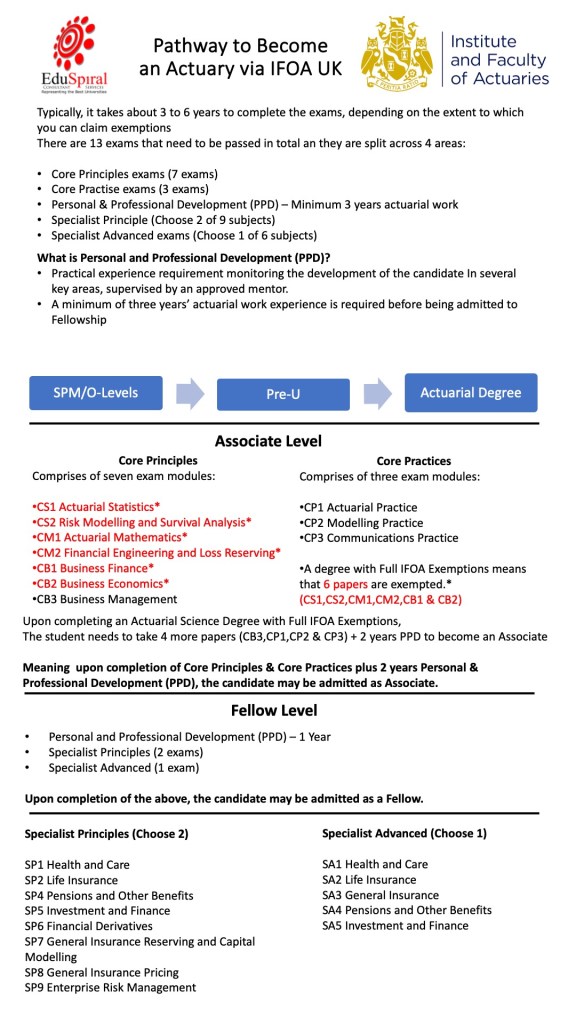
The Pathway to Become a Qualified Professional Actuary through the Institute and Faculty of Actuaries UK

What is the Institute and Faculty of Actuaries (IFoA), UK?
Institute and Faculty of Actuaries (IFoA) UK

As a professional body the Institute and Faculty of Actuaries (IFoA) has a responsibility to ensure that the curriculum is relevant, up-to-date and reflects the skills, knowledge and attributes required of actuaries in an ever-changing global business environment. At the same time the IFoA, as a full member of the International Actuarial Association (IAA), must ensure that its curriculum reflects the international standards set by them. This we have done by ensuring that the core subjects align themselves to the agreed 2017 IAA syllabus.

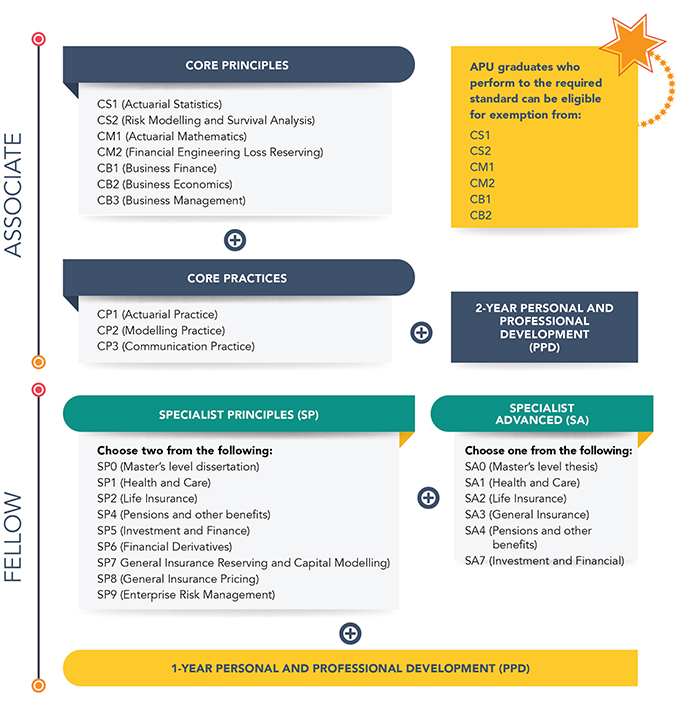
To become an Associate member you need to complete the following:

  • Core Principles subjects (CS1-2, CM1-2 and CB1-3) either by examination or exemption
  • Core Practices subjects (CP1, CP2 and CP3) either by examination or exemption
  • Personal and Professional Development (PPD) – A minimum of 2 years of PPD
  • Professional Skills Course (PSC)
  • Online Professional Awareness Test (OPAT)

To qualify as a Fellow you need to complete the following:

  • Core Principles subjects (CS1-2, CM1-2 and CB1-3) either by examination or exemption
  • Core Practices subjects (CP1, CP2 and CP3) either by examination or exemption
  • Two Specialist Principles (SP1, SP2, SP4, SP5, SP6, SP7, SP8 and SP9) subjects either by examination or exemption
  • One Specialist Advanced (SA1, SA2, SA3, SA4 and SA7) subject by examination or dissertation
  • Personal and Professional Development (PPD) A further minimum 1 year of PPD
  • Professional Skills Course (if you have not yet taken this course you must do so within 12 months of becoming a Fellow)
  • Online Professional Awareness Test (OPAT). Must take OPAT before taking CB3

Core Principles (7 Subjects)

Actuarial Science at Heriot-Watt University Malaysia
EduSpiral explained the pathway to become an actuaries & gave facts on why Heriot-Watt is the best for actuarial science. We also toured the campus and hostel.
Weng Hang, Actuarial Science at Heriot-Watt University Malaysia

General Structure

The Core Principles cover three main areas. These are:

  1. Actuarial Statistics (CS)
    • Actuarial Statistics (CS1)
    • Risk Modelling & Survival Analysis (CS2)
  2. Actuarial Mathematics (CM)
    • Actuarial Mathematics (CM1)
    • Financial Engineering and Loss Reserving (CM2)
  3. Business (CB)
    • Business Finance (CB1)
    • Business Economics (CB2)
    • Business Management (CB3) – Pre-requisite in OPAT

Within each area there are a number of subjects shown opposite. The Core Principles therefore comprises seven subjects.

Assessments for Core Principles

All Core Principle subjects will be assessed. Actuarial Statistics and Actuarial Mathematics have two elements of assessment. For each subject there will be a 3 hours 15 minutes written paper and a 1 hour 45 minutes problem-based assessment. For these subjects both elements of assessment must be taken at the same examination sitting. The two papers will be weighted (70% for the written paper and 30% for the problem based assessment). A single aggregate mark will then be calculated. Failure to reach the overall pass mark will require both elements of assessment to be retaken. The problem-based assessments will be computer based and taken at home or in your office.

Core Practices (5 Papers)

The Core Practices cover three areas. These are:

  1. Actuarial Practice (CP1)
  2. Modelling Practice (CP2)
  3. Communications Practice (CP3)

Assessments for Core Practices

All three will be assessed using written and computer-based examinations. For CP1 and CP2 there will be two elements of assessment for each subject. Each assessment carries equal weighting. A single aggregate mark will then be calculated. Failure to reach the overall pass mark will require both elements of assessments to be retaken. For CP3 there will be a single paper.

Specialist Principles (Choose 2 out of 9)

EduSpiral provided me with advise as well as helped me to get scholarships. Chun Tim, Foundation in Business into Actuarial Science, Taylor's University
EduSpiral provided me with advise as well as helped me to get scholarships.
Chun Tim, Foundation in Business into Actuarial Science, Taylor’s University

The Specialist Principles (SP) subjects require individuals to demonstrate an understanding of the concepts of specific specialist areas. Each subject will be assessed using a 3 hours and 15 minutes paper-based examination. These will be taken in an examination centre. Those who have obtained an alternative qualification have the option of applying for SP0.

This is normally through a Level 7, Master’s Thesis in an actuarially relevant subject. The Specialist Principle subjects are:

  • SP0: Master’s Level Thesis
  • SP1: Health and Care
  • SP2: Life Insurance
  • SP4: Pensions
  • SP5: Investment and Finance
  • SP6: Financial Derivatives
  • SP7: General Insurance: Reserving
  • SP8: General Insurance Pricing
  • SP9: Enterprise Risk Management

Two of these SP subjects have to be passed to be eligible to qualify as a Fellow. You do not need to take any SP subjects to qualify as an Associate.

Specialist Advanced (Choose 1 out of 7)

Actuarial Science at UCSI University
EduSpiral took us around to tour the campus and talk to the Head of Actuarial Science Department to help us make a better decision. Edward Loh (L) Partial Scholarship and Chee Wei (R) Full Scholarship for Actuarial Science at UCSI University

The Specialist Advanced (SA) subjects require individuals to apply specific knowledge and principles of actuarial practice to the provision of specific practice areas.

Subjects SA1 – SA7 will be assessed using a 3 hours and 15 minutes paper-based examination. These will be taken in an examination centre. Those who are planning to undertake some original research on an actuarial topic can apply to take the SA0 route. The research should be at MPhil or PHD level and is likely to require at least 2 years of study. The IFoA must be involved from the start of the project and agree the objectives of the research.

The Specialist Principle subjects are:

  • SA0: Research Master’s Thesis
  • SA1: Health and Care
  • SA2: Life Insurance
  • SA3: General Insurance
  • SA4: Pensions
  • SA7: Investment and Finance

One of these subjects has to be passed to be eligible to qualify as a Fellow. You do not need to take any SA subjects to qualify as an Associate.

Actuaries’ Code

Institute and Faculty of Actuaries (IFoA) UK Career Pathway after High School

Throughout their career as an actuary, individuals are expected to act within the framework of the Actuaries’ Code. The principles of which are:

  • Integrity – Members will act honestly and with the highest standards of integrity. Competence and Care – Members will perform their professional duties competently and with care.
  • Impartiality – Members will not allow bias, conflicts of interest, or the undue influence of others to override their professional judgement.
  • Compliance  – Members will comply with all relevant, legal, regulatory and professional requirements, take reasonable steps to ensure they are not placed in a position where they are unable to comply and will challenge non-compliance by others.
  • Communication – Members will communicate effectively and meet all applicable reporting standards.

To help members develop their understanding of how to apply this code in practice, the IFoA has developed different stages which need to be completed. For students these are:

Stage 1: Online Professional Awareness Test (OPAT) This is a 90 minute, mainly knowledge based, multiple choice online exam, which it is recommended you sit within your first year of membership. This must be sat and passed before applying to sit CB3.

Stage 2: Professional Skills Course (PSC) This is an online course which continues the development of professionalism through case-study discussion. These discussions explore the concepts of professionalism and business ethics. They also provide an opportunity to demonstrate judgement and decision making to resolve issues. The PSC must be completed in order to qualify at either the Associate or Fellow

Personal and Professional Development (PPD)

As part of the journey to become a qualified member of the IFoA, an individual needs to demonstrate they have the relevant skills and experience within a work environment. To do this, the IFoA requires PPD to be completed in addition to the examinations and professionalism requirements.

The PPD requirement includes three categories, subdivided into key competencies, which will carry a credit value. All credits will be recorded online and there will be a minimum annual requirement for each qualification route.

The PPD requirement will align with the CPD scheme which all members need to adhere to when qualified. The three key categories of PPD are:

  1. Effective Communications
  2. Problem Solving and Decision Making
  3. Professionalism

PPD was introduced in September 2017 and replaces Work Based Skills (WBS). There is also a requirement to complete 2hrs of formal learning each year

Actuarial Society of Malaysia (ASM) – Persatuan Aktuari Malaysia

Membership Classes (To become a member of Actuarial Society of Malaysia)

There are four membership classes under the ASM:

  1. Fellow
  2. Associate
  3. Ordinary
  4. Student

The requirements for each class are as follows:

Fellow

To join, professionals must be a Fellow of one of the following bodies:

  • Society of Actuaries (USA)
  • Casualty Actuarial Society (USA)
  • Faculty and Institute of Actuaries (UK)
  • Institute of Actuaries of Australia (Australia)
  • Canadian Institute of Actuaries (Canada)
    • Recommended by 2 Fellow members of the Society
    • Resident in Malaysia or deemed to be familiar with Malaysian conditions
    • At least 1 year’s experience in the Malaysian actuarial industry

Associate

To join, professionals must be an Associate of one of the following bodies:

  • Society of Actuaries (USA)
  • Casualty Actuarial Society (USA)
  • Faculty and Institute of Actuaries (UK)
  • Institute of Actuaries of Australia (Australia)
  • Canadian Institute of Actuaries (Canada)

OR

– Passed examinations of any professional actuarial bodies to be recognized as Fellow, which is
deemed to be at least equivalent to the examination requirements to become an Associate of the
above actuarial bodies.

Ordinary

– Satisfies one of the following:

  • Ordinary member of a professional actuarial body; OR
  • Passed at least 1 part/subject of the examinations of a professional actuarial body which has no class of Ordinary membership and is continuing to study for other examinations of the actuarial body; OR
  • Completed an actuarial course or other related statistical course in a university, college  or other academic institute and has achieved a qualification thereof; OR
  • Carrying out actuarial or other related work in a life or non-life insurance company, government office or actuarial consulting office.

– Nominated by 2 members of the Society

Student

  • Nominated by 2 persons delegated by the Vice Chancellor of the university
  • Does not meet the requirements for admission as Fellow, Associate or Ordinary member; OR meets       the requirements but is not gainfully employed and chooses to seek Student membership
  • Has a declared interest in actuarial matters
  • Undergraduate/postgraduate student in an actuarial-related program

Top Private Universities to Study Actuarial Science in Malaysia

Choosing to Study at the Best Private University for Actuarial Science will Help You to Handle the Professional Exams

Actuaries are business professionals who measure and manage the financial implications of future events—pro and con, certain and uncertain, probable and improbable. Actuaries measure and manage risk. With a deep understanding of mathematics, actuaries forecast possibilities and develop plans to manage financial risks. Applying a blend of math, statistics, computing and business knowledge, they serve as trusted financial and business advisors. Actuaries inform and make decisions that lead to profits, savings, stability and success.

Obtaining an Actuarial Science degree at a top private university in Malaysia provides the first step towards qualifying as an actuary. Actuarial Science is an extremely demanding field of study and only very dedicated and capable students are likely to succeed.

Actuarial Science is a very comprehensive course in the way that it covers Mathematics, Finance, Economics, Accounting, Business Models, Computer Programming and Risk Management. As such, a high aptitude in Mathematics is highly required. Actuarial Science degree students at top private universities in Malaysia will also learn Calculus, Statistics, Probability, and Financial Mathematics. With this fundamental Mathematical knowledge graduates will be able to solve complex actuarial problems.

The Actuarial Science degree programme has a heavy mathematical and statistical component. The first step after SPM or IGCSE/O-Levels, students will need to consider a private university in Malaysia that has a solid Actuarial Science degree programme that will help you prepare well for the professional papers. After completing your degree, you can continue on to two of the more popular professional papers in Malaysia which are the Society of Actuaries (SoA) USA and the Institute and Faculty of Actuaries (IFoA) (UK). A few private universities have managed to obtain full exemptions from IFoA allowing students the fastest pathway to becoming a professional actuary.

You might also be interested to read:

Please fill up the Form below and I will WhatsApp you and provide you with sound advise on how to choose the best private university or college in Malaysia to study at. Our knowledgeable & experienced counselor will send you a message on WhatsApp & provide assistance from there.

Go back

Your message has been sent

Warning
Warning
Warning
Warning
Warning
Warning
Warning
Warning
Warning

Warning.

Top Actuarial Science Private Universities in Malaysia

I wasn’t sure of which university to join for actuarial science. EduSpiral shared with me about the scholarship and actuarial pathways clearly which helped me to decide.
Wei Zhe, Actuarial Science at Asia Pacific University (APU)

Actuaries in Malaysia are professionals dealing with the financial impact of risk and uncertainty.

Actuaries use their skills in mathematics, economic, computer science, finance, probability and statistics, and business to assess the likelihood of occurrence of certain risky events formulate policies that minimize the cost of these risks.

As such, actuaries are essential to the insurance and reinsurance industry in Malaysia. In addition, they can be consultants to other businesses, including sponsors of pension plans; and to government agencies such as Bank Negara Malaysia.

A top actuarial science programme from a private university in Malaysia can enhance your ability to perform well on the rigorous demands of the actuarial professional exams and requirements.

In addition, exemptions from the professional papers will allow you to complete faster. The most common route to become an Actuary in Malaysia is taking the Professional Papers from the Society of Actuaries (SOA) – USA and the Institute and Faculty of Actuaries (IFoA) – UK.

Which are the Best Private Universities to Study Actuarial Science?

My father wanted me to study at the best university for actuarial science & I wasn't sure about my results. EduSpiral met up with us, explained about the course and university.
My father wanted me to study at the best university for actuarial science & I wasn’t sure about my results. EduSpiral met up with us, explained about the course and university.
Min En, Actuarial Science, Heriot-Watt University Malaysia

Outstanding private universities in Malaysia have garnered experience throughout the years in equipping students with the knowledge and skills to pass the difficult professional programmes. Their lecturers are highly experienced, qualified and competent. In addition, some have gained full exemptions from the IFoA. This can significantly reduce the time taken to qualify as a Fellow of the Institute and Faculty of Actuaries.

Top Private Universities in Malaysia for the Actuarial Science Degree Programme are:

  1. Heriot-Watt University Malaysia
  2. Asia Pacific University (APU)
  3. University of Southampton Malaysia (UoSM)
  4. Taylor’s University.
  5. UCSI University

The Best Education Pathway to Become a Professional Actuary in Malaysia

I was confused which university to choose for my studies and contacted EduSpiral. He provided facts & evidence to help me make the right choice. Vivian Chua, Actuarial Science at UCSI University
I was confused which university to choose for my studies and contacted EduSpiral. He provided facts & evidence to help me make the right choice.
Vivian Chua, Actuarial Science at UCSI University

The path to becoming an actuary in Malaysia involves going through a well-structured education plan. This involves university-level education and post-university examinations, as well as other requirements.

After SPM or IGCSE/O-Levels, students can go for the Foundation in Business Administration or Foundation in Arts and then enter into a degree programme in Actuarial Science with VEE exemptions from the Society of Actuaries (SOA). At most universities in Malaysia, students will also receive credits for all the 3 Validated by Educational Experience (VEE) papers from SOA as long as they receive a minimum mark of 70% in the equivalent papers.

Upon completing the Actuarial Science degree, students can then begin to take the professional exams.

During their undergraduate studies, students can attempt the examinations conducted by professional bodies such as Society of Actuaries (SOA) or Institute and Faculty of Actuaries (IFoA).

How long does it normally take to become an Actuary in Malaysia?

A normal bachelor degree takes 3 years (+1 year if you consider an Honours degree in Australia). Thereafter, writing the professional exams through the Institute and Faculty of Actuaries (UK) or Society of Actuaries (USA) takes an average of 3-7 years (working and studying) after the degree.

Actuarial Science/Math Degree (3-4 years) + Professional Papers (3-7 years taken part time as you work)

Which actuarial professional bodies are recognized in Malaysia?

Malaysian insurance regulator, Bank Negara Malaysia and the Actuarial Society of Malaysia (ASM) recognize Fellows of the following organizations as qualified actuaries:

Institute and Faculty of Actuaries (IFoA), UK

Institute and Faculty of Actuaries (IFoA) UK

As a professional body the Institute and Faculty of Actuaries (IFoA) has a responsibility to ensure that the curriculum is relevant, up-to-date and reflects the skills, knowledge and attributes required of actuaries in an ever-changing global business environment.

At the same time the IFoA, as a full member of the International Actuarial Association (IAA), must ensure that its curriculum reflects the international standards set by them. This we have done by ensuring that the core subjects align themselves to the agreed 2017 IAA syllabus.

Society of Actuaries (SOA) – USA

Society of Actuaries (SOA) – USA

The Society of Actuaries (SOA) is a professional organization for actuaries based in North America. It is a full member organization of the International Actuarial Association.

The Society’s vision is for actuaries to be recognized as the leading professionals in the modeling and management of financial risk and contingent events. The SOA has three overall goals: providing primary and continuing education for students and practicing actuaries, maintaining high professional standards for actuaries, and conducting research on actuarial trends and public policy issues.[5]

The Society’s members are mainly involved in the life, health, and pension areas of the actuarial profession. There are three designations offered by the Society. The two Associate-level designations are Associate of Society of Actuaries (ASA) and Chartered Enterprise Risk Analyst (CERA), which was introduced in 2007. The highest designation is Fellow of the Society of Actuaries (FSA).

What type of students should study Actuarial Science in Malaysia?

EduSpiral provided me with advise as well as helped me to get scholarships. Chun Tim, Foundation in Business into Actuarial Science, Taylor's University
EduSpiral provided me with advise as well as helped me to get scholarships.
Chun Tim, Foundation in Business into Actuarial Science, Taylor’s University

Students who have a passion for Maths and excel in it can consider Actuarial Science as a career in Malaysia. Actuarial Science is a very comprehensive course in the way that it covers Mathematics, Finance, Economics, Accounting, Business Models, Computer Programming and Risk Management. As such, a high aptitude in Mathematics is highly required.

Degree students will also learn Calculus, Statistics, Probability, and Financial Mathematics. With this fundamental Mathematical knowledge graduates will be able to solve complex actuarial problems.

However, actuaries in Malaysia must also have good verbal and written communication skills especially in English, strong computer skills, time-management skills, as well as possess good judgement, imagination and clear logical thinking. They also should have a knack for problem-solving, be self-confident, and possess the ability to work under pressure.

Sharpness, creativity, practicality coupled with good business sense are also some of the key personal attributes. An actuary who has devised a brilliant solution to complex problem must be able to explain his solution to non-actuaries!

Being an actuary also requires you to master several computer programming languages such as Microsoft Excel, Microsoft Visual Basic, Microsoft Visual FoxPro, and most importantly, Prophet – an actuarial software designed to crunch a large database. If you do not enjoy learning programming languages or writing codes, actuarial science would not be the career for you.

Other than that, actuaries bring a special set of skills to their work such as:

  • Specialised math knowledge
  • Calculus, statistics, probability
  • Keen analytical, project management, and problem solving skills
  • Good business sense
  • Finance, accounting, economics
  • Solid communication skills (oral and written)
  • Strong computer skills
  • Formulating spreadsheets, statistical analysis programs, database manipulation, programming languages

Actuaries are talented professionals, with personal characteristics such as:

  • Self-motivation
  • Creativity
  • Independence
  • Ability to work with others
  • Ambition

I

The skills developed and honed by successful actuaries include an excellent business sense with knowledge of finance, accounting, and economics; keen analytical, project management, and problem solving skills; specialized math knowledge; strong computer skills; and solid written and oral communication skills.

In addition, actuaries enjoy learning, like to solve complicated problems, enjoy writing and talking to people, can work effectively alone or as part of a team, are interested in a variety of historical, social, legislative, and political issues, and are self-motivated achievers.

As you can see, future actuaries need to be very well equipped to face the challenges of completing the professional papers and then to succeed in the competitive work environment. Students should choose universities that are reputable with an English-speaking environment so that they are forced to communicate in English and therefore improve. Remember, if you want to work for top Multi-National Insurance companies, banks and investment firms, you have to have a strong command of the English language.

What you Will Study in Actuarial Science in Malaysia

Actuarial Science at Heriot-Watt University Malaysia
EduSpiral explained the pathway to become an actuaries & gave facts on why Heriot-Watt is the best for actuarial science. We also toured the campus and hostel.
Weng Hang, Actuarial Science at Heriot-Watt University Malaysia

Obtaining an Actuarial Science degree at a top private university in Malaysia provides the first step towards qualifying as an actuary. Actuarial Science is an extremely demanding field of study and only very dedicated and capable students are likely to succeed.

Not all people are suited to study actuarial science as it is a very challenging course and requires a long time to become a professional actuaries. Students after SPM, O-Levels, Pre-U, STPM, A-Levels or UEC with excellent results in Maths and Add Maths can consider a career in actuary.

Actuarial Science is a very comprehensive course in the way that it covers Mathematics, Finance, Economics, Accounting, Business Models, Computer Programming and Risk Management. As such, a high aptitude in Mathematics is highly required.

Actuarial science includes a number of interrelated subjects, including mathematics, probability theory, statistics, finance, economics, and computer science. Historically, actuarial science used deterministic models in the construction of tables and premiums. The science has gone through revolutionary changes during the last 30 years due to the proliferation of high speed computers and the union of stochastic actuarial models with modern financial theory.

Actuarial Science degree students at top universities in Malaysia will also learn Calculus, Statistics, Probability, and Financial Mathematics. With this fundamental Mathematical knowledge graduates will be able to solve complex actuarial problems.

Actuarial science is the discipline that applies mathematical and statistical methods to assess risk in insurance, finance and other industries and professions. Actuaries are professionals who are qualified in this field through intense education and experience. Upon completion of the actuarial science degree programme in Malaysia, actuaries must demonstrate their competence by passing a series of thorough professional examinations.

Being an actuary also requires you to master several computer programming languages such as Microsoft Excel, Microsoft Visual Basic, Microsoft Visual FoxPro, R and most importantly, Prophet – an actuarial software designed to crunch a large database. If you do not enjoy learning programming languages or writing codes, actuarial science would not be the career for you.

Actuaries are professionals who like to solve complex problems. There are many factors impacting an actuarial solution that even one assumption is inaccurate, it would affect the whole solution and result.

Consequently, actuaries employ the actuarial control cycle – a problem-solving approach that applies equally well to the most broad and the focused actuarial problems. It is a model of actuarial practice in a wide range of fields and provides common grounding for all candidates.

Through the control cycle, all actuarial work is categorized into three main functions:

  1. Define the problem
  2. Design the solution
  3. Monitor the results

Because of their ability to analyse and solve complex problems, actuaries command a very high salary. In fact, it is one of the highest paid professions in Malaysia and globally.

Education Pathway after Secondary School to Become an Actuary in Malaysia through the Institute and Faculty of Actuaries (IFoA)

How to Become an Actuary after SPM or IGCSE/O-Levels through IFoA (UK) in Malaysia

  • The education pathway to become an Actuary in Malaysia requires students to go through a well-structured plan and takes about 3-6 years.
  • Students after SPM or IGCSE/O-Levels can study at top private universities in Malaysia with full exemptions from IFOA in order to become an actuary faster.
  • Qualifying to Become a Fellowship/Associateship through the Institute and Faculty of Actuaries (IFoA)

Actuaries deal with numbers, so being able to do basic mathematics quickly and correctly is usually a requirement on job descriptions. However, the maths associated with actuarial science can be a lot more complicated than that. Communication skills are also essential in becoming an actuary because you need to be able to articulate difficult topics to non-specialists, and you will also need to develop the capacity to give expert advice to non-actuaries and the general public.

One of the pathways to become a professional actuaries in Malaysia is taking the professional papers from the Institute and Faculty of Actuaries (IFoA) UK. The first step for students after SPM or IGCSE/O-Levels is to take a Pre-University Course such as the Foundation in Business Administration and then enter into the Actuarial Science degree at a private university that has full exemptions from IFoA. This will greatly shorten your time to qualify as an Actuary in Malaysia. Upon completion of the degree, you can then start taking the professional papers.

Students can study at top private universities in Malaysia with full exemptions from IFOA in order to become an actuary faster. A degree with Full IFOA Exemptions means that 6 papers are exempted which are – CS1,CS2,CM1,CM2,CB1 & CB2. Students need to take 4 more papers plus 2 years PPD to qualify as an Associate. To qualify as a Fellow, you will be required to complete 1 year of PPD, Specialist Principles (2 exams) & Specialist Advanced (1 exam).

Practical experience requirement monitoring the development of the candidate in several key areas, supervised by an approved mentor. A minimum of three years’ actuarial work experience is required before being admitted to Fellowship.

Typically, it takes about 3 to 6 years to complete the exams, depending on the extent to which you can claim exemptions. There are 13 exams in the IFOA that need to be passed in total an they are split across 4 areas:

  • Core Principles exams (7 exams) – covering fundamental actuarial techniques in mathematics, statistics and business
  • Core Practise exams (3 exams) – covering actuarial risk management, financial modelling and communication skills
  • Personal & Professional Development (PPD) – Minimum 3 years actuarial work
  • Specialist Principle (Choose 2 of 9 subjects) – bringing technical skills and knowledge to a more advanced level
  • Specialist Advanced exams (Choose 1 of 6 subjects) – through which you will improve your ability to apply both technical skills and professional actuarial judgement in real world situations

Read on below for the details of the pathway or if you would like advise on choosing the right university, please fill up the enquiry form.

You might also be interested to read:

Please fill up the Form below and I will WhatsApp you and provide you with sound advise on how to choose the best private university or college in Malaysia to study at. If you do not give your mobile number or full name as in IC, your query will not be answered. Our knowledgeable & experienced counsellor will send you a message on WhatsApp & provide assistance from there.

Go back

Your message has been sent

Warning
Warning
Warning
Warning
Warning
Warning
Warning
Warning
Warning

Warning.

How to Qualify to Become a Fellowship/Associateship through the Institute and Faculty of Actuaries (IFoA)

EduSpiral helped me to find the right college for A-Levels, & now they have helped me to choose what to study after my A-Levels. Chee Kin, Actuarial & Finance degree at UCSI University
EduSpiral helped me to find the right college for A-Levels, & now they have helped me to choose what to study after my A-Levels.
Chee Kin, Actuarial & Finance Graduate

If you have studied a university course that has been accredited by the IFoA or if you have studied a course with a significant amount of Maths included in the content then you may be eligible for exam exemptions.

It is worth looking into taking a degree with full IFOA exemptions so that you can avoid sitting an extra paper – because there’s 13 exams to get through and it takes people an average of 5 – 7 years to qualify to become a Fellow.

To qualify as a Fellow, you will be required to complete, or have been granted exemption(s) from the following examinations:

  • Core Principles x 7
  • Core Practices x 3
  • Specialist Principles x 2
  • Specialist Advanced x 1
  • Personal Professional Development (PPD)
  • Professional Skills Course (PSC)
  • Online Professional Awareness Test (OPAT)

The IFOA exams are rigorous and challenging.

Just for some context on how difficult the exams are, the pass rates tend to be below 50% for the later exams with the exception of a few. In fact for the April 2020 exams, the pass rates were as follows:

CB1: 59.6% | CB2: 70.7%

CP1: 44.5% | CP2: 65.7% | CP3: 50.3%

SP1: 41.7% | SP2: 39.9% | SP4: 26.0% | SP5: 42.6% | SP6: 59.5% | SP7: 20.5% | SP8: 40.0% | SP9: 23.9%

SA1: 47.8% | SA2: 48.9% | SA3: 30.9% | SA4: 29.1% | SA7: 39.1%

What is the Education Pathway to become an Actuary via IFOA after SPM or IGCSE/O-Levels?

The first step for students after SPM or IGCSE/O-Levels is to take a Pre-University Course such as the Foundation in Business Administration and then enter into the Actuarial Science degree at a private university that has full exemptions from IFoA.

A degree with Full IFOA Exemptions means that 6 papers are exempted which are – CS1,CS2,CM1,CM2,CB1 & CB2.

Students need to take 4 more papers plus 2 years PPD to qualify as an Associate.

To qualify as a Fellow, you will be required to complete 1 year of PPD, Specialist Principles (2 exams) & Specialist Advanced (1 exam).

Passing the professional exams is one part to becoming an actuary, and the other part is the requirement of at least three years’ practical experience to fully qualify.

What is the Institute and Faculty of Actuaries (IFoA), UK?

Institute and Faculty of Actuaries (IFoA) UK

As a professional body the Institute and Faculty of Actuaries (IFoA) has a responsibility to ensure that the curriculum is relevant, up-to-date and reflects the skills, knowledge and attributes required of actuaries in an ever-changing global business environment.

At the same time the IFoA, as a full member of the International Actuarial Association (IAA), must ensure that its curriculum reflects the international standards set by them.

This IFOA have done by ensuring that the core subjects align themselves to the agreed 2017 IAA syllabus.

To become an Associate member you need to complete the following:

  • Core Principles subjects (CS1-2, CM1-2 and CB1-3) either by examination or exemption
  • Core Practices subjects (CP1, CP2 and CP3) either by examination or exemption
  • Personal and Professional Development (PPD) – A minimum of 2 years of PPD
  • Professional Skills Course (PSC)
  • Online Professional Awareness Test (OPAT)

To qualify as a Fellow you need to complete the following:

My father wanted me to study at the best university for actuarial science & I wasn't sure about my results. EduSpiral met up with us, explained about the course and university.
My father wanted me to study at the best university for actuarial science & I wasn’t sure about my results. EduSpiral met up with us, explained about the course and university.
Min En, Actuarial Science, Heriot-Watt University Malaysia
  • Core Principles subjects (CS1-2, CM1-2 and CB1-3) either by examination or exemption
  • Core Practices subjects (CP1, CP2 and CP3) either by examination or exemption
  • Two Specialist Principles (SP1, SP2, SP4, SP5, SP6, SP7, SP8 and SP9) subjects either by examination or exemption
  • One Specialist Advanced (SA1, SA2, SA3, SA4 and SA7) subject by examination or dissertation
  • Personal and Professional Development (PPD) A further minimum 1 year of PPD
  • Professional Skills Course (if you have not yet taken this course you must do so within 12 months of becoming a Fellow)
  • Online Professional Awareness Test (OPAT). Must take OPAT before taking CB3

Core Principles (7 Subjects)

I was confused what to study & which university. My cousin introduced me to EduSpiral who helped me to make the right choice.
Ye Lun, Actuarial Science at Asia Pacific University (APU)

General Structure

The Core Principles cover three main areas. These are:

  1. Actuarial Statistics (CS)
    • Actuarial Statistics (CS1)
    • Risk Modelling & Survival Analysis (CS2)
  2. Actuarial Mathematics (CM)
    • Actuarial Mathematics (CM1)
    • Financial Engineering and Loss Reserving (CM2)
  3. Business (CB)
    • Business Finance (CB1)
    • Business Economics (CB2)
    • Business Management (CB3) – Pre-requisite in OPAT

Within each area there are a number of subjects shown opposite. The Core Principles therefore comprises seven subjects.

Assessments for Core Principles

All Core Principle subjects will be assessed. Actuarial Statistics and Actuarial Mathematics have two elements of assessment. For each subject there will be a 3 hours 15 minutes written paper and a 1 hour 45 minutes problem-based assessment. For these subjects both elements of assessment must be taken at the same examination sitting.

The two papers will be weighted (70% for the written paper and 30% for the problem based assessment). A single aggregate mark will then be calculated. Failure to reach the overall pass mark will require both elements of assessment to be retaken. The problem-based assessments will be computer based and taken at home or in your office.

Core Practices (5 Papers)

The Core Practices cover three areas. These are:

  1. Actuarial Practice (CP1)
  2. Modelling Practice (CP2)
  3. Communications Practice (CP3)

Assessments for Core Practices

All three will be assessed using written and computer-based examinations. For CP1 and CP2 there will be two elements of assessment for each subject. Each assessment carries equal weighting. A single aggregate mark will then be calculated. Failure to reach the overall pass mark will require both elements of assessments to be retaken. For CP3 there will be a single paper.

Specialist Principles (Choose 2 out of 9)

Actuarial Science at Heriot-Watt University Malaysia
My mum contacted EduSpiral and he gave me in-depth information on the courses & universities. He arranged for us to tour the universities to help me make the right choice.
Bryan Yap, Foundation in Business (Actuarial Science) at Heriot-Watt University Malaysia

The Specialist Principles (SP) subjects require individuals to demonstrate an understanding of the concepts of specific specialist areas. Each subject will be assessed using a 3 hours and 15 minutes paper-based examination. These will be taken in an examination centre. Those who have obtained an alternative qualification have the option of applying for SP0.

This is normally through a Level 7, Master’s Thesis in an actuarially relevant subject. The Specialist Principle subjects are:

  • SP0: Master’s Level Thesis
  • SP1: Health and Care
  • SP2: Life Insurance
  • SP4: Pensions
  • SP5: Investment and Finance
  • SP6: Financial Derivatives
  • SP7: General Insurance: Reserving
  • SP8: General Insurance Pricing
  • SP9: Enterprise Risk Management

Two of these SP subjects have to be passed to be eligible to qualify as a Fellow. You do not need to take any SP subjects to qualify as an Associate.

Specialist Advanced (Choose 1 out of 7)

Actuarial Science at Asia Pacific University (APU)
I wasn’t sure of which university to join for actuarial science. EduSpiral shared with me about the scholarship and actuarial pathways clearly which helped me to decide.
Wei Zhe, Actuarial Science at Asia Pacific University (APU)

The Specialist Advanced (SA) subjects require individuals to apply specific knowledge and principles of actuarial practice to the provision of specific practice areas.

Subjects SA1 – SA7 will be assessed using a 3 hours and 15 minutes paper-based examination. These will be taken in an examination centre. Those who are planning to undertake some original research on an actuarial topic can apply to take the SA0 route.

The research should be at MPhil or PHD level and is likely to require at least 2 years of study. The IFoA must be involved from the start of the project and agree the objectives of the research.

The Specialist Principle subjects are:

  • SA0: Research Master’s Thesis
  • SA1: Health and Care
  • SA2: Life Insurance
  • SA3: General Insurance
  • SA4: Pensions
  • SA7: Investment and Finance

One of these subjects has to be passed to be eligible to qualify as a Fellow. You do not need to take any SA subjects to qualify as an Associate

Subjects covered

Core Principles

The Core Principles cover three main areas. These exams are compulsory and are usually taken first by students.. These are also the most common exams for which you can get exemptions from in your undergraduate degree because you’ve already covered the same material on your course.

The Actuarial Statistics and Actuarial Mathematics modules, CS1, CS2, CM1 and CM2, have two elements of assessment. For each of those 4 subjects you will have a 3 hours 15 minutes written paper and a 1 hour 45 minutes online problem-based assessment. The two papers are weighted 70% for the written paper and 30% for the problem based assessment. For actuarial statistics, the computer-based exam is taken on R and for actuarial mathematics, the computer-based exam is taken on excel.

1. Actuarial Statistics (CS)

In Actuarial Statistics, emphasis is placed on being able to apply statistical methods to actuarial problems using real data sets and the open-source software environment R. This area comprises of two separate modules, each with two elements of assessment. Each module can be sat in different exam sessions but the two assessments which cover the module must be completed during the same exam session.

2. Actuarial Mathematics (CM)

Actuarial Mathematics provide students with core knowledge on areas such as how to price different financial products, such as bonds, and insurance products, such as life insurance. This area comprises of two separate modules, each with two elements of assessment. Each module can be sat in different exam sessions but the two assessments which cover the module must be completed during the same exam session.

3. Business (CB) subjects

Of the 3 business exams, CB1 and CB2 would usually be 3 hours 15 minutes paper-based exams which will now also be online for the next sitting and CB3 is a ‘Business Awareness Module’ that is sat online but it’s slightly different to the other exams discussed.

There are 3 business subjects

  • Business Finance
  • Business Economics
  • Business Management (case studies and simulation). This comprises business strategy and law, and includes a business simulation

Core Practices subjects

The Actuarial Practice subject builds on knowledge and skills learned in the Core Principles, to apply these principles to real actuarial problems. The material also covers risk management techniques and processes required by actuaries.

In Modelling Practice, you learn to model data, document the work (including maintaining an audit trail for a fellow student and senior actuary), analyse the methods used and outputs generated and communicate results and conclusions to a senior actuary.

Communication Practice

The Communication Practice subject helps ensure that you can communicate actuarial concepts to a non-technical audience. Students are encouraged to reflect on their communication style and become effective communicators.

The Core Practices cover three areas. These are:

  1. Actuarial Practice (CP1)
  2. Modelling Practice (CP2)
  3. Communications Practice (CP3)

– For CP1, there are two elements to this assessment: Paper 1 is a 3 hours 15 minutes paper-based assessment and Paper 2 is a 2 hours 30 minutes paper-based case study assessment with 45 minutes extra planning time at the start.

– CP2 also consists of two papers which involve using excel to carry out tasks on a spreadsheet and write out an audit trail explaining all the steps carried out and a summary report discussing the tasks and results in the spreadsheet.

– CP3 tests your ability to explain actuarial concepts in a simple, easy-to-understand manner. The exam involves writing an email/letter/report addressed to a non specialist who may not understand actuarial jargon and techniques.

Specialist Principles subjects

The Specialist Principles (SP) subjects require individuals to demonstrate an understanding of the concepts of specific specialist areas ranging from life insurance, pensions, health and care, investments and finance, general insurance reserving and pricing etc.

To progress to Fellow membership, you will need to pass two of the subjects below to demonstrate your understanding of the concepts in your chosen subjects and application of principles to the various sectors.

  • Health and Care: the provision of health and care business
  • Pensions and Other Benefits: financial management of pensions and other benefits.
  • Investment and Finance: management of investments
  • Financial Derivatives: the types, usage and valuation of financial derivatives in trading markets
  • General Insurance: Reserving and Capital Modelling
  • General Insurance Pricing: mathematical and economics techniques for general insurance operations
  • Enterprise Risk Management: qualitative and quantitative aspects of risk management, how these risks are aggregated and risk management frameworks.

Specialist Advanced subjects

The Specialist Advanced subjects require you to pass one of these subjects below, to show that you can apply principles of actuarial practice to an advanced area.

  • Health and Care
  • Life Insurance
  • General Insurance
  • Pensions and Other Benefits
  • Investment and Finance

Actuaries’ Code

Institute and Faculty of Actuaries (IFoA) UK Career Pathway after High School

Throughout their career as an actuary, individuals are expected to act within the framework of the Actuaries’ Code. The principles of which are:

  • Integrity – Members will act honestly and with the highest standards of integrity. Competence and Care – Members will perform their professional duties competently and with care.
  • Impartiality – Members will not allow bias, conflicts of interest, or the undue influence of others to override their professional judgement.
  • Compliance  – Members will comply with all relevant, legal, regulatory and professional requirements, take reasonable steps to ensure they are not placed in a position where they are unable to comply and will challenge non-compliance by others.
  • Communication – Members will communicate effectively and meet all applicable reporting standards.

To help members develop their understanding of how to apply this code in practice, the IFoA has developed different stages which need to be completed. For students these are:

Stage 1: Online Professional Awareness Test (OPAT) This is a 90 minute, mainly knowledge based, multiple choice online exam, which it is recommended you sit within your first year of membership. This must be sat and passed before applying to sit CB3.

Stage 2: Professional Skills Course (PSC) This is an online course which continues the development of professionalism through case-study discussion. These discussions explore the concepts of professionalism and business ethics. They also provide an opportunity to demonstrate judgement and decision making to resolve issues. The PSC must be completed in order to qualify at either the Associate or Fellow

Personal and Professional Development (PPD)

I was confused which university to choose for my studies and contacted EduSpiral. He provided facts & evidence to help me make the right choice. Vivian Chua, Actuarial Science at UCSI University
I was confused which university to choose for my studies and contacted EduSpiral. He provided facts & evidence to help me make the right choice.
Vivian Chua, Actuarial Science at UCSI University

As part of the journey to become a qualified member of the IFoA, an individual needs to demonstrate they have the relevant skills and experience within a work environment. To do this, the IFoA requires PPD to be completed in addition to the examinations and professionalism requirements.

The PPD requirement includes three categories, subdivided into key competencies, which will carry a credit value. All credits will be recorded online and there will be a minimum annual requirement for each qualification route.

The PPD requirement will align with the CPD scheme which all members need to adhere to when qualified. The three key categories of PPD are:

  1. Effective Communications
  2. Problem Solving and Decision Making
  3. Professionalism

PPD was introduced in September 2017 and replaces Work Based Skills (WBS). There is also a requirement to complete 2hrs of formal learning each year

Institute and Faculty of Actuaries (IFoA) Curriculum 2019

The IFoA has released information on their new curriculum for 2019. As the needs of the actuarial profession and the Institute and Faculty of Actuaries (IFoA) evolve, so must our curriculum.

This page contains all the exams information you need under the new curriculum. As actuarial science and the skill set of actuaries are used in wider applications in both traditional and non-traditional fields, and the IFoA increases its intake of overseas members, our curriculum must be updated to reflect these challenges and ensure that it is fit for purpose in today’s evolving world.

Further information on modules, including the syllabus and specimen papers, can be found under Curriculum 2019 V23 WEB

Why is the IFoA launching a new curriculum?

EduSpiral provided me with advise as well as helped me to get scholarships. Chun Tim, Foundation in Business into Actuarial Science, Taylor's University
EduSpiral provided me with advise as well as helped me to get scholarships.
Chun Tim, Foundation in Business into Actuarial Science, Taylor’s University

The employment opportunities available for those with an actuarial skill set continue to develop and grow, in some cases outside the traditional areas.

As a professional body the Institute and Faculty of Actuaries (IFoA) has a responsibility to ensure that the curriculum is relevant, up-to-date and reflects the skills, knowledge and attributes required of actuaries in an ever-changing global business environment.

At the same time the IFoA, as a full member of the International Actuarial Association (IAA), must ensure that its curriculum reflects the international standards set by them. This we have done by ensuring that the core subjects align themselves to the agreed 2017 IAA syllabus.

Definitive core reading and sample examination papers for the new curriculum are available at:

https://www.actuaries.org.uk/studying/curriculum-2019

Changes to the Qualification Structure

After chatting with EduSpiral on WhatsApp, he met me & my family to take us around the campus & provide further advise on the course. Zijun, Actuarial Science at Asia Pacific University (APU)
After chatting with EduSpiral on WhatsApp, he met me & my family to take us around the campus & provide further advise on the course.
Zijun, Actuarial Science at Asia Pacific University (APU)

On 2 January 2019, the IFoA will be delivering its new curriculum, with the first examinations being sat in April 2019. This is the culmination of an extensive consultation with a wide group of stakeholders.

Alongside these curriculum changes the IFoA will be making some changes to the qualification structure which we want to alert you to. These are as follows:

Associateship qualification All students joining the IFoA from 2 January 2019 will be required to qualify as an Associate before choosing to progress to Fellowship. You will do this after completing or gaining exemptions from the Core Principles and Core Practice subjects and a minimum of 2 years of PPD.

The pathway to Fellowship All students will still be able to take their examinations in any order but if they complete the examinations prior to becoming an Associate, they will still be required to complete a further year of PPD before becoming a Fellow.

A flexible qualification Students who wish to progress to Fellowship will be able to do so by completing their Specialist Principles and Specialist Advanced subjects, and a minimum of 1 further year of PPD. Employers will have the flexibility to support their employees in whichever pathway they deem the most appropriate.

Who is affected

Existing students who joined the IFoA before 2 January 2019 may not be affected by these IFoA changes.

The Curriculum

The actuarial qualification contains three fundamental components,
and these will not change. They are the examinations, professionalism and practical experience gained in the workplace. Whether you are aiming to qualify as an Associate or Fellow, you will need to complete all these components.

There have been changes to the names we are using for the Curriculum 2019 groups of subjects.

Top 3 Private Universities in Malaysia for Actuarial Science Degree with VEE Exemptions from Society of Actuaries (SOA)

Written by EduSpiral Consultant Services For more information contact 01111408838

The journey to become a qualified actuary as outlined by the Society of Actuaries (SOA) – one of the most prominent professional organisation for actuaries in the world – is divided into four stages. The first is the Validated by Educational Experience (VEE) stage where students who receive grades of 70% and above for subjects in economics, corporate finance and applied statistics – will receive credit for these professional papers.

The second stage involves five preliminary exams that candidates must pass before proceeding to the penultimate stage, namely, the Fundamentals of Actuarial Practices course and the Associateship Professionalism Course (APC). This will qualify them as an Associate of the Society of Actuaries (ASA). The final hurdle would be to qualify as a Fellow of the Society of Actuaries (FSA).

For more information contact 01111408838

Please fill up the Form below and I will WhatsApp you and provide you with sound advise on how to choose the best private university or college in Malaysia to study at. If you do not give your mobile number or full name as in IC, your query will not be answered. Our knowledgeable & experienced counsellor will send you a message on WhatsApp & provide assistance from there.

Go back

Your message has been sent

Warning
Warning
Warning
Warning
Warning
Warning
Warning
Warning
Warning

Warning.

Top Universities in Malaysia to Study Actuarial Science with Exemptions from Validated by Educational Experience (VEE) Papers from Society of Actuaries (SOA) and Prepare You for the Professional Exams

Actuarial Science at Asia Pacific University (APU)
I wasn’t sure of which university to join for actuarial science. EduSpiral shared with me about the scholarship and actuarial pathways clearly which helped me to decide.
Wei Zhe, Actuarial Science at Asia Pacific University (APU)

There are not many universities in Malaysia that offer the degree in Actuarial Science. Outstanding private universities in Malaysia for Actuarial Science or Actuarial Maths degree with VEE Paper exemptions from SOA are Heriot-Watt University MalaysiaAsia Pacific University (APU), and  Taylor’s University.

Students can consider studying the BSc (Hons) Actuarial Studies at Asia Pacific University (APU). APU is the first and the only Malaysian university that has all the six preliminary exams (P, FM, IFM, LTAM, STAM & SRM) and all the three VEE topics listed in its SOA UCAP profile.

Heriot-Watt’s Statistics & Operational Research course (Actuarial Mathematics and Statistics) was placed the world’s top 200. In addition, in the 2021 Complete University Guide, Heriot-Watt is ranked 11th in UK for Mathematics. The best university in Malaysia for Actuarial Science would be Heriot-Watt University Malaysia where students can get 8-paper exemptions out of 15 needed to qualify as a Fellow at the Institute and Faculty of Actuaries (FIA), UK. This degree is one of only a few to be accredited by the UK actuarial profession. Good performance means exemptions from professional examinations (CT1-CT8), giving prospective actuaries an advantage over those on other mathematics programmes.

Graduates who go on to qualify as actuaries with the Society of Actuaries in North America can get credit from some of the SOA examinations on the basis of exemptions from the IfoA examinations.

Heriot-Watt University is recognised as a Center of Actuarial Excellence by the Society of Actuaries (SOA), North America. Heriot-Watt University is the only Center of Actuarial Excellence in Europe and one of only 30 other schools worldwide with this designation. With roots dating back to 1889, the Society of Actuaries (SOA) is the world’s largest actuarial professional organization with more than 28,000 actuaries as members.

In addition, students will receive a dual award University of the West of England, UK degree at Taylor’s University for the BSc. (Hons) Actuarial Studies. Taylor’s University offers a 3-year and a 4-year Actuarial Studies degree programme.

The 1-year internship at Taylor’s University is offered in the third year of the 4-year programme, students have the opportunity to broaden their knowledge and gain industry exposure that will help them excel in their final year of studies.


Best Actuarial Science Degree Course in Malaysia at Asia Pacific University (APU)

Actuarial Science at Asia Pacific University (APU)
I wasn’t sure of which university to join for actuarial science. EduSpiral shared with me about the scholarship and actuarial pathways clearly which helped me to decide.
Wei Zhe, Actuarial Science at Asia Pacific University (APU)

At Asia Pacific University, Bachelor of Science (Hons) Actuarial Studies students will also receive credits for all the 3 Validated by Educational Experience (VEE) papers from SOA as long as they receive a minimum mark of 70% in the APU equivalent papers.

APU is the first and the only Malaysian university that has all the six preliminary exams (P, FM, IFM, LTAM, STAM & SRM) and all the three VEE topics listed in its SOA UCAP profile.

Moreover, APU is one of the first universities to receive Full IFoA Accreditation with (maximum) exemptions from CS1, CS2, CM1, CM2, CB1 & CB2 in the new IFoA curriculum.

After completing the Foundation in Business & Management, students will enter the BSc. (Hons) in Actuarial Studies at APU.  The actuarial science degree programme at Asia Pacific University (APU) is specifically designed to provide:

  • The necessary knowledge and skills to provide advice to institutions like insurance or reinsurance companies, pensions funds and financial and investment institutions. The skills acquired by actuaries are not confined to the financial sector but are also transferable to any organisation that has to deal with risk and make financial sense of the future.
  • Opportunities to adapt to Insurance-related industries by providing them with assignments to mimic the actual decision making process and broad-based information pertaining to the industries.
  • Opportunities to develop their skills to solve a problem and model a solution using specialized statistical and actuarial methods.

What you will study in the Bachelor of Science (Hons) in Actuarial Studies at Asia Pacific University (APU)

After chatting with EduSpiral on WhatsApp, he met me & my family to take us around the campus & provide further advise on the course.
Zijun, Actuarial Science at Asia Pacific University

Asia Pacific University’s BSc (Hons) in Actuarial Studies is a 3 years degree programme of full-time study. The actuarial studies degree programme at APU is designed not only to provide students with knowledge and skills to enter the actuarial profession but also prepare them for the professional examinations that will lead them to a qualified actuary.

APU’s Bachelor of Science (Honours) in Actuarial Studies programme is to develop students’ mathematical, statistical and analytical skills in addition to actuarial practices as preparation to become a qualified actuary.

Actuaries are highly regarded professional and they work across several industries including life and general insurance, commercial and investment banking, pensions and healthcare, consulting firms, and public sector.

Actuaries are problem solvers and strategic thinkers with a deep understanding of risk management; they are one of the top paying professionals as they are usually in high demand worldwide.

During their undergraduate studies, students can attempt the examinations conducted by professional bodies such as Society of Actuaries (SOA) or Institute and Faculty of Actuaries (IFoA) and upon graduation, they can embark on careers as an actuarial assistant.

In Asia Pacific University, Bachelor of Science (Hons) Actuarial Studies students will also receive credits for all the 3 Validated by Educational Experience (VEE) papers from SOA as long as they receive a minimum mark of 70% in the APU equivalent papers. APU is the first and the only Malaysian university that has all the six preliminary exams (P, FM, IFM, LTAM, STAM & SRM) and all the three VEE topics listed in its SOA UCAP profile.

While working, they continue to sit and pass the remaining professional exams, eventually becoming qualified actuaries in their chosen specialisation in various areas such as Corporate Finance and Enterprise Risk management, Individual Life and Annuities, Group and health Insurance, Retirement Benefits, Quantitative Finance and Investment, and General Insurance.

In addition, the Actuarial Science degree at Asia Pacific University (APU)  has been awarded full accreditation from the IFoA (UK). APU is among the 7 universities in Asia to receive such worldwide recognition.

APU graduates who perform to the required standard can be eligible for exemption from CS1, CS2, CM1, CM2, CB1 and CB2. This is a 6-paper exemption out of 7 papers of the Core Principles Professional Papers for the new IFoA Curriculum 2019, which is the maximum paper exemptions.

In addition, the university has competent teaching staff with professional or specialized academic qualification, possessing working experience from actuarial industries/academia.

APU’s Actuarial Science course syllabus is comprehensively structured in tandem and compliance with the 2 biggest actuarial bodies, the IFoA (UK) and the SOA (US).

APU graduates will also acquire the essential leadership qualities, work in teams, communication skills, problem solving abilities, critical thinking, as well as entrepreneurial and managerial skills that will enable them to face the challenging and exciting world today.

Actuaries usually work primarily for the insurance industry. They are also highly sought after by other sectors such as private corporations, banks, financial institutions and investment firms, brokerages and even government department such as Bank Negara also requires actuaries in risk management and financial consulting services.

APIIT & APU had continuously wins awards for excellence in education, research and development and for the achievements of their students. Students interested to register at APU may go to this link.


Study the Actuarial Science Degree at the Top Ranked Heriot-Watt University Malaysia

Actuarial Science, Heriot-Watt University Malaysia
My father wanted me to study at the best university for actuarial science & I wasn’t sure about my results. EduSpiral met up with us, explained about the course and university.
Min En, Actuarial Science, Heriot-Watt University Malaysia

Actuaries manage risk and uncertainty and evaluate the likely impact of future events. Heriot-Watt’s Actuarial Science programme is world-famous for its excellence. It contains all the courses that are essential for ensuring a flying start to a career as an actuary whilst at the same time fostering highly transferable mathematical skills.

If you excel at mathematics, enjoy problem solving and are looking for a degree that will prepare you for a rewarding career – both intellectually and financially – Actuarial Science could be the programme for you.

Heriot-Watt University Malaysia Bachelor’s degree mirrors the highly successful BSc Actuarial Science degree offered in the UK, which is accredited by the UK Actuarial Profession. This can significantly reduce the time taken to qualify as a Fellow of the Institute and Faculty of Actuaries.

Teaching and Assessment

Teaching is delivered through a combination of lectures, tutorials and project work. Course assessment is generally based on either coursework or an exam at the end of the semester, or a mixture of the two at the end of the semester or academic year.

Accreditation

Good performance in examinations means exemptions from all Core Technical subjects, CT1 to CT8, of the UK Institute and Faculty of Actuaries (IFoA) which can be converted to CS1 and 2, CM1 and 2 and CB1 and 2 under the new system of examinations, giving prospective actuaries an advantage over those in other mathematics programmes.

The degree is accredited by the Royal Statistical Society.

Accreditation of Actuarial Science Degree at Heriot-Watt University Malaysia

The UK Actuarial Profession has a structure of 26 professional examinations. To become a qualified Actuary (Fellow), you must pass 15 of these professional exams plus relevant work experience. The Actuarial Science degree program at Heriot-Watt University Malaysia will give you 8 paper exemptions from the Core Technical Subjects which are CT1 to CT8. This means that Heriot-Watt University Malaysia Actuarial Science graduates need to take 7 more of the professional examinations plus relevant work experience to become a qualified Actuary (Fellow) in Malaysia. Which means that this will be the fastest pathway to become an Actuary in Malaysia through Heriot-Watt University Malaysia’s Actuarial Science Degree.


Top Bachelor of Science (Hons) Actuarial Studies UK Dual Award degree programme at Taylor’s University Lakeside Campus

Taylor's University Lakeside Campus encompasses a modern, functional design with state-of-the-art facilities together with lush greenery and its trademark 5.5 acre lake
Taylor’s University Lakeside Campus encompasses a modern, functional design with state-of-the-art facilities together with lush greenery and its trademark 5.5 acre lake

Students wanting a top rated business degree can go for the Bachelor of Science (Hons) Actuarial Studies  UK Dual Award degree at Taylor’s University. Students will receive a degree from Taylor’s University as well as the top ranked University of the West of England, UK. These are just some of the reasons that Taylor’s University is one of the best universities in Malaysia for you to study the degree in Actuarial Studies.

Actuarial Studies is the extensive study of mathematics, probability, statistics, finance and economics. Offered by Taylor’s Business School (TBS), the programme transforms students into skilled analytical problem solvers who are trained to calculate and manage financial risk for businesses.

Beyond providing a comprehensive programme, Taylor’s University further enrich the educational experience through various learning opportunities to help students get the most out of their studies.

3-Year and 4-Year Bachelor of Science (Hons) Actuarial Studies UK Dual Award degree programme at Taylor’s University in Malaysia

Our mum asked us to talk to EduSpiral as we did not know what to study. EduSpiral had helped our older sister before. He met us at Taylor’s, talked to us and then gave us a tour.
Gan twins, Foundation in Arts at Taylor’s University

Designed to Suit Different Needs

The Actuarial Studies programme at Taylor’s University offers flexibility and allows students to choose how they wish to maximise their time at Taylor’s Business School. These options include:

A Semester Abroad
Students have the choice to complete a semester abroad in their second year. Credits gained during this semester will be recognised by Taylor’s University.

Short Internship
Offered in the final year of the 3-year programme, students have the opportunity to apply classroom lessons and gain industry experience from top companies.

Long Internship
Offered in the third year of the 4-year programme, students have the opportunity to broaden their knowledge and gain industry exposure that will help them excel in their final year of studies.

Flexible Learning
Students also have the option to transfer to another Taylor’s Business School programme during their course. Credits gained during their enrolment in Actuarial Studies will be credited to their new programme. Students have an option to take electives from other business programmes as well.

UK Dual Award from the University of the West of England (UWE), Bristol, U.K.

Taylor's University Lakeside Campus is strategically located in a modern and well-planned township. Just 30 minutes away from the bustling Kuala Lumpur
Taylor’s University Lakeside Campus is strategically located in a modern and well-planned township. Just 30 minutes away from the bustling Kuala Lumpur

Taylor’s Business School (TBS) offers dual award degree programmes in collaboration with the Bristol Business School, University of the West of England (UWE), UK. A quality review committee, comprising academics from both institutions, is established for quality assurance and the moderation of the standards of the programmes, which includes curriculum and assessment. Students will receive certification from both Taylor’s University and UWE upon completion of their degrees at Taylor’s.

Tracing its roots back to 1595, UWE represents a long and well-established tradition of first-class professional education and training. With over 30,000 students, UWE is a modern, growing university situated in Bristol, which is ranked UK no.1 most liveable city.

UWE has been ranked no.6 for employability in the UK. 95% of graduates are employed or in further study six months after graduation. Bristol is the eighth largest city in the UK, the largest city in the south west and is home to many large businesses and employers including Airbus, AXA, BBC, Environment Agency, Hewlett Parkard, Lloyds TSB, Ministry of Defence and Rolls-Royce.

Internship and Industry Immersion Programme at Taylor’s University

A distinctive feature of our Bachelor of Business (Hons) curriculum is the internship and industry immersion programme at established organisations. The internship programme aims to provide you with a deeper cross-cultural appreciation of both business practices and research, whereas industry immersion programme is specially designed to provide you with a wealth of exposure with some of the prestigious companies in the corporate world, and receive exclusive training, insights and mentorship form industry veterans.

Job Demand & Salary for Actuarial Science in Malaysia

Actuarial Science Salary & Career Opportunities in Malaysia

Written by EduSpiral Consultant Services. For more information contact 01111408838

Choosing the right course is just the first step in the right direction of achieving a life with stable or high income. And to get a job with a high salary, you need to choose a degree course that has a high job demand and salary. The career in Actuarial Science in Malaysia is one that’s financially rewarding should you work hard for it.

Actuaries are business professionals who measure and manage the financial implications of future events—pro and con, certain and uncertain, probable and improbable. Actuaries measure and manage risk. With a deep understanding of mathematics, actuaries forecast possibilities and develop plans to manage financial risks.

Read on to find out what the career opportunities and salary for Actuaries is in Malaysia.

You might also be interested to read:

For more information on the top private universities and colleges in Malaysia, WhatsApp 01111408838

Please fill up the Form below and I will WhatsApp you and provide you with sound advise on how to choose the best private university or college in Malaysia to study at. If you do not give your mobile number or full name as in IC, your query will not be answered. Our knowledgeable & experienced counsellor will send you a message on WhatsApp & provide assistance from there.

Go back

Your message has been sent

Warning
Warning
Warning
Warning
Warning
Warning
Warning
Warning
Warning

Warning.

Find Out What are the Salary and Career Opportunities for Actuarial Science in Malaysiaactuary growth

By and large, the rewards & remuneration for actuarial science professionals are good. It is no secret that an actuary is one of the higher paid jobs in Malaysia.

Of course, salaries can vary according to company policy and market forces of supply and demand. Actuaries have excellent promotion opportunities as they gain more experience and advancement to higher management levels will usually come rapidly with good job performance.

Many Actuaries have also migrated overseas to work, therefore, I have also included the salary for Actuaries for the USA, UK and Australia. When choosing a course, students should also keep in mind the future prospects of working overseas and potential for migration.

Future job prospects for actuarial science professionals in Malaysia

My father wanted me to study at the best university for actuarial science & I wasn't sure about my results. EduSpiral met up with us, explained about the course and university.
My father wanted me to study at the best university for actuarial science & I wasn’t sure about my results. EduSpiral met up with us, explained about the course and university.
Min En, Actuarial Science, Heriot-Watt University Malaysia

The Actuarial Society of Malaysia observed that with the expected continuous growth in the insurance market, the demand for actuaries in Malaysia will continue to grow in the next few decades. The rewards for an actuary is good and is one of the higher paid jobs. There is a demand for actuaries in Malaysia.

  • Given the expected continuous growth in the insurance market, it is anticipated that the demand for actuaries in Malaysia will continue to grow in the next few decades.
  • Future regulatory developments (e.g. requirement for certification of IBNR) and the increasing need for risk management are likely to result in significant increase in demand for actuarial services by general insurers.
  • With only 164 qualified actuaries in Malaysia, the market for actuaries can perhaps still be considered unsaturated. 

Compensation Benefits for Actuaries in Malaysia

I was confused which university to choose for my studies and contacted EduSpiral. He provided facts & evidence to help me make the right choice. Vivian Chua, Actuarial Science at UCSI University
I was confused which university to choose for my studies and contacted EduSpiral. He provided facts & evidence to help me make the right choice.
Vivian Chua, Actuarial Science at UCSI University

Compensation may vary significantly according to years of experience, industry, geographic region, and responsibilities. For example, an actuary with a fellowship designation working as a financial manager in the banking industry could earn a higher salary than another fellow working in the health insurance industry.

The actuarial profession is perfect for individuals who enjoy challenges and problems solving. Those who develop a track-record of success will have many opportunities for growth and advancement. Most employers of actuaries in Malaysia award merit increases as you gain experience and pass the actuarial examinations. Most companies also offer cash bonuses, salary increases, and promotions for each professional designation achieved.

Skills acquired by actuaries, especially the quantitative analysis of risk, are valued in the marketplace. As such, those who have the will to succeed can aspire to career advancement with an actuarial credential.

Actuaries Salary in Malaysia

After chatting with EduSpiral on WhatsApp, he met me & my family to take us around the campus & provide further advise on the course. Zijun, Actuarial Science at Asia Pacific University (APU)
After chatting with EduSpiral on WhatsApp, he met me & my family to take us around the campus & provide further advise on the course.
Zijun, Actuarial Science at Asia Pacific University (APU)

Actuaries are well compensated. Experienced fellows have the potential to earn from $150,000 to $250,000 annually, and many actuaries earn more than that.

Compensation may vary significantly according to years of experience, industry, geographic region, and responsibilities. For example, an actuary with a fellowship designation working as a financial manager in the banking industry could earn a higher salary than another fellow working in the health insurance industry.

The actuarial profession is perfect for individuals who enjoy challenges and problems solving. Those who develop a track-record of success will have many opportunities for growth and advancement.

According to Hays Recruitment Malaysia 2019 Salary Guide 

The yearly salary for the various job positions in actuaries in Malaysia are:

  • Chief Actuaries 420 – 660k
  • Department Head 180 – 300k
  • Senior Manager 180 – 264k
  • Manager 84 – 192k
  • Associate 60 – 84k

According to the 2020 Robert Walters Salary Report

The annual salary for an actuary in Malaysia is:

4 – 7 Years Experience 8 – 12 Years Experience 12+ Years Experience
Actuaries – Pricing & Valuation 90 – 180k a year 180 – 264k a year 264k+ a year

Actuaries Salary in the USA

Actuarial Science at Heriot-Watt University Malaysia
My mum contacted EduSpiral and he gave me in-depth information on the courses & universities. He arranged for us to tour the universities to help me make the right choice.
Bryan Yap, Foundation in Business (Actuarial Science) at Heriot-Watt University Malaysia

According to data reported by the U.S. Bureau of Labor Statistics (BLS), the median annual pay of an actuary – an individual who analyzes statistical data for the purpose of forecasting risk and liability – was $102,880 as of May 2018, the most recently available data. This breaks down to an average compensation of $49.46 per hour.

The best-paid 25 percent made $141,760 that year, while the lowest-paid 25 percent made $76,720. The typical actuary works full time in an office for a particular employer, but some work as consultants, traveling frequently to meet with clients.

Actuaries working with insurance brokerages and financial institutions earned the highest yearly salary – $108,920 – whereas those working for general companies earned the least – $97,110.

Job growth forecasts are strong, with the field expected to increase by 20% over the ten-year period of 2018-2028.

Actuaries rank #11 in Best Business Jobs. Jobs are ranked according to their ability to offer an elusive mix of factors. Read more about how we rank the best jobs.

  • #11 in Best Business Jobs
  • #23 in Best STEM Jobs
  • #24 in Best Paying Jobs
  • #54 in 100 Best Jobs

Actuaries Salary in the UK

  • Starting salaries for graduates generally fall between £25,000 and £35,000. The average salary is £32,000. Salaries vary according to location, and are usually higher in London.
  • Newly qualified actuaries in insurance companies can earn between £40,000 and £55,000. Increments are usually paid for examination success.
  • At a senior level, or with 10 to 15 years’ experience, salaries are typically more than £60,000. There is a wide range of salaries for experienced actuaries, but high financial rewards and excellent benefits packages are common.
  • Salaries in excess of £200,000 are typical for senior directors.

Actuaries Salary in Australia

In Australia, the number of qualified actuaries is 2,972*. A newly qualified Fellow can expect to earn around $125,000 per year and incomes rise quickly. Senior actuaries can easily earn over $300,000 a year.

Actuaries Salary in Singapore

In Singapore, the starting base salary salaries for actuarial graduates may be about SGD$3,000 per month on average. Upon obtaining a Fellowship from a recognised actuarial association, with work experience, actuaries may earn in excess of SGD$120,000 a year.

How many Professional Actuaries are there in Malaysia? Actuarial Society of Malaysia (ASM) Society Statistics as at 30 June 2019

Membership Breakdown by Class

Class Total
Fellow 164
Associate 65
Ordinary 721
Student 18
Total 968

Membership Breakdown by Professional Body

Professional Body Total
Society of Actuaries 515
Institute & Faculty of Actuaries 286
Institute of Actuaries of Australia 38
Casualty Actuarial Society 88
Others 41
Total 968

The Job of an Actuaries in Malaysia

Actuarial Science at Asia Pacific University (APU)
I wasn’t sure of which university to join for actuarial science. EduSpiral shared with me about the scholarship and actuarial pathways clearly which helped me to decide.
Wei Zhe, Actuarial Science at Asia Pacific University (APU)

Basically an Actuary calculates the amount of premiums to charge to a policy holder using mathematical models based on statistical data from the past. Since we are not able to predict the future, the actuary has to use mathematical models to make projections as accurate as possible on the chances that disease, accidents or death will occur to a person at a particular age and the potential for claims.

Then the insurance company is able to charge the premium for the financial protection. For example, a premium for a young male driver would be higher as the risks are higher as compared with an experienced driver or the premium for a non-smoker is lower because of the lower health risk.

In short, actuaries use and analyse historical data using mathematical models to come up with projections on the chances of something happening in order to formulate the pricing.

Actuaries are also involved in designing insurance products, formulating involved in designing insurance products, formulating investment strategies, determining reserves to be set up to meet future claims and recommend distribution of profits to shareholders taking into account the insurance company’s future obligation to policyholders.

Actuaries also estimate the amount of future claims by analysing past data or experience to assign probabilities to events such as death, sickness, disability, loss of property or even loss of business profits. Actuaries provide solutions to today’s insurance and financial problems that properly take into account the financial impact of future events. With the actuaries’ expert knowledge in financial matters, they are often key advisors to the Board of Directors.

An actuary’s job is not just boring desk-bound number crunching. Actuaries are faced with challenges of the ever-changing economic environment in which they have to constantly update their techniques of assessment and calculation. It is an intellectual challenge to analyse current trends and predict the future as we live in a world where the unexpected (e.g. the SARS outbreak, September 11 etc.) can happen.

Due to the demand for actuarial technical skills and knowledge, there are vast career options and opportunities for an actuary. Traditionally, actuaries worked only in the insurance industry.

However, with the growing acknowledgement and recognition of actuarial skills today across the various financial sectors, the potential employment opportunities of an actuary have expanded to encompass banks, investment companies, security and commodity broker firms, regulators and even lecturing in the education sector. With such demand, there is an ever-increasing need for actuaries all around the world.

In Malaysia, most actuaries are still working in the traditional life and non-life insurance industry. However, based on trends worldwide and the rapid growth of the Malaysian financial industry, it is expected that more and more actuaries will ventured into the non-traditional areas as mentioned above.

Graduates of the Actuarial Studies major are well prepared for careers in the following areas:

  • Banking and finance
  • Capital and risk management
  • Financial planning
  • Financial reporting and performance management
  • General insurance
  • Health insurance
  • Investments and asset management
  • Life insurance: product pricing, design and distribution
  • Superannuation
  • Valuation of insurance liabilities and financial instruments.

What are the Job Responsibilities of an Actuaries?

Specific tasks vary, but your work might include:

EduSpiral provided me with advise as well as helped me to get scholarship at UCSI. Chun Tim, Actuarial Science, UCSI University
EduSpiral provided me with advise as well as helped me to get scholarship at UCSI.
Chun Tim, Actuarial Science, UCSI University

  • Using mathematical modelling techniques and statistical concepts to determine probability and assess risks, such as analysing pension scheme liabilities, to price commercial insurance
  • Analysing statistical data in order to calculate, for example, accident rates for particular groups of people
  • Developing new financial products
  • Preparing presentations, reports, valuations and quarterly updates
  • Monitoring risk within trading positions in investment banking to ensure excessive risks are not taken during the fast pace of trading
  • Presenting reports, explaining their implications to managers and directors and advising risk limitation
  • Advising on issues such as the selection of investment managers or the administration of pensions and benefits
  • Working with IT professionals to develop systems to ensure compliance with the requirements of regulatory bodies
  • Carrying out relationship management, liaising with clients such as investment managers, financial directors and external stakeholders
    supervising staff
  • Working with mergers and acquisitions.

What are the examples of actuarial work?

The traditional areas in which actuaries operate in Malaysia are: consultancy, investment, life and general insurance and pensions. Actuaries are also increasingly moving into other areas of the financial sector where their analytical skills can be employed.

  • Consultancy
    • Actuarial consultancies offer a whole range of services to their clients on issues such as acquisitions, mergers, corporate recovery and financing capital projects. Many also offer advice to employers and trustees who run occupational pension schemes. In fact, such consultancies are probably the biggest employers of actuaries in the UK.
  • Investment
    • In the area of investment, actuaries are involved in a range of work such as: pricing financial derivatives, working in fund management, or working in quantative investment research. Often investment actuaries work in fields where their understanding of insurance or pension liabilities helps them to manage the investment of the corresponding assets.
  • Insurance
    • The work carried out by actuaries in insurance includes designing new insurance policies, setting premium rates, calculating a company’s financial status (based on the policies already sold), and answering technical queries from policyholders. Insurance actuaries also undertake detailed investigations of different experiences; such as how assets and expenses have performed and the extent of different types of claims for different types of insurance policies (eg death claims for life insurance or car theft for motor insurance).
  • Pensions & Employee Benefits
    • In the pensions field, actuaries are usually involved in designing and advising company pension schemes, especially where a value needs to be placed on a scheme’s accumulated pension promises. Actuaries are also involved in designing schemes for employee benefits.

Where do most actuaries work in Malaysia?

Actuaries are normally found in the insurance industry. They also work in consulting, financial institutions, banks, investment, brokerages, or as lecturers.

The American Society of Actuaries defines actuaries as ‘professionals who provide expert advice and relevant solutions for business and societal problems that involve economic risk.’  In Malaysia, one of the places where actuaries are often found is at insurance companies. Using mathematical models based on statistical data, they are the brains behind the calculation of the amount of insurance premium that a policyholder has to pay.

With their readily transferable skills, actuaries can also be found in many other fields. Besides the hugely popular insurance field, an actuary can work in finance, marketing, manufacturing or in the development of new products.

For example, an actuary might be hired by a business to help determine where it should invest its money based on risk and potential return analysis. Opportunities for actuaries range from the education industry to research work and even to government agencies. Because of the importance of their work, actuaries are respected throughout the business community.

In Malaysia, most actuaries can be found in life insurance companies, financial institutions such as banks, consultancies providing advice in the fields of employee benefits, life insurance and general insurance, Bank Negara Malaysia and public universities.

The areas of work for actuaries are not limited to insurance firms only. Instead, the horizon for this line of job is very wide. Below are some of the areas of work which actuaries do:

  • Life Insurance / Family Takaful
  • General Insurance / General Takaful
  • Reinsurance / Retakaful
  • Actuarial Consulting
  • Investment and Financial Services
  • Employee Benefit Industry (e.g. EPF)
  • Government Sector (e.g. BNM)
  • Colleges and Universities

What are the career options available to actuaries?

Actuarial Science is a qualification you can take anywhere in the world. It’s a highly regarded profession that is high in demand in Malaysia and you’ll be well rewarded for your analytical and problem solving skills and your ability to lead. Emerging as a key growth sector of the 21st century, actuarial science applies elements of economics, finance, statistics and advanced mathematics to interpret, manage and evaluate risk.

Employment opportunities include working as an investment analyst, portfolio manager, actuarial consultant, insurance actuary, superannuation actuary, risk analyst, big data analyst, liability manager and high level manager.

Actuaries have historically taken on the following positions in companies:

  • Chief Executive Officer (CEO)
  • Chief Risk Officer (CRO)
  • Chief Financial Officer (CFO)
  • Appointed Actuary / Signing Actuary
  • Asset/Investment Consultant
  • Management Consultant

Actuaries can Specialise in Various Fields in Malaysia

Combining their skills in mathematics, statistics, economics and finance, actuaries are able to gauge and make expert financial predictions about the future.

Actuaries can specialise in the following fields:actuarial

  • Traditional life insurance
    • They focus on the analysis of mortality, the production of life tables and the application of interest to produce life insurance, annuities and endowment policies. It also includes credit and mortgage insurance, long term care insurance and health savings account.
  • Health insurance
    • They focus on the analyses of rates of disability, morbidity, mortality, fertility and other contingencies. Also of great importance are the effects of consumer choice and the geographical distribution of medical services as well as the procedures and use of drugs and therapies.
  • Pension industry
    • They measure costs of alternative strategies with regards to the design, maintenance or redesigning of pension plans. The strategies are greatly influenced by collective bargaining, the changing demographics of the workforce, changes in internal revenue code and financial and economic trends among others.
  • Property and casualty
    • They focus on data collection, measurement, estimation, forecasting and valuation tools to provide financial and underwriting data for management to assess marketing opportunities and the required degree of risk taking.
  • Reinsurance
    • Focus on designing and pricing reinsurance and retro-reinsurance schemes. Their responsibility also includes establishing reserve funds for known claims and future claims as well as catastrophes.

What do Actuaries work as in Malaysia?

Actuaries work in insurance and everywhere in-between.

Actuaries are at work all over the world—anticipating and solving financial, economic and other problems for companies, institutions and societies.

Actuaries are in demand in financially focused businesses including insurance, employee benefits and consulting. The field is expanding to include just about any industry or opportunity where decisions carry financial weight: banking and investments, government, energy, e-commerce and marketing. More and more, leaders want to reinforce their decisions with trusted analysis.

Actuaries measure risk and discover ways for people and organizations to stay secure, even when the risks are high. And because risk is everywhere, so are actuaries.

People generally know that actuaries work in the insurance industry but what is it that an actuary really does? If you have a life insurance policy, you’ll have to pay premiums regularly to your insurance company in exchange for the financial protection that the company is providing you. Have you ever wondered who calculates the amount of premium you have to pay?

Actuaries build and use mathematical models based on statistical data to calculate the appropriate amount of premiums to charge policyholders. This will require projections of how events will unfold in the future. In calculating the right amount of premiums, the actuary will need to project how large potential claims will be and when they will occur.

Such projections are incorporated into the models to calculate the premium required. At the same time, judgement, business acumen and experience are required to understand and logically interpret the results of the model before finally coming up with a solution to the problem. Actuarial science is a combination of science and art!

Calculation of premiums is only one of the many contributions of actuaries to insurance companies. In addition to pricing decisions, actuaries are involved in designing insurance products, formulating investment strategies, determining reserves to be set up to meet future claims and recommending distribution of profits to shareholders after taking into account the insurance company’s future obligation to policyholders.

Actuaries also estimate the amount of future claims by analysing past data or experience to assign probabilities to events such as death, sickness, disability, loss of property or even loss of business profits. Actuaries provide solutions to today’s insurance and financial problems that properly take into account the financial impact of future events. With the actuaries’ expert knowledge in financial matters, they are often key advisors to the Board of Directors.

An actuary’s job is not just boring desk-bound number crunching. Actuaries are faced with challenges of the ever-changing economic environment in which they have to constantly update their techniques of assessment and calculation. It is an intellectual challenge to analyse current trends and predict the future as we live in a world where the unexpected (e.g. the SARS outbreak, September 11 etc.) can happen.

Due to the demand for actuarial technical skills and knowledge, there are vast career options and opportunities for an actuary. Traditionally, actuaries worked only in the insurance industry. However, with the growing acknowledgement and recognition of actuarial skills today across the various financial sectors, the potential employment opportunities of an actuary have expanded to encompass banks, investment companies, security and commodity broker firms, regulators and even lecturing in the education sector. With such demand, there is an ever-increasing need for actuaries all around the world.

In Malaysia, most actuaries are still working in the traditional life and non-life insurance industry. However, based on trends worldwide and the rapid growth of the Malaysian financial industry, it is expected that more and more actuaries will ventured into the non-traditional areas as mentioned above.

In the wide field of opportunities to manage risk, one industry employs more actuaries than any other: insurance. Within this industry, actuaries hold significant positions:

  • In insurance companies, where actuaries develop, price and manage products across all lines of business—life, health, retirement, and general insurance (property and casualty).
  • With consulting firms, where actuaries advise employers on the design and management of pension, retirement and other employee benefit programs and provide actuarial advice to insurance companies and other providers of financial services.
  • Within employee benefits departments, where actuaries define, create and manage pension and retirement plans for employees.
  • In government agencies, where actuaries operate retirement and insurance programs.
  • For financial advisories, where actuaries provide financial planning guidance to individuals.

With actuarial work, opportunities grow and change along with the world. For instance, changes in healthcare laws have created the need for more actuaries to evaluate the effects of those laws on insurance programs and benefit plans. Additionally, catastrophic weather brings opportunity for actuaries in the general insurance field to predict, evaluate and cover the risks associated with potential storms.

Examples of actuarial work:

  • Valuation –performs experience studies, cash flow testing and other tasks to set the amount of reserve and capital to be held by an insurer
  • Pricing –determines product features and pricing of products
  • Pension –certifies the contributions needed to adequately fund a pension plan
  • Consulting –advises clients on actuarial financial risks, usually associated with employee benefits and insurance
  • Reinsurance –performs traditional actuarial duties for a reinsurer that would accept risk from a direct insurance company
  • General Insurance – performs roles like a valuation or pricing actuary, with a specialty in property and casualty insurance
  • Health Insurance –performs actuarial duties for a health organization or insurer
  • Product Line or Segment Risk Management – performs risk management functions for a specific line of business for an insurance company

Non-traditional Career Pathways for Actuaries in Malaysia

In terms of employment opportunities for actuaries, the insurance industry is number one—but not the only industry for actuaries.

Wherever there is risk—and a desire to manage it—there is opportunity for actuaries to apply analytical skills and business knowledge to solve problems. Changes in the world bring new risks; and new risks mean new challenges for actuaries. Also, as more leaders and organizations see that risk modeling and management can help them navigate volatile situations, actuarial careers are taking exciting turns.

Actuaries are finding roles in industries where actuaries have never been.

As companies seek greater control over risk, they are bringing actuarial work in-house. Enterprise Risk Management has become such a trusted, essential function that some organizations employ a Chief Risk Officer, a risk management-focused position at the most senior level of business leadership.

Additionally, actuaries find professional growth and personal satisfaction in fields such as:

  • Financial services, such as banking, investment management and stock markets in developing economies
  • Technology, e-commerce and business start-ups of all sorts
  • Environmental causes, climate change and weather risk management
  • Transportation, such as shipping and air travel
  • Energy, such as utilities, oil and gas
  • Government institutions, social programs and other groups that help shape legislation

Examples of non-traditional actuarial fields in Malaysia

  • Business Analytics, where actuaries work on predictive modeling and data mining
  • Enterprise Risk Management, where actuaries provide tools, techniques and perspective to manage operational risks at an enterprise or corporate level
  • Senior Management, where actuaries provide broad business and management oversight for an organization’s most senior decision makers
  • Investments and Fund Management, where actuaries focus on asset risks for asset managers but also contribute in areas such as hedging strategy, derivatives structuring and structured finance
  • Banking and Financial Services, where actuaries help banks and financial services companies with product portfolio, capital management and risk analysis
  • Environmental Finance, where actuaries apply finance techniques and practices to environmental issues
  • Wealth Management and Financial Planning, where actuaries contribute skills and expertise to wealth management firms and individuals (rather than to insurance companies)
  • Health and Retirement Financing, where actuaries offer advice on aspects of social insurance including funding levels and population projections
  • Sales and Marketing, where actuaries help set policies, messages and compensation levels for those directly involved in marketing
  • Entrepreneurial Actuaries, which represents a wide range of opportunities for actuaries who desire to set up and run their own business

Which Private Universities in Malaysia have Full Exemptions from Institute & Faculty of Actuaries (IFoA) UK

Study at a Top Private University in Malaysia with Full Exemptions from IFoA (UK)

Written by EduSpiral Consultant Services. For more information contact 01111408838

To become a professional actuaries in Malaysia, one must take the relevant professional exams and pass them. One route to become an Actuary in Malaysia is taking the Professional Papers from the Institute and Faculty of Actuaries (IFoA) UK. Furthermore, Malaysian insurance regulator, Bank Negara Malaysia and the Actuarial Society of Malaysia (ASM) recognize Fellows from the Institute and Faculty of Actuaries (IFoA) UK  as qualified actuaries in Malaysia.

The first step after SPM or O-Levels is to take a Pre-University Course such as the Foundation in Business Administration or Foundation in Arts and then enter into the Actuarial Science degree. Upon completion of the degree, you can then start taking the professional papers. Read on to find out Which are the top private universities in Malaysia with full Exemptions from Institute and Faculty of Actuaries (IFoA)

You might also be interested to read:

For more information contact 01111408838

Please fill up the Form below and I will WhatsApp you and provide you with sound advise on how to choose the best private university or college in Malaysia to study at. If you do not give your mobile number or full name as in IC, your query will not be answered. Our knowledgeable & experienced counsellor will send you a message on WhatsApp & provide assistance from there.

Go back

Your message has been sent

Warning
Warning
Warning
Warning
Warning
Warning
Warning
Warning
Warning

Warning.

Study at a Top Private University in Malaysia for Actuarial Science

Actuarial Science, Heriot-Watt University Malaysia
My father wanted me to study at the best university for actuarial science & I wasn’t sure about my results. EduSpiral met up with us, explained about the course and university. Min En, Actuarial Science, Heriot-Watt University Malaysia

At Asia Pacific University, Bachelor of Science (Hons) Actuarial Studies students will also receive credits for all the 3 Validated by Educational Experience (VEE) papers from SOA as long as they receive a minimum mark of 70% in the APU equivalent papers.

In addition, the Actuarial Science degree at Asia Pacific University (APU)  has been awarded full accreditation from the IFoA (UK). APU is among the 7 universities in Asia to receive such worldwide recognition.

APU graduates who perform to the required standard can be eligible for exemption from CS1, CS2, CM1, CM2, CB1 and CB2. This is a 6-paper exemption out of 7 papers of the Core Principles Professional Papers for the new IFoA Curriculum 2019, which is the maximum paper exemptions.

In addition, the university has competent teaching staff with professional or specialized academic qualification, possessing working experience from actuarial industries/academia.

APU’s Actuarial Science course syllabus is comprehensively structured in tandem and compliance with the 2 biggest actuarial bodies, the IFoA (UK) and the SOA (US).

Heriot-Watt University Malaysia’s team of leading academics is internationally recognised for research, scholarship and teaching in mathematical and actuarial sciences. The Actuarial Science degree at Heriot-Watt University Malaysia receives the same exemptions from the VEE papers from SOA.

HWUM Bachelor’s degree mirrors the highly successful BSc Actuarial Science degree offered in the UK, which is accredited by the UK Actuarial Profession. This can significantly reduce the time taken to qualify as a Fellow of the Institute and Faculty of Actuaries.

Good performance in examinations means exemptions from all Core Technical subjects, CT1 to CT8, of the UK Institute and Faculty of Actuaries (IFoA) which can be converted to CS1 and 2, CM1 and 2 and CB1 and 2 under the new system of examinations, giving prospective actuaries an advantage over those in other mathematics programmes.

The degree is accredited by the Royal Statistical Society.

How to Qualify to Become a Fellowship/Associateship through the Institute and Faculty of Actuaries (IFoA)

What is the Institute and Faculty of Actuaries (IFoA), UK?

Institute and Faculty of Actuaries (IFoA) UK

As a professional body the Institute and Faculty of Actuaries (IFoA) has a responsibility to ensure that the curriculum is relevant, up-to-date and reflects the skills, knowledge and attributes required of actuaries in an ever-changing global business environment. At the same time the IFoA, as a full member of the International Actuarial Association (IAA), must ensure that its curriculum reflects the international standards set by them. This we have done by ensuring that the core subjects align themselves to the agreed 2017 IAA syllabus.

To become an Associate member you need to complete the following:

  • Core Principles subjects (CS1-2, CM1-2 and CB1-3) either by examination or exemption
  • Core Practices subjects (CP1, CP2 and CP3) either by examination or exemption
  • Personal and Professional Development (PPD) – A minimum of 2 years of PPD
  • Professional Skills Course (PSC)
  • Online Professional Awareness Test (OPAT)

To qualify as a Fellow you need to complete the following:

Actuarial Science at Asia Pacific University (APU)
I wasn’t sure of which university to join for actuarial science. EduSpiral shared with me about the scholarship and actuarial pathways clearly which helped me to decide.
Wei Zhe, Actuarial Science at Asia Pacific University (APU)

  • Core Principles subjects (CS1-2, CM1-2 and CB1-3) either by examination or exemption
  • Core Practices subjects (CP1, CP2 and CP3) either by examination or exemption
  • Two Specialist Principles (SP1, SP2, SP4, SP5, SP6, SP7, SP8 and SP9) subjects either by examination or exemption
  • One Specialist Advanced (SA1, SA2, SA3, SA4 and SA7) subject by examination or dissertation
  • Personal and Professional Development (PPD) A further minimum 1 year of PPD
  • Professional Skills Course (if you have not yet taken this course you must do so within 12 months of becoming a Fellow)
  • Online Professional Awareness Test (OPAT). Must take OPAT before taking CB3

Core Principles (7 Subjects)

General Structure

The Core Principles cover three main areas. These are:

  1. Actuarial Statistics (CS)
    • Actuarial Statistics (CS1)
    • Risk Modelling & Survival Analysis (CS2)
  2. Actuarial Mathematics (CM)
    • Actuarial Mathematics (CM1)
    • Financial Engineering and Loss Reserving (CM2)
  3. Business (CB)
    • Business Finance (CB1)
    • Business Economics (CB2)
    • Business Management (CB3) – Pre-requisite in OPAT

Within each area there are a number of subjects shown opposite. The Core Principles therefore comprises seven subjects.

Assessments for Core Principles

All Core Principle subjects will be assessed. Actuarial Statistics and Actuarial Mathematics have two elements of assessment. For each subject there will be a 3 hours 15 minutes written paper and a 1 hour 45 minutes problem-based assessment. For these subjects both elements of assessment must be taken at the same examination sitting. The two papers will be weighted (70% for the written paper and 30% for the problem based assessment). A single aggregate mark will then be calculated. Failure to reach the overall pass mark will require both elements of assessment to be retaken. The problem-based assessments will be computer based and taken at home or in your office.

Core Practices (5 Papers)

The Core Practices cover three areas. These are:

  1. Actuarial Practice (CP1)
  2. Modelling Practice (CP2)
  3. Communications Practice (CP3)

Assessments for Core Practices

All three will be assessed using written and computer-based examinations. For CP1 and CP2 there will be two elements of assessment for each subject. Each assessment carries equal weighting. A single aggregate mark will then be calculated. Failure to reach the overall pass mark will require both elements of assessments to be retaken. For CP3 there will be a single paper.

Specialist Principles (Choose 2 out of 9)

The Specialist Principles (SP) subjects require individuals to demonstrate an understanding of the concepts of specific specialist areas. Each subject will be assessed using a 3 hours and 15 minutes paper-based examination. These will be taken in an examination centre. Those who have obtained an alternative qualification have the option of applying for SP0.

This is normally through a Level 7, Master’s Thesis in an actuarially relevant subject. The Specialist Principle subjects are:

  • SP0: Master’s Level Thesis
  • SP1: Health and Care
  • SP2: Life Insurance
  • SP4: Pensions
  • SP5: Investment and Finance
  • SP6: Financial Derivatives
  • SP7: General Insurance: Reserving
  • SP8: General Insurance Pricing
  • SP9: Enterprise Risk Management

Two of these SP subjects have to be passed to be eligible to qualify as a Fellow. You do not need to take any SP subjects to qualify as an Associate.

Specialist Advanced (Choose 1 out of 7)

The Specialist Advanced (SA) subjects require individuals to apply specific knowledge and principles of actuarial practice to the provision of specific practice areas.

Subjects SA1 – SA7 will be assessed using a 3 hours and 15 minutes paper-based examination. These will be taken in an examination centre. Those who are planning to undertake some original research on an actuarial topic can apply to take the SA0 route. The research should be at MPhil or PHD level and is likely to require at least 2 years of study. The IFoA must be involved from the start of the project and agree the objectives of the research.

The Specialist Principle subjects are:

  • SA0: Research Master’s Thesis
  • SA1: Health and Care
  • SA2: Life Insurance
  • SA3: General Insurance
  • SA4: Pensions
  • SA7: Investment and Finance

One of these subjects has to be passed to be eligible to qualify as a Fellow. You do not need to take any SA subjects to qualify as an Associate.

Actuaries’ Code

Institute and Faculty of Actuaries (IFoA) UK Career Pathway after High School

Throughout their career as an actuary, individuals are expected to act within the framework of the Actuaries’ Code. The principles of which are:

  • Integrity – Members will act honestly and with the highest standards of integrity. Competence and Care – Members will perform their professional duties competently and with care.
  • Impartiality – Members will not allow bias, conflicts of interest, or the undue influence of others to override their professional judgement.
  • Compliance  – Members will comply with all relevant, legal, regulatory and professional requirements, take reasonable steps to ensure they are not placed in a position where they are unable to comply and will challenge non-compliance by others.
  • Communication – Members will communicate effectively and meet all applicable reporting standards.

To help members develop their understanding of how to apply this code in practice, the IFoA has developed different stages which need to be completed. For students these are:

Stage 1: Online Professional Awareness Test (OPAT) This is a 90 minute, mainly knowledge based, multiple choice online exam, which it is recommended you sit within your first year of membership. This must be sat and passed before applying to sit CB3.

Stage 2: Professional Skills Course (PSC) This is an online course which continues the development of professionalism through case-study discussion. These discussions explore the concepts of professionalism and business ethics. They also provide an opportunity to demonstrate judgement and decision making to resolve issues. The PSC must be completed in order to qualify at either the Associate or Fellow

Personal and Professional Development (PPD)

As part of the journey to become a qualified member of the IFoA, an individual needs to demonstrate they have the relevant skills and experience within a work environment. To do this, the IFoA requires PPD to be completed in addition to the examinations and professionalism requirements.

The PPD requirement includes three categories, subdivided into key competencies, which will carry a credit value. All credits will be recorded online and there will be a minimum annual requirement for each qualification route.

The PPD requirement will align with the CPD scheme which all members need to adhere to when qualified. The three key categories of PPD are:

  1. Effective Communications
  2. Problem Solving and Decision Making
  3. Professionalism

PPD was introduced in September 2017 and replaces Work Based Skills (WBS). There is also a requirement to complete 2hrs of formal learning each year

How to Choose the Best Degree in Actuarial Science in Malaysia?

Which are the Best Actuarial Science Courses in Malaysia that Suits You?

Written by EduSpiral Consultant Services. For more information contact 01111408838

Most practicing actuaries in Malaysia have a degree in actuarial science or related course. Similar to accountants, graduates must also pass professional exams, before they become recognised as an actuary. The path to becoming an actuary involves going through a well-structured education plan. One must pass professional examinations and various on-the-job assessments, in addition to obtaining a degree in actuarial science.

Students who have a passion for Maths and excel in it can consider Actuarial Science as a career in Malaysia. A top actuarial science programme from a private university in Malaysia can enhance your ability to perform well on the rigorous demands of the actuarial professional exams and requirements. In addition, exemptions from the professional papers will allow you to complete faster. The most common route to become an Actuary in Malaysia is taking the Professional Papers from the Society of Actuaries (SOA) – USA and the Institute and Faculty of Actuaries (IFoA) – UK.

You might also be interested to read:

For more information on the top private universities and colleges in Malaysia, WhatsApp 01111408838

Please fill up the Form below and I will WhatsApp you and provide you with sound advise on how to choose the best private university or college in Malaysia to study at. If you do not give your mobile number or full name as in IC, your query will not be answered. Our knowledgeable & experienced counsellor will send you a message on WhatsApp & provide assistance from there.

Go back

Your message has been sent

Warning
Warning
Warning
Warning
Warning
Warning
Warning
Warning
Warning

Warning.

What you Will Study in Actuarial Science Degree Programme in Malaysia

Actuarial Science, Heriot-Watt University Malaysia
My father wanted me to study at the best university for actuarial science & I wasn’t sure about my results. EduSpiral met up with us, explained about the course and university.
Min En, Actuarial Science, Heriot-Watt University Malaysia

Obtaining an Actuarial Science degree at a top private university in Malaysia provides the first step towards qualifying as an actuary. Actuarial Science is an extremely demanding field of study and only very dedicated and capable students are likely to succeed.

Not all people are suited to study actuarial science as it is a very challenging course and requires a long time to become a professional actuaries. Students after SPM, O-Levels or UEC with As in Maths and Add Maths can consider a career in actuary.

Actuarial Science is a very comprehensive course in the way that it covers Mathematics, Finance, Economics, Accounting, Business Models, Computer Programming and Risk Management. As such, a high aptitude in Mathematics is highly required.

Furthermore, actuarial Science degree students at top universities in Malaysia includes a number of interrelated subjects such as Calculus, Statistics, Probability, Probability Theory, Economics, Finance and Financial Mathematics. With this fundamental Mathematical knowledge graduates will be able to solve complex actuarial problems. Historically, actuarial science used deterministic models in the construction of tables and premiums.

The science has gone through revolutionary changes during the last 30 years due to the proliferation of high speed computers and the union of stochastic actuarial models with modern financial theory. Being an actuary also requires you to master several computer programming languages such as Microsoft Excel, Microsoft Visual Basic, Microsoft Visual FoxPro, R and most importantly, Prophet – an actuarial software designed to crunch a large database. If you do not enjoy learning programming languages or writing codes, actuarial science would not be the career for you.

Actuarial science is the discipline that applies mathematical and statistical methods to assess risk in insurance, finance and other industries and professions. Actuaries are professionals who are qualified in this field through intense education and experience.

Upon completion of the actuarial science degree programme in Malaysia, actuaries must demonstrate their competence by passing a series of thorough professional examinations.

Who Should Study Actuarial Science in Malaysia?

After chatting with EduSpiral on WhatsApp, he met me & my family to take us around the campus & provide further advise on the course. Zijun, Actuarial Science at Asia Pacific University (APU)
After chatting with EduSpiral on WhatsApp, he met me & my family to take us around the campus & provide further advise on the course.
Zijun, Actuarial Science at Asia Pacific University (APU)

To become an actuary, you will generally need to have a high-level of mathematical ability and an above-average level of intelligence.

However, actuaries in Malaysia must also have good verbal and written communication skills especially in English, strong computer skills, time-management skills, as well as possess good judgement, imagination and clear logical thinking.

They also should have a knack for problem-solving, be self-confident, and possess the ability to work under pressure.

Sharpness, creativity, practicality coupled with good business sense are also some of the key personal attributes. An actuary who has devised a brilliant solution to complex problem must be able to explain his solution to non-actuaries!

Important characteristics for an actuary to have would be as follows:

  • Mathematics is one of your favourite subjects. You study mathematics at the highest possible level and achieve good grades for it. You have a strong interest in solving complicated problems.
  • An excellent business sense with knowledge of finance, accounting, and economics; keen analytical, project management, and problem solving skills
  • You see yourself working as an actuary or risk manager for an insurance company, consultancy, pension fund or another financial or government institution.
  • You have an affinity for numbers as well as the societal reality behind them, you are a good abstract thinker and you have strong analytical skills.
  • You are interested in a variety of historical, social, legislative, and political issues, and are self-motivated achievers.
  • Students should have achieved high marks in English and possess good oral & written communication skills.
  • You are capable of working independently: you know how to use a library. Initiative and inquisitiveness are also of great value.

Moreover, being an actuary also requires you to master several computer programming languages such as Microsoft Excel, Microsoft Visual Basic, Microsoft Visual FoxPro, R and most importantly, Prophet – an actuarial software designed to crunch a large database. If you do not enjoy learning programming languages or writing codes, actuarial science would not be the career for you.

To summarise, actuaries bring a special set of skills to their work such as:

  • Specialised math knowledge
  • Calculus, statistics, probability
  • Keen analytical, project management, and problem solving skills
  • Good business sense
  • Finance, accounting, economics
  • Solid communication skills (oral and written)
  • Strong computer skills
  • Formulating spreadsheets, statistical analysis programs, database manipulation, programming languages

Actuaries are talented professionals, with personal characteristics such as:

  • Self-motivation
  • Creativity
  • Independence
  • Ability to work with others
  • Ambition

Entry Requirements

Students after SPM or O-Levels with at least 5 credits including Maths and relevant subjects may enter the  Foundation in Business  or Foundation in Arts for 1 year before continuing on to the Actuarial Studies degree.

Pre-University graduates in Malaysia from programmes such as UEC, STPM, A-Levels, SAM, CPU, AUSMAT and others may enter directly into the Actuarial Science or Actuarial Studies degree providing they meet the minimum entry requirements.

What are the Rewards for Actuarial Science Graduates in Malaysia?

Actuarial Science at UCSI University (APU)
I was confused what to study & which university. My cousin introduced me to EduSpiral who helped me to make the right choice.
Ye Lun, Actuarial Science at Asia Pacific University (APU)

  • Financial – qualified actuaries have significantly higher salaries than most other professionals in the financial services industry. In addition, due to increments commonly offered for exam progress, actuarial executives can expect to outperform their peers in other sectors even before qualifying.
  • Intellectually stimulating – actuaries are rewarded for their problem solving and analytical skills. As such, job satisfaction comes from working in an intellectually stimulating and challenging environment. This encourages continual growth in one’s technical skill and ability, paving the way to involvement at senior levels of all organisations.
  • Employment opportunities – due to the constant demand for actuaries exceeding supply, there is rarely ever a shortage of demand for actuaries. Many actuaries have also successfully transitioned to other non-traditional areas such as corporate finance and investments, where their analytical and quantitative skills are highly sought after.

The Work of Actuaries

EduSpiral helped me to find the right college for A-Levels, & now they have helped me to choose what to study after my A-Levels. Chee Kin, Actuarial & Finance degree at UCSI University
EduSpiral helped me to find the right college for A-Levels, & now they have helped me to choose what to study after my A-Levels.
Chee Kin, Actuarial & Finance degree at UCSI University

Actuaries are professionals who like to solve complex problems. There are many factors impacting an actuarial solution that even one assumption is inaccurate, it would affect the whole solution and result.

Consequently, actuaries employ the actuarial control cycle – a problem-solving approach that applies equally well to the most broad and the focused actuarial problems. It is a model of actuarial practice in a wide range of fields and provides common grounding for all candidates.

Through the control cycle, all actuarial work is categorized into three main functions:

  1. Define the problem
  2. Design the solution
  3. Monitor the results

Because of their ability to analyse and solve complex problems, actuaries command a very high salary. In fact, it is one of the highest paid professions in Malaysia and globally.

Bachelor of Science (Hons) Actuarial Studies Course Details, Entry Requirements, Fees & Intakes at Asia Pacific University (APU) Malaysia

Find Out About the Bachelor of Science (Hons) Actuarial Studies Degree Course Details, Entry Requirements, Fees & Intakes at Asia Pacific University (APU) Malaysia

Written by EduSpiral Consultant Services. For more information contact 01111408838

Malaysian students after high school or Pre-University wanting to find out more about the Bachelor of Science (Hons) Actuarial Studies course, intake dates & tuition fees at Asia Pacific University (APU), Malaysia have come to the right place. We will provide detailed information for the course and counseling is available.

Established in 1993, Asia Pacific University (APU) is famous in Malaysia for its technology courses and is one of the first private universities to offer the actuarial science degree programme. The Actuarial Science degree at Asia Pacific University (APU)  has been awarded full accreditation from the Institute and Faculty of Actuaries (IFoA) (UK). APU is among the 7 universities in Asia to receive such worldwide recognition. In addition, APU is the first and the only Malaysian university that has all the six preliminary exams (P, FM, IFM, LTAM, STAM & SRM) and all the three VEE topics listed in its SOA UCAP profile.

Read on to find out why you should choose to study the Actuarial Science degree at APU.

For more information contact 01111408838

Please fill up the Form below and I will WhatsApp you and provide you with sound advise on how to choose the best private university or college in Malaysia to study at. If you do not give your mobile number or full name as in IC, your query will not be answered. Our knowledgeable & experienced counsellor will se nd you a message on WhatsApp & provide assistance from there.

Go back

Your message has been sent

Warning
Warning
Warning
Warning
Warning
Warning
Warning
Warning
Warning

Warning.

Actuarial Science Degree Programme at Asia Pacific University (APU) in Malaysia

Actuarial Science at Asia Pacific University (APU)
I wasn’t sure of which university to join for actuarial science. EduSpiral shared with me about the scholarship and actuarial pathways clearly which helped me to decide. Wei Zhe, Actuarial Science at Asia Pacific University (APU)

Students after SPM or O-Levels will join the Foundation in Business & Finance at APU and subsequently upon successful completion will continue into the BSc. (Hons) in Actuarial Studies at APU.

The actuarial science degree programme at Asia Pacific University (APU) is specifically designed to provide:

  • The necessary knowledge and skills to provide advice to institutions like insurance or reinsurance companies, pensions funds and financial and investment institutions. The skills acquired by actuaries are not confined to the financial sector but are also transferable to any organisation that has to deal with risk and make financial sense of the future.
  • Opportunities to adapt to Insurance-related industries by providing them with assignments to mimic the actual decision making process and broad-based information pertaining to the industries.
  • Opportunities to develop their skills to solve a problem and model a solution using specialized statistical and actuarial methods.

Why Study Actuarial Science at Asia Pacific University?

Asia Pacific University (APU) was awarded the Premier Digital Tech University status and 100% are Employed by Graduation

  • A course of study in Actuarial Science which has been awarded full accreditation from the IFoA (UK). APU is among the 7 universities in Asia to receive such worldwide recognition.
  • Competent teaching staff with professional or specialized academic qualification, possessing working experience from actuarial industries/academia.
  • Course syllabus which is comprehensively structured in tandem and compliance with the 2 biggest actuarial bodies, the IFoA (UK) and the SOA (US).
  • Comprehensive guidance to mold graduates to be industry-ready.
  • According to the latest Graduate Tracer Study 2018 by Ministry of Education Malaysia, 100% of APU graduates are employed by graduation. This is not just a number, but a significant symbol of APU’s success and pride in nurturing professionals for global careers.
  • The university has more than 12,000 students coming from over 100 countries. 60% of its students are international students giving the campus a very international flavour. This is advantageous to Malaysian students who want to learn in a global environment in order to compete in the multinational work force of the future. In addition, it forces Malaysian students to improve their English while communicating with the international students.

Actuarial Science Programme Details at Asia Pacific University (APU)

Actuarial Science at UCSI University (APU)
I was confused what to study & which university. My cousin introduced me to EduSpiral who helped me to make the right choice. Ye Lun, Actuarial Science at Asia Pacific University (APU)

APU’s Bachelor of Science (Honours) in Actuarial Studies is a 3-year degree programme of full-time study. This programme is to develop students’ mathematical, statistical and analytical skills in addition to actuarial practices as preparation to become a qualified actuary.

Actuaries are highly regarded professional and they work across several industries including life and general insurance, commercial and investment banking, pensions and healthcare, consulting firms, and public sector. Actuaries are problem solvers and strategic thinkers with a deep understanding of risk management; they are one of the top paying professionals as they are usually in high demand worldwide.

Education Pathway to the Actuarial Science Degree at Asia Pacific University (APU)

After chatting with EduSpiral on WhatsApp, he met me & my family to take us around the campus & provide further advise on the course. Zijun, Actuarial Science at Asia Pacific University (APU)

Students after SPM or O-Levels may go for the Foundation in Business & Finance at Asia Pacific University for 1 year before continuing on to the 3-year BSc. (Hons) Actuarial Studies degree.

With 3 credits in SPM or O-Levels including Maths, students may go for the 2-year Diploma in Accounting and then enter into Year 2 of the Actuarial Studies degree at top rank Asia Pacific University (APU).

Pre-University students with the relevant results in STPM, A-Levels, SAM, CPU, AUSMAT, etc. can enter directly into Year 1 of the BSc. (Hons) Actuarial Studies degree.

Entry Requirements for the Actuarial Studies Degree at Asia Pacific University (APU)

Programmes General Requirements
DIRECT ENTRY TO LEVEL 1 OF THE DEGREE:
STPM • 2 Passes in STPM with a minimum Grade C+ (GP 2.33) and a Credit in Mathematics and a Pass in English at SPM Level or its equivalent.
A-LEVEL • 2 Passes in A-Level in any 2 subjects, and a Credit in Mathematics and a Pass in English at SPM/O-Level/ IGCSE or its equivalent.
UEC • 5 Grade B’s in UEC including Mathematics with a Pass in English.
MATRICULATION/ FOUNDATION • Passed Foundation programme (minimum CGPA of 2.5) with a Credit in Mathematics and a Pass in English at SPM/O-Level/IGCSE or equivalent.
DIRECT ENTRY TO LEVEL 2 OF THE DEGREE:
DIPLOMA IN ACCOUNTING • Passed Diploma with minimum CGPA of 2.5 and a Credit in Mathematics at SPM level.

Any qualification that APU accepts as equivalent to the above.

What you will study in the Bachelor of Science (Hons) in Actuarial Studies at Asia Pacific University (APU)

An excellent study environment at Asia Pacific University (APU)

APU BSc (Hons) in Actuarial Studies is a 3 years degree programme of full-time study. This programme is designed not only to provide students with knowledge and skills to enter the actuarial profession but also prepare them for the professional examinations that will lead them to a qualified actuary.

During their undergraduate studies, students can attempt the examinations conducted by professional bodies such as Society of Actuaries (SOA) or Institute and Faculty of Actuaries (IFoA) and upon graduation, they can embark on careers as an actuarial assistant.

While working, they continue to sit and pass the remaining professional exams, eventually becoming qualified actuaries in their chosen specialisation in various areas such as Corporate Finance and Enterprise Risk management, Individual Life and Annuities, Group and health Insurance, Retirement Benefits, Quantitative Finance and Investment, and General Insurance.

APU graduates will also acquire the essential leadership qualities, work in teams, communication skills, problem solving abilities, critical thinking, as well as entrepreneurial and managerial skills that will enable them to face the challenging and exciting world today.

Actuaries usually work primarily for the insurance industry. They are also highly sought after by other sectors such as private corporations, banks, financial institutions and investment firms, brokerages and even government department such as Bank Negara also requires actuaries in risk management and financial consulting services.

Accreditation & Recognition of the Actuarial Science Degree at Asia Pacific University (APU)

Institute and Faculty of Actuaries (IFoA) UK

The Actuarial Science degree at Asia Pacific University (APU)  has been awarded full accreditation from the Institute and Faculty of Actuaries (IFoA) (UK). APU is among the 7 universities in Asia to receive such worldwide recognition.

APU graduates who perform to the required standard can be eligible for exemption from CS1, CS2, CM1, CM2, CB1 and CB2. This is a 6-paper exemption out of 7 papers of the Core Principles Professional Papers for the new IFoA Curriculum 2019, which is the maximum paper exemptions.

In addition, the university has competent teaching staff with professional or specialized academic qualification, possessing working experience from actuarial industries/academia.

APU’s Actuarial Science course syllabus is comprehensively structured in tandem and compliance with the 2 biggest actuarial bodies, the IFoA (UK) and the SOA (US).

At Asia Pacific University, Bachelor of Science (Hons) Actuarial Studies students will also receive credits for all the 3 Validated by Educational Experience (VEE) papers from SOA as long as they receive a minimum mark of 70% in the APU equivalent papers.

APU is the first and the only Malaysian university that has all the six preliminary exams (P, FM, IFM, LTAM, STAM & SRM) and all the three VEE topics listed in its SOA UCAP profile.

The Actuarial Science degree at Asia Pacific University (APU)  has been awarded full accreditation from the Institute and Faculty of Actuaries (IFoA) (UK)

SOCIETY OF ACTUARIES (SOA), USA
      

APU is also recognized by the Society of Actuaries (US) that our BSc (Hons) Actuarial Studies will prepare students for all the six preliminary exams (P, FM, IFM, LTAM, STAM, and SRM) in the new SOA curriculum. This is in addition to the approved coursework for all the three VEE topics (Accounting & Finance, Economics, and Mathematical Statistics).

What You Will Study in the Bachelor of Science (Honours) in Actuarial Studies

Actuarial Science at UCSI University (APU)
I was confused what to study & which university. My cousin introduced me to EduSpiral who helped me to make the right choice. Ye Lun, Actuarial Science at Asia Pacific University (APU)

APU’s Bachelor of Science (Honours) in Actuarial Studies is a 3-year degree programme of full-time study. This programme is to develop students’ mathematical, statistical and analytical skills in addition to actuarial practices as preparation to become a qualified actuary.

Actuaries are highly regarded professional and they work across several industries including life and general insurance, commercial and investment banking, pensions and healthcare, consulting firms, and public sector.

Actuaries are problem solvers and strategic thinkers with a deep understanding of risk management; they are one of the top paying professionals as they are usually in high demand worldwide.

Year 1 Subjects for the BSc (Hons) in Actuarial Studies at Asia Pacific University

Asia Pacific University (APU) is ranked Tier 5 or "Excellent" in the SETARA 2013 rating by MQA. APU is now operating at its new iconic campus at Technology Park Malaysia, Kuala Lumpur.
Asia Pacific University (APU) is ranked Tier 5 or “Excellent” in the SETARA rating by MQA.

Equipping students with essential fundamentals of Mathematics, Statistics, Economics and Finance starts at Level 1. To complement the core knowledge, the students will also learn Business, Communication, and IT skills, before progressing to the Level 2 of Actuarial Science study.

Modules

  • Probability Models
  • Linear Algebra
  • Business and Communication Skills
  • Calculus
  • Financial Accounting
  • Microeconomics
  • Macroeconomic
  • Introduction to R Programming
  • Advanced Probability Models
  • Statistics

Year 2 Subjects for the BSc (Hons) in Actuarial Studies at Asia Pacific University

Library at Asia Pacific University (APU)

The core knowledge of Mathematics and Statistics now act as engine to drive the complex models of Economics and Finance in the actuarial industries.

Those core knowledge are integrated to form actuarial tools and infrastructure, ready to be used for planning and managing purposes. Students will receive exposure and coaching which are actuarial centric, targeting at industrial applications. They are gradually groomed to be more independent in their study and research efforts.

Modules

  • Asset and Liability Valuations
  • Financial Statement Analysis
  • Predictive Analytics
  • Financial Mathematics
  • Calculus II
  • Regression Analysis
  • Financial Economics
  • Financial Planning and Control
  • Business Research Methods
  • Financial Management
  • Business Ethics & Governance
  • Mathematics of Financial Derivatives

INTERNSHIP (16 WEEKS)

At APU, we encourage our students to be entrepreneurial and innovative. After the completion of Level 2, students will undertake a short internship/industrial training of a minimum of 16 weeks. This will provide our students opportunities to engage with realworld business problems both in our programmes and in our renowned Professional Training placements.

Year 3 Subjects for the BSc (Hons) in Actuarial Studies at Asia Pacific University

Top lecturers teach at Asia Pacific University (APU)

The students are now ready to merge their knowledge and industrial experience to forge ahead and put into action their acquired skills in planning, managing and analyzing risk. At this level, emphasis is placed on evaluating financial performance of businesses from actuary’s perspectives.

Students will have the opportunity to understand the critical roles played by actuaries, for example, in the development and pricing of insurance products. Risk Management, Actuarial Modeling and Ratemaking are some of a wide repertoire of skills to be used.

Modules

  • Stochastic Processes
  • Life Contigencies
  • Strategic Management
  • Corporate Finance
  • Risk Theory
  • Investigation in Actuarial Studies
  • Option and Bond Valuations
  • Survival Analysis
  • Life Contingencies 2
  • Pension and Retirement Plans
  • Project in Actuarial Studies

MQA Compulsory Subjects*

  • Ethnic Relations (M’sian Students)
  • Islamic & Asian Civilisation (M’sian Students)
  • Malaysian Studies (Int’l Students)
  • Malay Communication Language (Int’l Students)
  • Workplace Professional Communication Skills
  • Employee & Employment Trends
  • Co-Curriculum

​(*All students are required to successfully complete these modules as stipulated by the Malaysian Qualification Agency)

Career Options for Graduates of the BSc. (Hons) in Actuarial Studies at Asia Pacific University (APU)

  • Actuary
  • Risk Analyst
  • Financial Analyst
  • Financial Planning Advisor
  • Regulator
  • Statistician
  • Mathematician
  • Professor

Intake Dates for the BSc. (Hons) in Actuarial Studies at Asia Pacific University (APU)

The duration for the BSc. (Hons) in Actuarial Studies at Asia Pacific University (APU) is 3 years with 2 semesters a year. Each semester is 6 months long.

Intakes for the degree programmes are in February, April, September and November of each year. For the exact dates, please WhatsApp 01111408838

2020 Course Fees:

Malaysian Students International Students
Year 1: RM 25,400
Year 2: RM 25,800
Year 3: RM 26,800
Total: RM 78,000
Year 1: RM 28,600 (USD 7,150)
Year 2: RM 29,700 (USD 7,430)
Year 3: RM 29,900 (USD 7,480)
Total: RM 88,200 (USD 22,060)

* Fees stated above do not include Deposits and other Miscellaneous Fees. Please refer to Fee Guide for details.

Study Actuarial Science Because of High Job Demand & Salary in Malaysia

Studying Actuarial Science in Malaysia is a Pathway to a Financially Rewarding Career

Written by EduSpiral Consultant Services. For more information contact 01111408838

With only 100 qualified actuaries in Malaysia, the market for actuaries can perhaps still be considered unsaturated. Due to the demand for actuarial technical skills and knowledge, there are vast career options and opportunities for an actuary. Traditionally, actuaries worked only in the insurance industry.

However, with the growing acknowledgement and recognition of actuarial skills today across the various financial sectors, the potential employment opportunities of an actuary have expanded to encompass banks, investment companies, security and commodity broker firms, regulators and even lecturing in the education sector. With such demand, there is an ever-increasing need for actuaries all around the world.

Furthermore, salaries for actuaries is can be very high compared to the similar jobs in financial institutions.

You might also be interested to read:

For more information on the top private universities and colleges in Malaysia, WhatsApp 01111408838

Please fill up the Form below and I will WhatsApp you and provide you with sound advise on how to choose the best private university or college in Malaysia to study at. If you do not give your mobile number or full name as in IC, your query will not be answered. Our knowledgeable & experienced counsellor will send you a message on WhatsApp & provide assistance from there.

Go back

Your message has been sent

Warning
Warning
Warning
Warning
Warning
Warning
Warning
Warning
Warning

Warning.

Choosing to Study Actuarial Science in Malaysia can get you into High Paying Jobs in your Future Career

My father wanted me to study at the best university for actuarial science & I wasn't sure about my results. EduSpiral met up with us, explained about the course and university.
My father wanted me to study at the best university for actuarial science & I wasn’t sure about my results. EduSpiral met up with us, explained about the course and university.
Min En, Actuarial Science, Heriot-Watt University Malaysia

One of the main aim of getting a university education in Malaysia is to find a stable job so that you can take care of yourself and your family. However, nowadays, with the high cost of living, just finding any job will not do. You will need to find a job that has a high salary.

Choosing the right course is just the first step in the right direction of achieving a life with stable or high income. And to get a job with a high salary, you need to choose a degree course that has a high job demand and salary. The career in Actuarial Science in Malaysia is one that’s financially rewarding should you work hard for it.

In addition, the university that you study that course at also plays an important part in helping you to gain the knowledge and skills to perform well in your career and earn a high income.

How much do Actuaries Earn in Malaysia?

For those who are willing to work hard, Actuary is a financially-rewarding profession. Experienced fellows have the potential to earn from $150,000 to $250,000 annually, and many actuaries earn more than that.

Compensation may vary significantly according to years of experience, industry, geographic region, and responsibilities. For example, an actuary with a fellowship designation working as a financial manager in the banking industry could earn a higher salary than another fellow working in the health insurance industry.

The actuarial profession is perfect for individuals who enjoy challenges and problems solving. Those who develop a track-record of success will have many opportunities for growth and advancement.

Most employers of actuaries award merit increases as you gain experience and pass the actuarial examinations. Most companies also offer cash bonuses, salary increases, and promotions for each professional designation achieved.

Skills acquired by actuaries, especially the quantitative analysis of risk, are valued in the marketplace. As such, those who have the will to succeed can aspire to career advancement with an actuarial credential.

According to Hays Recruitment Malaysia 2019 Salary Guide 

The yearly salary for the various job positions in actuaries in Malaysia are:

  • Chief Actuaries 420 – 660k
  • Department Head 180 – 300k
  • Senior Manager 180 – 264k
  • Manager 84 – 192k
  • Associate 60 – 84k

According to the 2020 Robert Walters Salary Report

The annual salary for an actuary in Malaysia is:

4 – 7 Years Experience 8 – 12 Years Experience 12+ Years Experience
Actuaries – Pricing & Valuation 90 – 180k a year 180 – 264k a year 264k+ a year


What is the Job Demand for Actuaries in Malaysia?

Ong Shze Yeong, Head of Actuarial at AXA Affin General Insurance Berhad was at UCSI University to discuss the general insurance industry in Malaysia and to share career insights in this emerging market.

With only 100 qualified actuaries in Malaysia, the market for actuaries can perhaps still be considered unsaturated. Due to the demand for actuarial technical skills and knowledge, there are vast career options and opportunities for an actuary. Traditionally, actuaries worked only in the insurance industry.

However, with the growing acknowledgement and recognition of actuarial skills today across the various financial sectors, the potential employment opportunities of an actuary have expanded to encompass banks, investment companies, security and commodity broker firms, regulators and even lecturing in the education sector. With such demand, there is an ever-increasing need for actuaries all around the world.

Given the expected continuous growth in the insurance market, it is anticipated that the demand for actuaries in Malaysia will continue to grow in the next few decades. Future regulatory developments (e.g. requirement for certification of IBNR) and the increasing need for risk management are likely to result in significant increase in demand for actuarial services by general insurers.

Currently, Malaysians are generally under-insured or not insured, and there is a lack of understanding of insurance products by the general public. However, as the country develops and the middle-working class population grows, there will be an increase in financial awareness. This will create a lot of potential growth in the Malaysian market. There is a demand in Life and takaful insurance, since the majority of Malaysians are Muslims where there is demand for Sharia compliant products.

Where do Actuaries Work?

I was confused which university to choose for my studies and contacted EduSpiral. He provided facts & evidence to help me make the right choice. Vivian Chua, Actuarial Science at UCSI University
I was confused which university to choose for my studies and contacted EduSpiral. He provided facts & evidence to help me make the right choice.
Vivian Chua, Actuarial Science at UCSI University

Actuarial science is also an internationally-recognised qualification that is a passport to working anywhere globally. Actuaries are in demand mainly in the financial services sector, working in banks, insurance and investment companies as well as government bodies.

Actuaries are excellent risk managers. They work in the specialist areas of insurance, pensions, benefits, healthcare, investments and banking, or for any large organization where risk management plays an important role, or for a consultancy advising on all sorts of different projects.

Therefore, actuaries play very important roles in the insurance and finance industries in Malaysia. They include life insurance companies, general insurance companies, and reinsurance companies.

Actuarial Science is a job that is recession-proof, therefore providing security for your career.

Who Should Study Actuarial Science?

After chatting with EduSpiral on WhatsApp, he met me & my family to take us around the campus & provide further advise on the course. Zijun, Actuarial Science at Asia Pacific University (APU)
After chatting with EduSpiral on WhatsApp, he met me & my family to take us around the campus & provide further advise on the course.
Zijun, Actuarial Science at Asia Pacific University (APU)

The work is challenging and intellectually stimulating, especially for those who love numbers and logic.

For an actuary, being good in mathematics is a must. However, actuaries must also have good verbal and written communication skills, strong computer skills, time-management skills, as well as possess good judgement, imagination and clear logical thinking.

They also should have a knack for problem-solving, be self-confident, and possess the ability to work under pressure. Sharpness, creativity, practicality coupled with good business sense are also some of the key personal attributes. An actuary who has devised a brilliant solution to complex problem must be able to explain his solution to non-actuaries!

You can also see your efforts having a big impact on the industry and society as a whole, as when you devise and formulate financially-secure benefit plans and programmes that serve to protect clients.

What will you Study in an Actuarial Science Degree in Malaysia?

Actuarial Science at Asia Pacific University (APU)
I wasn’t sure of which university to join for actuarial science. EduSpiral shared with me about the scholarship and actuarial pathways clearly which helped me to decide.
Wei Zhe, Actuarial Science at Asia Pacific University (APU)

Actuarial Science is a very comprehensive course in the way that it covers Mathematics, Finance, Economics, Accounting, Business Models, Computer Programming and Risk Management. As such, a high aptitude in Mathematics is highly required.

Actuarial science includes a number of interrelated subjects, including mathematics, probability theory, statistics, finance, economics, and computer science. Historically, actuarial science used deterministic models in the construction of tables and premiums. The science has gone through revolutionary changes during the last 30 years due to the proliferation of high speed computers and the union of stochastic actuarial models with modern financial theory.

Actuarial Science degree students at top universities in Malaysia will also learn Calculus, Statistics, Probability, and Financial Mathematics. With this fundamental Mathematical knowledge graduates will be able to solve complex actuarial problems.

Actuarial science is the discipline that applies mathematical and statistical methods to assess risk in insurance, finance and other industries and professions. Actuaries are professionals who are qualified in this field through intense education and experience. Upon completion of the actuarial science degree programme in Malaysia, actuaries must demonstrate their competence by passing a series of thorough professional examinations.

Being an actuary also requires you to master several computer programming languages such as Microsoft Excel, Microsoft Visual Basic, Microsoft Visual FoxPro, and most importantly, Prophet – an actuarial software designed to crunch a large database. If you do not enjoy learning programming languages or writing codes, actuarial science would not be the career for you.

Where do Actuaries Work in Malaysia?

I received a lot of in-depth information about the course & university from EduSpiral. He took us around for a campus tour as well as the hostel in Cyberjaya.
Wen Hang, Actuarial Science at Heriot-Watt University Malaysia

Actuaries are normally found in the insurance industry. They also work in consulting, financial institutions, banks, investment, brokerages, or as lecturers.

The American Society of Actuaries defines actuaries as ‘professionals who provide expert advice and relevant solutions for business and societal problems that involve economic risk.’  In Malaysia, one of the places where actuaries are often found is at insurance companies. Using mathematical models based on statistical data, they are the brains behind the calculation of the amount of insurance premium that a policyholder has to pay.

With their readily transferable skills, actuaries can also be found in many other fields. Besides the hugely popular insurance field, an actuary can work in finance, marketing, manufacturing or in the development of new products.

For example, an actuary might be hired by a business to help determine where it should invest its money based on risk and potential return analysis. Opportunities for actuaries range from the education industry to research work and even to government agencies. Because of the importance of their work, actuaries are respected throughout the business community.

In Malaysia, most actuaries can be found in life insurance companies, financial institutions such as banks, consultancies providing advice in the fields of employee benefits, life insurance and general insurance, Bank Negara Malaysia and public universities.

The areas of work for actuaries are not limited to insurance firms only. Instead, the horizon for this line of job is very wide. Below are some of the areas of work which actuaries do:

  • Life Insurance / Family Takaful
  • General Insurance / General Takaful
  • Reinsurance / Retakaful
  • Actuarial Consulting
  • Investment and Financial Services
  • Employee Benefit Industry (e.g. EPF)
  • Government Sector (e.g. BNM)
  • Colleges and Universities

What is the Day-to-Day Job of an Actuaries in Malaysia?

Foundation in Business (Actuarial Science) at Heriot-Watt University Malaysia
My mum contacted EduSpiral and he gave me in-depth information on the courses & universities. He arranged for us to tour the universities to help me make the right choice.
Bryan Yap, Foundation in Business (Actuarial Science) at Heriot-Watt University Malaysia

In the insurance industry, actuaries are the financial engineers. Actuaries analyse and predict the probability that a potential event will generate a claim, and ascertain the amount of money needed for claims payouts. They are also involved in regulation, policy writing, product design and marketing of the products.

The main roles of actuaries in insurance companies are to calculate the premium for the insurance products, and determine whether the insurance company is financially solvent. In contrast, the roles of actuaries in the finance industry are in the field of risk management and assets liabilities management. They help in assessing all possible risks and manage them before the problems surface.

Actuaries are often required to work overtime in some aggressive companies, especially when they are to meet deadlines. As such, life of an actuary can be thrilling or stressful, depending on how you perceive it.

Combining their skills in mathematics, statistics, economics and finance, actuaries are able to gauge and make expert financial predictions about the future.

What areas can Actuaries Specialise in for their Job in Malaysia?

Actuaries can specialise in the following fields:

  • Traditional life insurance
    • They focus on the analysis of mortality, the production of life tables and the application of interest to produce life insurance, annuities and endowment policies. It also includes credit and mortgage insurance, long term care insurance and health savings account.
  • Health insurance
    • They focus on the analyses of rates of disability, morbidity, mortality, fertility and other contingencies. Also of great importance are the effects of consumer choice and the geographical distribution of medical services as well as the procedures and use of drugs and therapies.
  • Pension industry
    • They measure costs of alternative strategies with regards to the design, maintenance or redesigning of pension plans. The strategies are greatly influenced by collective bargaining, the changing demographics of the workforce, changes in internal revenue code and financial and economic trends among others.
  • Property and casualty
    • They focus on data collection, measurement, estimation, forecasting and valuation tools to provide financial and underwriting data for management to assess marketing opportunities and the required degree of risk taking.
  • Reinsurance
    • Focus on designing and pricing reinsurance and retro-reinsurance schemes. Their responsibility also includes establishing reserve funds for known claims and future claims as well as catastrophes.

What is the Education Pathway to Become an Actuary in Malaysia?

Actuarial Science at UCSI University (APU)
I was confused what to study & which university. My cousin introduced me to EduSpiral who helped me to make the right choice.
Ye Lun, Actuarial Science at Asia Pacific University (APU)

The Actuarial Science degree programme has a heavy mathematical and statistical component. The first step after SPM or O-Levels, students will need to consider a private university in Malaysia that has a solid Actuarial Science degree programme that will help you prepare well for the professional papers. Students should have excellent overall results including Maths in order to tackle the academic rigours of the actuarial science programme.

Students after SPM or O-Levels with at least 5 credits including the relevant subjects may enter the  Foundation in Business  or Foundation in Arts for 1 year before continuing on to the Actuarial Studies degree. Pre-University graduates in Malaysia from programmes such as UEC, STPM, A-Levels, SAM, CPU, AUSMAT and others may enter directly into the Actuarial Science or Actuarial Studies degree providing they meet the minimum entry requirements.

After completing your degree, you can continue on to two of the more popular professional papers in Malaysia which are the Society of Actuaries (SoA) USA and the Institute and Faculty of Actuaries (IFoA) (UK).

Society of Actuaries (SOA) USA Pathway

One must pass the actuarial professional examinations and various on-the-job assessments, in addition to obtaining a degree. A normal actuarial studies degree spans 3 years.  Outstanding private universities in Malaysia for Actuarial Science or Actuarial Maths degree with VEE Paper exemptions from SOA are Heriot-Watt University Malaysia,  Asia Pacific University (APU),  UCSI University and  Taylor’s University. Students should choose the best university in Malaysia for actuarial science to prepare them well to face the professional exams.

Thereafter, completing the professional exams may take another 3-7 years (considering working full-time while studying). The Society of Actuaries (SOA) has a series of examinations and modules that you can take to become a fully-qualified actuary. This is usually undertaken while one is already working as an entry-level actuary, and this certification process is often sponsored by the employer while the candidate gains practical experience at the same time.

Most people will take around six to eight years to complete the requirements to become an Associate, and another two or three years to become a Fellow, by which time one will usually be in one’s thirties.

After qualifying to be an actuary, one can choose to specialise in one of the areas of insurance, viz life, health protection, property, pensions etc. Later, one can also choose to work with a consulting firm or even be an independent consultant.

However, even those who did not manage to sit for all the exams will still be recognised for those that they have successfully completed. Those who have taken only the first three exams can qualify to become underwriters.

Institute and Faculty of Actuaries (IFoA) Curriculum 2019 Pathway

One of the pathways to become a professional actuaries in Malaysia is taking the professional papers from the Institute and Faculty of Actuaries (IFoA) UK.  As a professional body the Institute and Faculty of Actuaries (IFoA) has a responsibility to ensure that the curriculum is relevant, up-to-date and reflects the skills, knowledge and attributes required of actuaries in an ever-changing global business environment. At the same time the IFoA, as a full member of the International Actuarial Association (IAA), must ensure that its curriculum reflects the international standards set by them.

To become an Associate member you need to complete 7 subjects of the Core Principles. The Core Principles cover three main areas which are Actuarial Statistics (CS), Actuarial Mathematics (CM) and Business (CB). Additionally, 3 Core Practices subjects (CP1, CP2 and CP3) either by examination or exemption and a minimum of 2 years of Personal and Professional Development (PPD).

To qualify as a Fellow you need to complete Two Specialist Principles subjects either by examination or exemption. You can choose 2 out of 9 subjects. Furthermore, you will need to complete One Specialist Advanced (Choose 1 out of 7 subjects) subject by examination or dissertation and a further minimum 1 year of Personal and Professional Development (PPD)

The best university in Malaysia for Actuarial Science would be Heriot-Watt University Malaysia where students can get 8-paper exemptions out of 15 needed to qualify as a Fellow at the Institute and Faculty of Actuaries (FIA), UK.

The Actuarial Science degree at Asia Pacific University (APU)  has been awarded full accreditation from the Institute and Faculty of Actuaries (IFoA) (UK)APU is among the 7 universities in Asia to receive such worldwide recognition.

Where to Study the Best Degree for Actuarial Science in Malaysia?

EduSpiral helped me to find the right college for A-Levels, & now they have helped me to choose what to study after my A-Levels. Chee Kin, Actuarial & Finance degree at UCSI University
EduSpiral helped me to find the right college for A-Levels, & now they have helped me to choose what to study after my A-Levels.
Chee Kin, Actuarial & Finance degree at UCSI University

At Asia Pacific University, Bachelor of Science (Hons) Actuarial Studies students will also receive credits for all the 3 Validated by Educational Experience (VEE) papers from SOA as long as they receive a minimum mark of 70% in the APU equivalent papers.

In addition, the Actuarial Science degree at Asia Pacific University (APU)  has been awarded full accreditation from the IFoA (UK). APU is among the 7 universities in Asia to receive such worldwide recognition.

APU graduates who perform to the required standard can be eligible for exemption from CS1, CS2, CM1, CM2, CB1 and CB2. This is a 6-paper exemption out of 7 papers of the Core Principles Professional Papers for the new IFoA Curriculum 2019, which is the maximum paper exemptions.

In addition, the university has competent teaching staff with professional or specialized academic qualification, possessing working experience from actuarial industries/academia.

APU’s Actuarial Science course syllabus is comprehensively structured in tandem and compliance with the 2 biggest actuarial bodies, the IFoA (UK) and the SOA (US).

Heriot-Watt University Malaysia’s team of leading academics is internationally recognised for research, scholarship and teaching in mathematical and actuarial sciences. The Actuarial Science degree at Heriot-Watt University Malaysia receives the same exemptions from the VEE papers from SOA.

HWUM Bachelor’s degree mirrors the highly successful BSc Actuarial Science degree offered in the UK, which is accredited by the UK Actuarial Profession. This can significantly reduce the time taken to qualify as a Fellow of the Institute and Faculty of Actuaries.

Good performance in examinations means exemptions from all Core Technical subjects, CT1 to CT8, of the UK Institute and Faculty of Actuaries (IFoA) which can be converted to CS1 and 2, CM1 and 2 and CB1 and 2 under the new system of examinations, giving prospective actuaries an advantage over those in other mathematics programmes.

The degree is accredited by the Royal Statistical Society.

Students will receive a dual award University of the West of England, UK degree at Taylor’s University for the BSc. (Hons) Actuarial Studies. Taylor’s University offers a 3-year and a 4-year Actuarial Studies degree programme.

The 1-year internship is offered in the third year of the 4-year programme, students have the opportunity to broaden their knowledge and gain industry exposure that will help them excel in their final year of studies.

Furthermore, students can consider studying the BSc (Hons) Actuarial Science at affordable and top ranked UCSI University. Many of UCSI’s students have completed 3 to 5 professional papers of the SOA during Year 2 and 3 of the Actuarial Science degree which reflects on the strength of their lecturers and curriculum.


Route to Becoming an Actuary in Malaysia through the Society of Actuaries (SOA) Professional Exams

All you need to know about becoming an Actuary through an Actuarial Science degree and then taking the professional papers from the Society of Actuaries (SOA) USA in Malaysia

Written by EduSpiral Consultant Services For more information contact 01111408838

The most common route to become an Actuary in Malaysia is taking the Professional Papers from the Society of Actuaries (SOA) – USA. Malaysian insurance regulator, Bank Negara Malaysia and the Actuarial Society of Malaysia (ASM) recognize Fellows from the Society of Actuaries (U.S.) as qualified actuaries in Malaysia.

After SPM or O-Levels, students can go for the Foundation in Business Administration or Foundation in Arts and then enter into a degree programme in Actuarial Science with VEE exemptions from the Society of Actuaries (SOA). At most universities in Malaysia, students will also receive credits for all the 3 Validated by Educational Experience (VEE) papers from SOA as long as they receive a minimum mark of 70% in the equivalent papers.

Upon completing the Actuarial Science degree, students can then begin to take the professional exams. During their undergraduate studies, students can attempt the examinations conducted by the Society of Actuaries (SOA).

You might also be interested to read:

For more information contact 0111140883

Please fill up the Form below and I will WhatsApp you and provide you with sound advise on how to choose the best private university or college in Malaysia to study at. If you do not give your mobile number or full name as in IC, your query will not be answered. Our knowledgeable & experienced counsellor will send you a message on WhatsApp & provide assistance from there.

Go back

Your message has been sent

Warning
Warning
Warning
Warning
Warning
Warning
Warning
Warning
Warning

Warning.

Best Education Pathway to Study Actuarial Science and Become a Professional Actuary in Malaysia

I was confused what to study & which university. My cousin introduced me to EduSpiral who helped me to make the right choice. Ye Lun, Actuarial Science at Asia Pacific University
I was confused what to study & which university. My cousin introduced me to EduSpiral who helped me to make the right choice.
Ye Lun, Actuarial Science at Asia Pacific University

Actuarial science is a discipline that assesses financial risks in the insurance and finance fields, using mathematical and statistical methods.

Actuarial science applies the mathematics of probability and statistics to define, analyze and solve the financial implications of uncertain future events. Traditional actuarial science largely revolves around the analysis of mortality and the production of life tables, and the application of compound interest.

Students after SPM, IGSE or O-Levels, can go for the Foundation in Business and subsequently the Actuarial Science degree programme with exemptions from the professional papers. Students may attempt part of the Society of Actuaries (SOA) professional papers during their degree programme or upon completing the degree.

There are not many universities in Malaysia that offer the degree in Actuarial Science. To study Actuarial Science in Malaysia, students should choose a university that best equips them with the knowledge and skills to succeed in actuaries.

During their undergraduate studies, students can attempt the examinations conducted by professional bodies such as Society of Actuaries (SOA). The SOA is the world’s largest actuarial professional organisation and one that constantly highlights the importance of education, credentialing and professional development. Although based in the USA, the society has a global footprint.

Through research and education, the SOA’s mission is to advance actuarial knowledge and to enhance the ability of actuaries to provide expert advice and relevant solutions for financial, business and societal challenges.

Most people will take around six to eight years to complete the requirements to become an Associate, and another two or three years to become a Fellow, by which time one will usually be in one’s thirties.

The current structure for the respective exam series is briefly described below:

Society of Actuaries (U.S.)

  • 5 Preliminary Exams
  • Validation by Educational Experience (VEE) – 3 subjects
  • Fundamental Actuarial Practices (FAP) – 8 modules + 2 assessments
  • Associateship Professionalism Course
  • FSA Module – 2 Modules
  • FSA Exams – 2 Exams
  • Strategic Business Management Module
  • Fellowship Admissions Course

Top Private Universities Offering the Actuarial Science Degree Programme in Malaysia

My father wanted me to study at the best university for actuarial science & I wasn't sure about my results. EduSpiral met up with us, explained about the course and university.
My father wanted me to study at the best university for actuarial science & I wasn’t sure about my results. EduSpiral met up with us, explained about the course and university.
Min En, Actuarial Science, Heriot-Watt University Malaysia

Outstanding private universities in Malaysia for Actuarial Science or Actuarial Maths degree with VEE exemptions from the Society of Actuaries (SOA) are Asia Pacific University (APU), Heriot-Watt University Malaysia, UCSI University and  Taylor’s University.

At Asia Pacific University, Bachelor of Science (Hons) Actuarial Studies students will also receive credits for all the 3 Validated by Educational Experience (VEE) papers from SOA as long as they receive a minimum mark of 70% in the APU equivalent papers.

In addition, the Actuarial Science degree at Asia Pacific University (APU)  has been awarded full accreditation from the IFoA (UK). APU is among the 7 universities in Asia to receive such worldwide recognition.

APU graduates who perform to the required standard can be eligible for exemption from CS1, CS2, CM1, CM2, CB1 and CB2. This is a 6-paper exemption out of 7 papers of the Core Principles Professional Papers for the new IFoA Curriculum 2019, which is the maximum paper exemptions.

In addition, the university has competent teaching staff with professional or specialized academic qualification, possessing working experience from actuarial industries/academia.

APU’s Actuarial Science course syllabus is comprehensively structured in tandem and compliance with the 2 biggest actuarial bodies, the IFoA (UK) and the SOA (US).

Heriot-Watt University Malaysia’s team of leading academics is internationally recognised for research, scholarship and teaching in mathematical and actuarial sciences. The Actuarial Science degree at Heriot-Watt University Malaysia receives the same exemptions from the VEE papers from SOA.

HWUM Bachelor’s degree mirrors the highly successful BSc Actuarial Science degree offered in the UK, which is accredited by the UK Actuarial Profession. This can significantly reduce the time taken to qualify as a Fellow of the Institute and Faculty of Actuaries.

Good performance in examinations means exemptions from all Core Technical subjects, CT1 to CT8, of the UK Institute and Faculty of Actuaries (IFoA) which can be converted to CS1 and 2, CM1 and 2 and CB1 and 2 under the new system of examinations, giving prospective actuaries an advantage over those in other mathematics programmes.

The degree is accredited by the Royal Statistical Society.

Students will receive a dual award University of the West of England, UK degree at Taylor’s University for the BSc. (Hons) Actuarial Studies. Taylor’s University offers a 3-year and a 4-year Actuarial Studies degree programme.

The 1-year internship is offered in the third year of the 4-year programme, students have the opportunity to broaden their knowledge and gain industry exposure that will help them excel in their final year of studies.

Furthermore, students can consider studying the BSc (Hons) Actuarial Science at affordable and top ranked UCSI University. Many of UCSI’s students have completed 3 to 5 professional papers of the SOA during Year 2 and 3 of the Actuarial Science degree which reflects on the strength of their lecturers and curriculum.

Qualifying to become a professional Actuary in Malaysia through taking the Society of Actuaries (SOA) Professional Papers

I was confused which university to choose for my studies and contacted EduSpiral. He provided facts & evidence to help me make the right choice. Vivian Chua, Actuarial Science at UCSI University
I was confused which university to choose for my studies and contacted EduSpiral. He provided facts & evidence to help me make the right choice.
Vivian Chua, Actuarial Science at UCSI University

No specific degree is mandatory, but like most good jobs, graduating from university will give one a certain edge and credibility. Most practising actuaries today have a degree in mathematics, actuarial science, statistics or computer science. Similar to accountants, graduates must also pass professional exams, before they become recognised as an actuary.

In Malaysia, to be recognised as an actuary, one will have to be a registered member with the Actuarial Society of Malaysia (ASM).

What kind of support do local and foreign companies provide?

Most, if not all local and foreign companies support their actuarial students by having actuarial development programs with the following incentives:

  • Study and exam leave
  • Full/partial reimbursement on costs of study material
  • Salary increment and/or bonus upon passing of exams

Which actuarial professional bodies are recognized in Malaysia?

Malaysian insurance regulator, Bank Negara Malaysia and the Actuarial Society of Malaysia (ASM) recognize Fellows of the following organizations as qualified actuaries:

Currently, the ASM does not conduct any of its own exams, but aspiring actuaries in Malaysia can choose to take the exams conducted by one of the above professional bodies.

What are the passing rates like for the Actuarial Science Professional Papers?

Passing rates are generally low compared with other professions.
For the Institute, Society or Faculty professional exams, passing rates as low as 15% – 25% per subject are not uncommon. 

What about exams and qualifications for Actuary?

The current structure for the respective exam series is briefly described below:

  • Society of Actuaries (U.S.)
    • 5 Preliminary Exams
    • Validation by Educational Experience (VEE) – 3 subjects
    • Fundamental Actuarial Practices (FAP) – 8 modules + 2 assessments
    • Associateship Professionalism Course
    • FSA Module – 2 Modules
    • FSA Exams – 2 Exams
    • Strategic Business Management Module
    • Fellowship Admissions Course

Society of Actuaries (SOA) – USA

After chatting with EduSpiral on WhatsApp, he met me & my family to take us around the campus & provide further advise on the course. Zijun, Actuarial Science at Asia Pacific University (APU)
After chatting with EduSpiral on WhatsApp, he met me & my family to take us around the campus & provide further advise on the course.
Zijun, Actuarial Science at Asia Pacific University (APU)

The journey to become a qualified actuary as outlined by the Society of Actuaries (SOA) – one of the most prominent professional organisation for actuaries in the world – is divided into four stages.

  • The first is the Validated by Educational Experience (VEE) stage where students who receive grades of 70% and above for subjects in economics, corporate finance and applied statistics – will receive credit for these professional papers.
  • The second stage involves five preliminary exams that candidates must pass before proceeding to the penultimate stage, namely, the Fundamentals of Actuarial Practices course and the Associateship Professionalism Course (APC). This will qualify them as an Associate of the Society of Actuaries (ASA).
  • The final hurdle would be to qualify as a Fellow of the Society of Actuaries (FSA).

Route to Becoming an Actuary throught the Society of Actuaries professional exams – SOA

To attain the Associate of the Society of Actuaries (ASA) designation a candidate must successfully complete the requirements shown below, and have the Application for Admission as an Associate approved by the SOA Board of Directors. Requirements include examinations, an e-Learning course, a proctored project assessment, validation of educational experiences outside the SOA Education system (VEE), and a professionalism seminar.

Route to Becoming an Actuary throught the Society of Actuaries professional exams – SOA


1. Preliminary Education Component

Consists of five papers:

  • Exam P Probability
  • Exam FM Financial Mathematics
  • Exam LTAM (Long-Term Actuarial Mathematics)
  • Exam IFM (Investments & Financial Markets)
  • Exam STAM (Short-Term Actuarial Mathematics)

2. Validation by Educational Experience (VEE)

There are three required VEE topics as of July 1, 2018:

  • Economics
  • Accounting and Finance
  • Mathematical Statistics

NOTE: Some candidates may be eligible to obtain VEE transition credit for the previously required topics of Corporate Finance and Applied Statistics.

The VEE topics are not formal prerequisites for the preliminary exams and may be fulfilled independently of the exam process. However, you must pass two SOA, CAS or CIA actuarial exams before applying to have your VEE credit added to your record.

NOTE: VEE topics are not prerequisites for the preliminary examinations. They need not be completed prior to writing any of the preliminary exams and may be fulfilled independently of the preliminary exam process.

Credit for VEE can be obtained through various courses completed from colleges or other education programs. Within Malaysia, candidates can gain credit via the following Private Universities:

3. Fundamentals of Actuarial practice (FAP)

A series of online learning modules, called the Fundamentals of Actuarial Practice (FAP), are intended to be taken after the preliminary exams. They cover real-world topics such as insurance and professionalism with readings, case studies and projects. The preliminary exams and FAP modules comprise the majority of the education requirement for the ASA designation.

Web-based course comprising eight modules and two assessments:

Modules:

  • Module 1 – Introduction / The Role of the Professional Actuary
  • Module 2 – Core External Forces
  • Module 3 – Risk in Actuarial Problems
  • Module 4 – Actuarial Solutions
  • Module 5 – Actuarial Models
  • Module 6 – Model Selection and Solution Design
  • Module 7 – Selection of Initial Assumptions
  • Module 8 – Monitoring Results and Completing the Control Cycle

Assessments:

  • First Assessment upon completion of Modules 1 to 5
  • Final Assessment upon completion of Modules 6 to 8

4. Associate Professionalism Course (ACP)

Half day course covering professionalism, ethics and legal liabilities.

Upon completion of the Preliminary Education Component, VEE, FAP and ACP, the candidate will obtain the title of Associate of the SOA (ASA).

5. Specialty Tracks for Fellowship Courses 

Upper-level exam topics for the FSA designation include plan design, risk classification, enterprise risk management, ratemaking and valuation. Three fellowship exams are taken in one of six specialization tracks chosen by the candidate – Finance & Enterprise Risk Management, Investments, Individual Life Insurance & Annuities, Retirement Benefits, Group & Health Insurance, or General Insurance.

To proceed from Associate to Fellow in the SOA, specific exams and modules have to be completed from one of the following specialty tracks:

  • Corporate Finance and ERM (CFE)
  • Quantitative Finance and Investment (QFI)
  • Individual Life and Annuities
  • Retirement Benefits
  • Group and Health
  • General Insurance

6. Decision Making and Communication (DMAC) Module

E-learning module on written and oral communication skills and decision making skills, applied in solving business problems.

7. Fellowship Admissions Course (FAC)

Final fellowship course consisting of lectures, case studies and presentations to increase awareness in professional ethical and malpractice issues, encourage problem-solving from different perspectives and facilitate coaching in oral communications.

Upon completion of all of the above, the candidate will obtain the title of Fellow of the SOA (FSA).

Route to Becoming an Fellow through the Society of Actuaries professional exams – SOA

Membership Classes (To become a member of Actuarial Society of Malaysia)

There are four membership classes under the ASM:

  1. Fellow
  2. Associate
  3. Ordinary
  4. Student

The requirements for each class are as follows:

Fellow

To join, professionals must be a Fellow of one of the following bodies:

  • Society of Actuaries (USA)
  • Casualty Actuarial Society (USA)
  • Faculty and Institute of Actuaries (UK)
  • Institute of Actuaries of Australia (Australia)
  • Canadian Institute of Actuaries (Canada)
    • Recommended by 2 Fellow members of the Society
    • Resident in Malaysia or deemed to be familiar with Malaysian conditions
    • At least 1 year’s experience in the Malaysian actuarial industry

Associate

To join, professionals must be an Associate of one of the following bodies:

  • Society of Actuaries (USA)
  • Casualty Actuarial Society (USA)
  • Faculty and Institute of Actuaries (UK)
  • Institute of Actuaries of Australia (Australia)
  • Canadian Institute of Actuaries (Canada)

OR

– Passed examinations of any professional actuarial bodies to be recognized as Fellow, which is
deemed to be at least equivalent to the examination requirements to become an Associate of the
above actuarial bodies.

Ordinary

– Satisfies one of the following:

  • Ordinary member of a professional actuarial body; OR
  • Passed at least 1 part/subject of the examinations of a professional actuarial body which has no class of Ordinary membership and is continuing to study for other examinations of the actuarial body; OR
  • Completed an actuarial course or other related statistical course in a university, college  or other academic institute and has achieved a qualification thereof; OR
  • Carrying out actuarial or other related work in a life or non-life insurance company, government office or actuarial consulting office.

– Nominated by 2 members of the Society

Student

  • Nominated by 2 persons delegated by the Vice Chancellor of the university
  • Does not meet the requirements for admission as Fellow, Associate or Ordinary member; OR meets       the requirements but is not gainfully employed and chooses to seek Student membership
  • Has a declared interest in actuarial matters
  • Undergraduate/postgraduate student in an actuarial-related program