

How to Become an Actuary in Malaysia
Actuaries measure and manage risk. Basically an Actuary calculates the amount of premiums to charge to a policy holder using mathematical models based on statistical data from the past. Since we are not able to predict the future, the actuary has to use mathematical models to make projections as accurate as possible on the chances that disease, accidents or death will occur to a person at a particular age and the potential for claims. Then the insurance company is able to charge the premium for the financial protection. For example, a premium for a young male driver would be higher as the risks are higher as compared with an experienced driver or the premium for a non-smoker is lower because of the lower health risk.
In short, actuaries use and analyse historical data using mathematical models to come up with projections on the chances of something happening in order to formulate the pricing. Actuaries measure and manage risk. With a deep understanding of mathematics, actuaries forecast possibilities and develop plans to manage financial risks. Applying a blend of math, statistics, computing and business knowledge, they serve as trusted financial and business advisors. Actuaries inform and make decisions that lead to profits, savings, stability and success.
The pathway to become a professional actuary in Malaysia can be long. One must pass the actuarial professional examinations and various on-the-job assessments, in addition to obtaining a degree. A normal actuarial studies degree spans 3 years. Thereafter, completing the professional exams may take another 3-7 years (considering working full-time while studying).
Obtaining an Actuarial Science degree at a top private university in Malaysia provides the first step towards qualifying as an actuary. Actuarial Science is an extremely demanding field of study and only very dedicated and capable students are likely to succeed.
The Actuarial Science degree programme has a heavy mathematical and statistical component. The first step after SPM or IGCSE/O-Levels, students will need to consider a private university in Malaysia that has a solid Actuarial Science degree programme that will help you prepare well for the professional papers. After completing your degree, you can continue on to two of the more popular professional papers in Malaysia which are the Society of Actuaries (SoA) USA and the Institute and Faculty of Actuaries (IFoA) (UK). A few private universities have managed to obtain full exemptions from IFoA allowing students the fastest pathway to becoming a professional actuary.
You might also be interested to read:
- Top Private Universities in Malaysia Best for Actuarial Science Studies Courses
- Pathway to Become an Actuary in Malaysia through the Institute and Faculty of Actuaries (IFoA) Curriculum 2019
- Actuarial Science in Malaysia – Job, Salary, Education Pathway & Professional Papers
- Which are the Top Private Universities Best for Actuarial Science Malaysia
- Top Universities in Malaysia for Actuarial Science Best for Preparing You for the Society of Actuaries (SOA) Exams
- How to Become a Professional Actuary in Malaysia through the Institute and Faculty of Actuaries (IFoA)
- Studying Actuarial Science in Malaysia & the Best Pathway to Become a Professional Actuary
- Studying Actuarial Science in Malaysia can get you a High Salary Career
- Best Pathway to Becoming an Actuary in Malaysia through the Society of Actuaries (SOA) Professional Exams
- Best Actuarial Science Degree Courses in Malaysia
- Actuarial Science Degree at Malaysia’s Private Universities with VEE Exemptions
Do you have any questions for us on this article? Or need advise on choosing the right course and private university? If so, then please fill up the Enquiry Form below. Our team of experts will help you solve your queries at the earliest via WhatsApp.


The Best Education Pathway to Become a Professional Actuary in Malaysia

Min En, Actuarial Science, Heriot-Watt University Malaysia
The path to becoming an actuary in Malaysia involves going through a well-structured education plan. This involves university-level education and post-university examinations, as well as other requirements.
After SPM or IGCSE/O-Levels, students can go for the Foundation in Business Administration or Foundation in Arts and then enter into a degree programme in Actuarial Science with VEE exemptions from the Society of Actuaries (SOA) or full exemptions from the Institute and Faculty of Actuaries (IFoA).
Students who have completed a Pre-University programme, may enter into the Actuarial Science degree programme.
At most universities in Malaysia, students will also receive credits for all the 3 Validated by Educational Experience (VEE) papers from SOA as long as they receive a minimum mark of 70% in the equivalent papers.
Upon completing the Actuarial Science degree, students can then begin to take the professional exams. Students can attempt the examinations conducted by professional bodies such as the Society of Actuaries (SOA) or Institute and Faculty of Actuaries (IFoA). They are 2 of the more popular professional bodies in Malaysia.
How long does it normally take to become an Actuary in Malaysia?
A normal bachelor degree takes 3 years. Thereafter, writing the professional exams through the Institute and Faculty of Actuaries (UK) or Society of Actuaries (USA) takes an average of 3-7 years (working and studying) after the degree.
Actuarial Science/Math Degree (3-4 years) + Professional Papers (3-7 years taken part time as you work)
Qualifying to become a professional Actuary in Malaysia
No specific degree is mandatory, but like most good jobs, graduating from university will give one a certain edge and credibility. Most practising actuaries today have a degree in mathematics, actuarial science, statistics or computer science. Similar to accountants, graduates must also pass professional exams, before they become recognised as an actuary.
In Malaysia, to be recognised as an actuary, one will have to be a registered member with the Actuarial Society of Malaysia (ASM).
What are the Passing Rates like for the Actuarial Science Professional Exams?
Passing rates are generally low compared with other professions. For the Institute, Society or Faculty professional exams, passing rates as low as 15% – 25% per subject are not uncommon.
What kind of support do local and foreign companies provide?
Most, if not all local and foreign companies support their actuarial students by having actuarial development programs with the following incentives:
- Study and exam leave
- Full/partial reimbursement on costs of study material
- Salary increment and/or bonus upon passing of exams
Which Actuarial Professional Bodies are Recognized in Malaysia?
Malaysian insurance regulator, Bank Negara Malaysia and the Actuarial Society of Malaysia (ASM) recognize Fellows of the following organizations as qualified actuaries:
- Society of Actuaries (U.S.)
- Institute and Faculty of Actuaries (UK)
- Faculty of Actuaries (Scotland)
- Institute of Actuaries of Australia
- Canadian Institute of Actuaries
- Casualty Actuarial Society (U.S.)
Currently, the ASM does not conduct any of its own exams, but aspiring actuaries in Malaysia can choose to take the exams conducted by one of the above professional bodies.
What about professional exams and qualifications for Actuary?
The ASM does not conduct its own exams but actuarial students in Malaysia have a choice of taking any of the USA, U.K. or Australian exams from the above professional bodies.
About the Society of Actuaries (SOA) – USA

The Society of Actuaries (SOA) is a professional organization for actuaries based in North America. It is a full member organization of the International Actuarial Association.
The Society’s vision is for actuaries to be recognized as the leading professionals in the modeling and management of financial risk and contingent events. The SOA has three overall goals: providing primary and continuing education for students and practicing actuaries, maintaining high professional standards for actuaries, and conducting research on actuarial trends and public policy issues.[5]
The Society’s members are mainly involved in the life, health, and pension areas of the actuarial profession. There are three designations offered by the Society. The two Associate-level designations are Associate of Society of Actuaries (ASA) and Chartered Enterprise Risk Analyst (CERA), which was introduced in 2007. The highest designation is Fellow of the Society of Actuaries (FSA). As of April 1, 2011, SOA membership consisted of 8,712 Associates and 13,489 Fellows.
Requirements for membership for the SOA include the actuarial exams, a comprehensive series of competitive exams. Topics covered in the exams include mathematics, finance, insurance, economics, interest theory, life models, and actuarial science. Non-members working in the actuarial profession and taking exams are often referred to as actuarial students or candidates.
Overview of the Society of Actuaries (SOA) Examinations in Malaysia

Vivian Chua, Actuarial Science at UCSI University
Professional designations in the Society are earned by completing a rigorous system of examinations. It is common for actuarial students to work full-time in the profession while studying for the exams.
The first five (“preliminary”) exams consist mostly of core mathematics related to actuarial science including probability, statistics, interest theory, life contingencies, and risk models.
A series of online learning modules, called the Fundamentals of Actuarial Practice (FAP), are intended to be taken after the preliminary exams. They cover real-world topics such as insurance and professionalism with readings, case studies and projects. The preliminary exams and FAP modules comprise the majority of the education requirement for the ASA designation.
Upper-level exam topics for the FSA designation include plan design, risk classification, enterprise risk management, ratemaking and valuation. Three fellowship exams are taken in one of six specialization tracks chosen by the candidate – Finance & Enterprise Risk Management, Investments, Individual Life Insurance & Annuities, Retirement Benefits, Group & Health Insurance, or General Insurance.
Candidates completing the Finance & Enterprise Risk Management track will also earn the CERA designation. Candidates in any of the other five tracks have the option of replacing their track-specific Enterprise Risk Management exam with a more generalized ERM exam in order to obtain the CERA designation in addition to FSA
Meaning of FSA and ASA Designations

Chee Kin, Actuarial & Finance Graduate
The Society of Actuaries Bylaws states that a member may use the designation “Fellow of the Society of Actuaries” or “Associate of the Society of Actuaries,” as applicable, or the corresponding initials. Since these designations will be viewed by the public as conveying a certain professional standing, this brief explanation of their meaning is intended to be helpful to our members and to the public.
The Society of Actuaries, as described in our Mission and Vision Statement, is an education, research, and professional membership organization. Achieving Fellowship or Associateship status is based primarily on completing specified educational requirements, with no requirement related to a certain number of years of practical actuarial experience. The FSA and ASA designations and CERA credential signify completion of the following educational achievements:
- Chartered Enterprise Risk Analyst: A Chartered Enterprise Risk Analyst (CERA) of the Society of Actuaries has demonstrated knowledge in the identification, measurement and management of risk within risk–bearing enterprises. The CERA has also completed a professionalism course covering the professional code of conduct and the importance of adherence to recognized standards of practice. CERAs who have the Application for Admission as an Associate approved by the SOA Board of Directors will be granted membership as an Associate.
- Associate: An Associate of the Society of Actuaries has demonstrated knowledge of the fundamental concepts and techniques for modeling and managing risk. The Associate has also learned the basic methods of applying those concepts and techniques to common problems involving uncertain future events, especially those with financial implications. The Associate has also completed a professionalism course covering the professional code of conduct and the importance of adherence to recognized standards of practice. Associates who have been members of the SOA for five or more years may also vote in Society of Actuaries elections.
- Fellow: Has demonstrated a knowledge of the business environments within which financial decisions concerningpensions, life insurance, health insurance, general insurance and investments are made including the application of mathematical concepts and other techniques to the various areas of actuarial practice. The Fellow has further demonstrated an in–depth knowledge of the application of appropriate techniques to a specific area of actuarial practice. Fellows may vote in Society of Actuaries elections.
When Associate status is achieved, the individual becomes a member of the Society of Actuaries, is able to attend meetings, join in discussions, participate on Committees, join Sections, and is subject to the code of conduct for the profession. All Fellows and five-year Associates may vote in Society of Actuaries elections.
While these educational accomplishments are a vital part of an actuary’s progress, they must be combined with appropriate training and practical experience in order for an actuary to be qualified to practice and to give advice on a specific issue.
It is important to note that the Society of Actuaries’ professional designations and credentials, of themselves, recognize educational accomplishment only.
In most cases, by the time an individual reaches the Fellowship level, considerable practical experience has been acquired.
The combination of educational achievement, practical experience, and formal qualification (e.g., Enrolled Actuary; Fellow, Canadian Institute of Actuaries; Member, American Academy of Actuaries) permits the actuary to practice within his or her area of expertise.
Qualifying to become a professional Actuary in Malaysia through taking the Society of Actuaries (SOA) Professional Papers
No specific degree is mandatory, but like most good jobs, graduating from university will give one a certain edge and credibility. Most practising actuaries today have a degree in mathematics, actuarial science, statistics or computer science. Similar to accountants, graduates must also pass professional exams, before they become recognised as an actuary.
In Malaysia, to be recognised as an actuary, one will have to be a registered member with the Actuarial Society of Malaysia (ASM).
What about SOA exams and qualifications for Actuary?
The current structure for the Society of Actuaries (U.S.) exam series is briefly described below:
- 6 Preliminary Exams
- Validation by Educational Experience (VEE) – 3 subjects
- Fundamental Actuarial Practices (FAP) – 8 modules + 2 assessments
- Project (Predictive Analytics)
- Associateship Professionalism Course
- FSA Module – 2 Modules
- FSA Exams – 2 Exams
- Strategic Business Management Module
- Fellowship Admissions Course
Society of Actuaries (SOA) – USA

Zijun, Actuarial Science at Asia Pacific University (APU)
The journey to become a qualified actuary as outlined by the Society of Actuaries (SOA) – one of the most prominent professional organisation for actuaries in the world – is divided into four stages.
- The first is the Validated by Educational Experience (VEE) stage where students who receive grades of 70% and above for subjects in economics, corporate finance and applied statistics – will receive credit for these professional papers.
- The second stage involves 6 preliminary exams that candidates must pass before proceeding to the penultimate stage, namely, the Fundamentals of Actuarial Practices (E-Learning), Project (Predictive Analytics) and the Associateship Professionalism Course (APC). This will qualify them as an Associate of the Society of Actuaries (ASA).
- The final hurdle would be to qualify as a Fellow of the Society of Actuaries (FSA).
Route to Becoming an Actuary through the Society of Actuaries professional exams – SOA
To attain the Associate of the Society of Actuaries (ASA) designation a candidate must successfully complete the requirements shown below, and have the Application for Admission as an Associate approved by the SOA Board of Directors. Requirements include examinations, an e-Learning course, a proctored project assessment, validation of educational experiences outside the SOA Education system (VEE), and a professionalism seminar.

1. Preliminary Education Component
Consists of 6 papers:
- Exam P Probability
- Exam FM Financial Mathematics
- Exam LTAM (Long-Term Actuarial Mathematics)
- Exam IFM (Investments & Financial Markets)
- Exam STAM (Short-Term Actuarial Mathematics)
- Exam SRM (Statistics for Risk Modelling)
2. Validation by Educational Experience (VEE)
There are three required VEE topics as of July 1, 2018:
- Economics
- Accounting and Finance
- Mathematical Statistics
NOTE: VEE topics are not prerequisites for the preliminary examinations. They need not be completed prior to writing any of the preliminary exams and may be fulfilled independently of the preliminary exam process.
3. Fundamentals of Actuarial practice (FAP) – E-Learning
A series of online learning modules, called the Fundamentals of Actuarial Practice (FAP), are intended to be taken after the preliminary exams. They cover real-world topics such as insurance and professionalism with readings, case studies and projects. The preliminary exams and FAP modules comprise the majority of the education requirement for the ASA designation.
Web-based course comprising eight modules and two assessments:
Modules:
- Module 1 – Introduction / The Role of the Professional Actuary
- Module 2 – Core External Forces
- Module 3 – Risk in Actuarial Problems
- Module 4 – Actuarial Solutions
- Module 5 – Actuarial Models
- Module 6 – Model Selection and Solution Design
- Module 7 – Selection of Initial Assumptions
- Module 8 – Monitoring Results and Completing the Control Cycle
Assessments:
- First Assessment upon completion of Modules 1 to 5
- Final Assessment upon completion of Modules 6 to 8
4. Project (Predictive Analytics)
5. Associate Professionalism Course (ACP) – Seminar
Half day course covering professionalism, ethics and legal liabilities.
Upon completion of the Preliminary Education Component, VEE, FAP and ACP, the candidate will obtain the title of Associate of the SOA (ASA).
5. Specialty Tracks for Fellowship Courses
Upper-level exam topics for the FSA designation include plan design, risk classification, enterprise risk management, ratemaking and valuation. Three fellowship exams are taken in one of six specialization tracks chosen by the candidate – Finance & Enterprise Risk Management, Investments, Individual Life Insurance & Annuities, Retirement Benefits, Group & Health Insurance, or General Insurance.
To proceed from Associate to Fellow in the SOA, specific exams and modules have to be completed from one of the following specialty tracks:
- Corporate Finance and ERM (CFE)
- Quantitative Finance and Investment (QFI)
- Individual Life and Annuities
- Retirement Benefits
- Group and Health
- General Insurance
6. Decision Making and Communication (DMAC) Module
E-learning module on written and oral communication skills and decision making skills, applied in solving business problems.
7. Fellowship Admissions Course (FAC)
Final fellowship course consisting of lectures, case studies and presentations to increase awareness in professional ethical and malpractice issues, encourage problem-solving from different perspectives and facilitate coaching in oral communications.
Upon completion of all of the above, the candidate will obtain the title of Fellow of the SOA (FSA).

The Pathway to Become a Qualified Professional Actuary through the Institute and Faculty of Actuaries UK
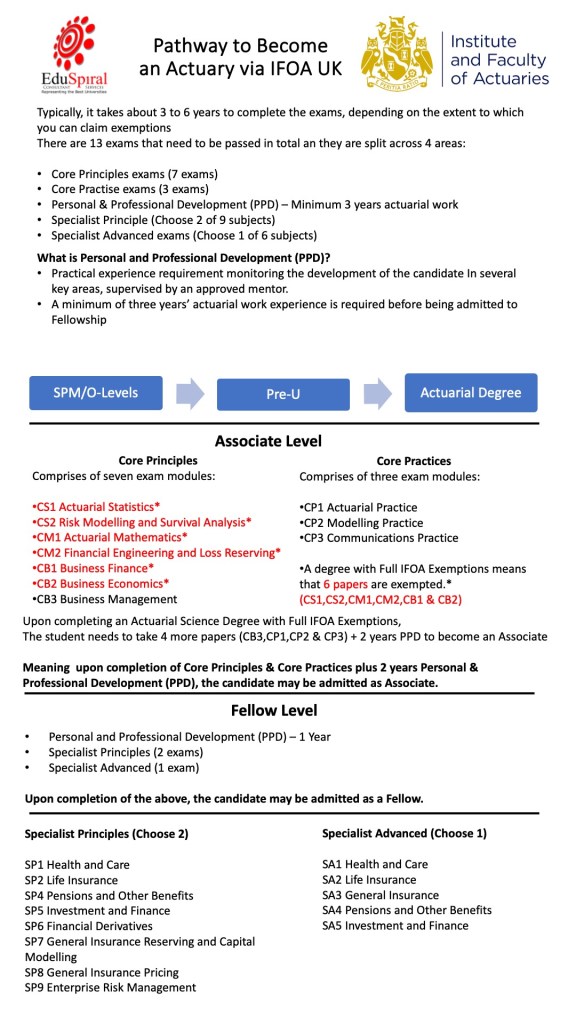
What is the Institute and Faculty of Actuaries (IFoA), UK?
As a professional body the Institute and Faculty of Actuaries (IFoA) has a responsibility to ensure that the curriculum is relevant, up-to-date and reflects the skills, knowledge and attributes required of actuaries in an ever-changing global business environment. At the same time the IFoA, as a full member of the International Actuarial Association (IAA), must ensure that its curriculum reflects the international standards set by them. This we have done by ensuring that the core subjects align themselves to the agreed 2017 IAA syllabus.
To become an Associate member you need to complete the following:
- Core Principles subjects (CS1-2, CM1-2 and CB1-3) either by examination or exemption
- Core Practices subjects (CP1, CP2 and CP3) either by examination or exemption
- Personal and Professional Development (PPD) – A minimum of 2 years of PPD
- Professional Skills Course (PSC)
- Online Professional Awareness Test (OPAT)
To qualify as a Fellow you need to complete the following:
- Core Principles subjects (CS1-2, CM1-2 and CB1-3) either by examination or exemption
- Core Practices subjects (CP1, CP2 and CP3) either by examination or exemption
- Two Specialist Principles (SP1, SP2, SP4, SP5, SP6, SP7, SP8 and SP9) subjects either by examination or exemption
- One Specialist Advanced (SA1, SA2, SA3, SA4 and SA7) subject by examination or dissertation
- Personal and Professional Development (PPD) A further minimum 1 year of PPD
- Professional Skills Course (if you have not yet taken this course you must do so within 12 months of becoming a Fellow)
- Online Professional Awareness Test (OPAT). Must take OPAT before taking CB3
Core Principles (7 Subjects)

Weng Hang, Actuarial Science at Heriot-Watt University Malaysia
General Structure
The Core Principles cover three main areas. These are:
- Actuarial Statistics (CS)
- Actuarial Statistics (CS1)
- Risk Modelling & Survival Analysis (CS2)
- Actuarial Mathematics (CM)
- Actuarial Mathematics (CM1)
- Financial Engineering and Loss Reserving (CM2)
- Business (CB)
- Business Finance (CB1)
- Business Economics (CB2)
- Business Management (CB3) – Pre-requisite in OPAT
Within each area there are a number of subjects shown opposite. The Core Principles therefore comprises seven subjects.
Assessments for Core Principles
All Core Principle subjects will be assessed. Actuarial Statistics and Actuarial Mathematics have two elements of assessment. For each subject there will be a 3 hours 15 minutes written paper and a 1 hour 45 minutes problem-based assessment. For these subjects both elements of assessment must be taken at the same examination sitting. The two papers will be weighted (70% for the written paper and 30% for the problem based assessment). A single aggregate mark will then be calculated. Failure to reach the overall pass mark will require both elements of assessment to be retaken. The problem-based assessments will be computer based and taken at home or in your office.
Core Practices (5 Papers)
The Core Practices cover three areas. These are:
- Actuarial Practice (CP1)
- Modelling Practice (CP2)
- Communications Practice (CP3)
Assessments for Core Practices
All three will be assessed using written and computer-based examinations. For CP1 and CP2 there will be two elements of assessment for each subject. Each assessment carries equal weighting. A single aggregate mark will then be calculated. Failure to reach the overall pass mark will require both elements of assessments to be retaken. For CP3 there will be a single paper.
Specialist Principles (Choose 2 out of 9)

Chun Tim, Foundation in Business into Actuarial Science, Taylor’s University
The Specialist Principles (SP) subjects require individuals to demonstrate an understanding of the concepts of specific specialist areas. Each subject will be assessed using a 3 hours and 15 minutes paper-based examination. These will be taken in an examination centre. Those who have obtained an alternative qualification have the option of applying for SP0.
This is normally through a Level 7, Master’s Thesis in an actuarially relevant subject. The Specialist Principle subjects are:
- SP0: Master’s Level Thesis
- SP1: Health and Care
- SP2: Life Insurance
- SP4: Pensions
- SP5: Investment and Finance
- SP6: Financial Derivatives
- SP7: General Insurance: Reserving
- SP8: General Insurance Pricing
- SP9: Enterprise Risk Management
Two of these SP subjects have to be passed to be eligible to qualify as a Fellow. You do not need to take any SP subjects to qualify as an Associate.
Specialist Advanced (Choose 1 out of 7)

The Specialist Advanced (SA) subjects require individuals to apply specific knowledge and principles of actuarial practice to the provision of specific practice areas.
Subjects SA1 – SA7 will be assessed using a 3 hours and 15 minutes paper-based examination. These will be taken in an examination centre. Those who are planning to undertake some original research on an actuarial topic can apply to take the SA0 route. The research should be at MPhil or PHD level and is likely to require at least 2 years of study. The IFoA must be involved from the start of the project and agree the objectives of the research.
The Specialist Principle subjects are:
- SA0: Research Master’s Thesis
- SA1: Health and Care
- SA2: Life Insurance
- SA3: General Insurance
- SA4: Pensions
- SA7: Investment and Finance
One of these subjects has to be passed to be eligible to qualify as a Fellow. You do not need to take any SA subjects to qualify as an Associate.
Actuaries’ Code

Throughout their career as an actuary, individuals are expected to act within the framework of the Actuaries’ Code. The principles of which are:
- Integrity – Members will act honestly and with the highest standards of integrity. Competence and Care – Members will perform their professional duties competently and with care.
- Impartiality – Members will not allow bias, conflicts of interest, or the undue influence of others to override their professional judgement.
- Compliance – Members will comply with all relevant, legal, regulatory and professional requirements, take reasonable steps to ensure they are not placed in a position where they are unable to comply and will challenge non-compliance by others.
- Communication – Members will communicate effectively and meet all applicable reporting standards.
To help members develop their understanding of how to apply this code in practice, the IFoA has developed different stages which need to be completed. For students these are:
Stage 1: Online Professional Awareness Test (OPAT) This is a 90 minute, mainly knowledge based, multiple choice online exam, which it is recommended you sit within your first year of membership. This must be sat and passed before applying to sit CB3.
Stage 2: Professional Skills Course (PSC) This is an online course which continues the development of professionalism through case-study discussion. These discussions explore the concepts of professionalism and business ethics. They also provide an opportunity to demonstrate judgement and decision making to resolve issues. The PSC must be completed in order to qualify at either the Associate or Fellow
Personal and Professional Development (PPD)
As part of the journey to become a qualified member of the IFoA, an individual needs to demonstrate they have the relevant skills and experience within a work environment. To do this, the IFoA requires PPD to be completed in addition to the examinations and professionalism requirements.
The PPD requirement includes three categories, subdivided into key competencies, which will carry a credit value. All credits will be recorded online and there will be a minimum annual requirement for each qualification route.
The PPD requirement will align with the CPD scheme which all members need to adhere to when qualified. The three key categories of PPD are:
- Effective Communications
- Problem Solving and Decision Making
- Professionalism
PPD was introduced in September 2017 and replaces Work Based Skills (WBS). There is also a requirement to complete 2hrs of formal learning each year
Actuarial Society of Malaysia (ASM) – Persatuan Aktuari Malaysia
Membership Classes (To become a member of Actuarial Society of Malaysia)
There are four membership classes under the ASM:
- Fellow
- Associate
- Ordinary
- Student
The requirements for each class are as follows:
Fellow
To join, professionals must be a Fellow of one of the following bodies:
- Society of Actuaries (USA)
- Casualty Actuarial Society (USA)
- Faculty and Institute of Actuaries (UK)
- Institute of Actuaries of Australia (Australia)
- Canadian Institute of Actuaries (Canada)
- Recommended by 2 Fellow members of the Society
- Resident in Malaysia or deemed to be familiar with Malaysian conditions
- At least 1 year’s experience in the Malaysian actuarial industry
Associate
To join, professionals must be an Associate of one of the following bodies:
- Society of Actuaries (USA)
- Casualty Actuarial Society (USA)
- Faculty and Institute of Actuaries (UK)
- Institute of Actuaries of Australia (Australia)
- Canadian Institute of Actuaries (Canada)
OR
– Passed examinations of any professional actuarial bodies to be recognized as Fellow, which is deemed to be at least equivalent to the examination requirements to become an Associate of the above actuarial bodies.
Ordinary
– Satisfies one of the following:
- Ordinary member of a professional actuarial body; OR
- Passed at least 1 part/subject of the examinations of a professional actuarial body which has no class of Ordinary membership and is continuing to study for other examinations of the actuarial body; OR
- Completed an actuarial course or other related statistical course in a university, college or other academic institute and has achieved a qualification thereof; OR
- Carrying out actuarial or other related work in a life or non-life insurance company, government office or actuarial consulting office.
– Nominated by 2 members of the Society
Student
- Nominated by 2 persons delegated by the Vice Chancellor of the university
- Does not meet the requirements for admission as Fellow, Associate or Ordinary member; OR meets the requirements but is not gainfully employed and chooses to seek Student membership
- Has a declared interest in actuarial matters
- Undergraduate/postgraduate student in an actuarial-related program
 Top Private Universities & Colleges in Malaysia